


Former Uber Technologies Inc chief executive officer Travis Kalanick is skewering a lawsuit filed by a former ally, describing it as a malicious attempt to sever his remaining ties to the widely used ride-hailing service that he cofounded.
Kalanick lashed out in legal documents filed late on Thursday in response to a Delaware Chancery Court lawsuit filed against Uber last week by one of its major investors and a former Kalanick supporter, Benchmark Capital.
The acrimony sets the stage for what could be a bitter battle pitting the pugnacious Kalanick against Benchmark, a major Silicon Valley venture capital (VC) firm.
Benchmark has seen its 2011 investment of US$12 million in Uber grow into a stake worth more than US$7 billion, based on company valuations.
The San Francisco company is also still looking for a new CEO to replace Kalanick, who resigned in late June under pressure from Benchmark and other investors worried about Uber’s direction.
Benchmark alleges that Kalanick has been interfering in the CEO search and manipulating Uber’s board in a scheme to bring him back as the company’s leader.
In his filing, Kalanick said that Benchmark had secretly plotted against him and launched its plan to oust him from Uber “at the most shameful of times” — shortly after his mother was killed and his father critically injured in a boating accident on May 27.
Benchmark had no comment on Kalanick’s filing, referring to an earlier statement saying that the firm felt it had no other choice but to sue to stop unacceptable behavior at Uber.
Kalanick notified Uber of his plans to take an indefinite leave of absence as CEO on June 11 — two days after his mother’s funeral.
Uber’s board, including Benchmark partner Bill Gurley, supported the move and assured him he could return as CEO whenever he was emotionally ready, Kalanick’s filing said.
However, just nine days after he went on leave, Benchmark partners Peter Fenton and Matt Cohler came to Kalanick’s hotel in Chicago to demand that he submit his permanent resignation as CEO, the filing said.
If Kalanick refused, Fenton and Cohler threatened to sully his reputation in a public campaign, it added.


ENERGY ISSUES: The TSIA urged the government to increase natural gas and helium reserves to reduce the impact of the Middle East war on semiconductor supply stability Chip testing and packaging service provider ASE Technology Holding Co (日月光投控) yesterday said it planned to invest more than NT$100 billion (US$3.15 billion) in building a new advanced chip testing facility in Kaohsiung to keep up with customer demand driven by the artificial intelligence (AI) boom. That would be included in the company’s capital expenditure budget next year, ASE said. There is also room to raise this year’s capital spending budget from a record-high US$7 billion estimated three months ago, it added. ASE would have six factories under construction this year, another record-breaking number, ASE chief operating officer Tien Wu

The EU and US are nearing an agreement to coordinate on producing and securing critical minerals, part of a push to break reliance on Chinese supplies. The potential deal would create incentives, such as minimum prices, that could advantage non-Chinese suppliers, according to a draft of an “action plan” seen by Bloomberg. The EU and US would also cooperate on standards, investments and joint projects, as well as coordinate on any supply disruptions by countries like China. The two sides are additionally seeking other “like-minded partners” to join a multicountry accord to help create these new critical mineral supply chains, which feed into

For weeks now, the global tech industry has been waiting for a major artificial intelligence (AI) launch from DeepSeek (深度求索), seen as a benchmark for China’s progress in the fast-moving field. More than a year has passed since the start-up put Chinese AI on the map in early last year with a low-cost chatbot that performed at a similar level to US rivals. However, despite reports and rumors about its imminent release, DeepSeek’s next-generation “V4” model is nowhere in sight. Speculation is also swirling over the geopolitical implications of which computer chips were chosen to train and power the new
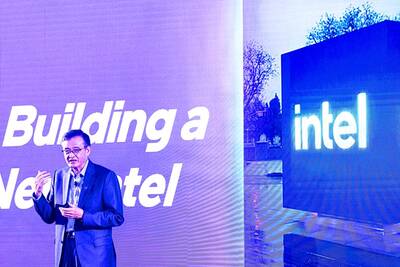
Intel Corp is joining Elon Musk’s long-shot effort to develop semiconductors for Tesla Inc, Space Exploration Technologies Corp and xAI, marking a surprising twist in the chipmaker’s comeback bid. Intel would help the Terafab project “refactor” the technology in a chip factory, the company said on Tuesday in a post on X, Musk’s social media platform. That is a stage in the development process that typically helps make chips more powerful or reliable. The chipmaker’s shares jumped 4.2 percent to US$52.91 in New York trading on Tuesday. The Terafab project is a grand plan by Musk to eventually manufacture his own chips for


 RSS
RSS