


The EU and US are nearing an agreement to coordinate on producing and securing critical minerals, part of a push to break reliance on Chinese supplies.
The potential deal would create incentives, such as minimum prices, that could advantage non-Chinese suppliers, according to a draft of an “action plan” seen by Bloomberg.
The EU and US would also cooperate on standards, investments and joint projects, as well as coordinate on any supply disruptions by countries like China.
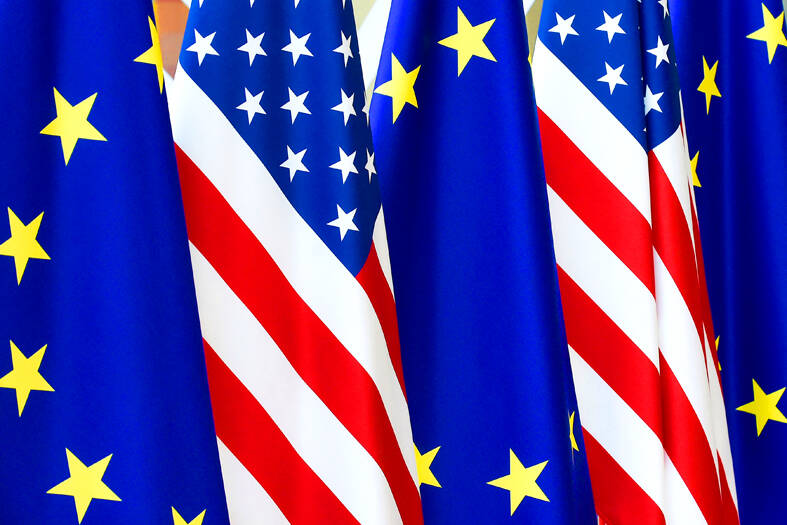
Photo: AFP
The two sides are additionally seeking other “like-minded partners” to join a multicountry accord to help create these new critical mineral supply chains, which feed into nearly all modern technology, from missile guidance systems and fighter jets to electric vehicles.
Countries are scrambling to secure critical minerals access after Beijing imposed sweeping export controls last year, including on rare earths, in response to US President Donald Trump’s tariffs. The move snarled global supply chains and left companies in Europe facing production shutdowns.
“The administration is taking an entrepreneurial approach to mitigating critical mineral supply chain vulnerabilities, including completing action plans on critical minerals that have been finalized with Mexico and Japan,” the Office of the US Trade Representative said in a statement. “We look forward to finalizing this agreement with the EU soon.”
For months, the US and many of its closest trading partners have discussed the need to develop a rare earth and critical minerals industry shielded from low-cost Chinese competition. China processes more than 80 percent of the world’s rare earths.
While countries are still far from agreeing on specifics about how to carry out a uniform policy — covering details such as price floors for each mineral, subsidies and purchase guarantees — the EU-US plan would join a similar pact with Mexico that indicates a lasting commitment to hashing out difficult details in the coming years.
The EU-US plan also echoes similar statements in a news release from the EU, US and Japan in February.
Bloomberg last month reported that the three nations were set to announce plans to lay the foundation for a critical minerals trade agreement.
As part of a nonbinding memorandum of understanding, also seen by Bloomberg, the EU-US partnership would cover “critical minerals along the entire value chain and life-cycle management, including exploration, extraction, processing, refining, recycling and recovery.”
The partnership could also include joint public procurement and cooperation on export restrictions, stockpiling and mapping mineral resources, the draft memorandum said.
The documents are being reviewed by EU member states, people familiar with the matter said.
The drafts could still change, the people said on condition of anonymity.
SECOND-RATE: Models distilled from US products do not perform the same as the original and undo measures that ensure the systems are neutral, the US’ cable said The US Department of State has ordered a global push to bring attention to what it said are widespread efforts by Chinese companies, including artificial intelligence (AI) start-up DeepSeek (深度求索), to steal intellectual property from US AI labs, according to a diplomatic cable. The cable, dated Friday and sent to diplomatic and consular posts around the world, instructs diplomatic staff to speak to their foreign counterparts about “concerns over adversaries’ extraction and distillation of US AI models.” Distillation is the process of training smaller AI models using output from larger, more expensive ones to lower the costs of training a powerful new
Shares of Taiwan Semiconductor Manufacturing Co (TSMC, 台積電) have repeatedly hit new highs, but an equity analyst said the stock’s valuation remains within a reasonable range and any pullback would likely be technical. The contract chipmaker’s historical price-to-earnings (P/E) ratio has ranged between 20 and 30, Cathay Futures Consultant Co (國泰證期) analyst Tsai Ming-han (蔡明翰) told Central News Agency. With market consensus projecting that TSMC would post earnings per share of about NT$100 (US$3.17) this year, supported by strong global demand for artificial intelligence (AI) applications, and the stock currently trading at a P/E ratio of below 25, Tsai said the valuation
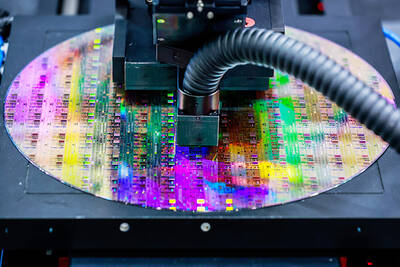
The artificial intelligence (AI) boom has triggered a seismic reshuffling of global equity markets, with Taiwan and South Korea muscling past European nations one by one. With its stock market now valued at nearly US$4.3 trillion, Taiwan surpassed the UK, Europe’s biggest market, earlier this month, data compiled by Bloomberg showed. South Korea is about US$140 billion away from doing the same. The tech-heavy Asian markets have shot past Germany and France in the past seven months. The shift is largely down to massive gains in shares of three companies that provide essential hardware for AI: Taiwan Semiconductor Manufacturing Co (TSMC, 台積電),
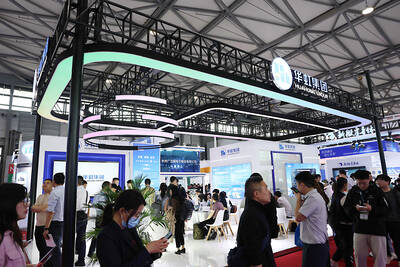
The US Department of Commerce last week ordered multiple chip equipment companies to halt shipments of certain tools to China’s second-largest chipmaker, Hua Hong Semiconductor Ltd (華虹半導體), its latest action to slow the country’s development of advanced chips, two people familiar with the matter said. The department sent letters to at least a handful of companies informing them of restrictions on tools and other materials destined for two Hua Hong facilities US officials believe make China’s most sophisticated chips, the people said. Top US chip equipment companies Lam Research Corp, Applied Materials Inc and KLA Corp, each of which has significant


 RSS
RSS