


On his first day at work as a security guard, Steve was greeted warmly, drawing attention from passersby, including some taking selfies with him, at the tony retail-residential complex he patrolled. Then he fell into the fountain.
Steve was a security robot employed by the Washington Harbour center in the Georgetown district of the US capital.
According to some tech watchers, robots like Steve herald a new era for intelligent machines assisting in crime prevention and law enforcement.
Steve’s mishap in the middle of last month set of a flurry of reaction on social media, with some saying the robot had “drowned” or committed suicide.
However, Steve turned up on Twitter to debunk the fake news, tweeting: “The reports of my death are greatly exaggerated.”
Still, he had to be sent back to his Silicon Valley headquarters. He was replaced by his “sibling,” Rosie, which has resumed patrols in the complex.
Steve and Rosie are produced by the California tech start-up Knightscope Inc, which has raised about US$17 million and includes a team with experience in robotics, law enforcement, artificial intelligence and the automotive sector.
At Washington Harbour, property manager Allison Johnson of MRP Realty LLC said residents and tenants appeared happy to see Steve and Rosie.
“It’s nice to have extra robot eyes on the property,” she said. “There are indications this will be a great addition to the security team.”
Knightscope was founded in response to the 2012 mass shooting at Sandy Hook Elementary School in Connecticut and the 2013 deadly bomb attack near the finish line of the Boston race, according to the company’s Web site.
The company claims its robots are not intended to replace humans, but to help security and law enforcement be more effective.
The robots are equipped with a 360-degree camera, thermal imaging, automatic license plate recognition, directional microphones, proximity sensors and other technology.
Their “anomaly detection software” is designed to determine when there is a threat and alert appropriate authorities.
Knightscope has deployed its 1.5m-tall outdoor K5 robots, such as Steve and Rosie, and the smaller indoor K3 robots at malls and other businesses under a partnership with the security firms Securitas AB and Allied Universal.
Kightscope expects it can take a bite out of crime and reduce security costs as well.
It charges clients an average of US$7 per hour, according to its regulatory filing.
A small number of rivals are also entering the field.
Fellow Silicon Valley start-up Cobalt Robotics has begun delivering indoor security robots to businesses in California, primarily for security during nights and weekends.
The robots “have the computational intelligence of an autonomous car, but for indoor security,” said Travis Deyle, Cobalt’s cofounder and chief executive and a former engineer at Google X.
Deyle said the Cobalt robots can be deployed as a fleet in a building or complex and monitored at a control station.
“They are looking for things that shouldn’t be there, for leaks. When it detects something, it flags a human pilot,” Deyle said.
Deyle said the sector is “at the dawn” and poised for expansion, benefiting from the development of low-cost sensors, good wireless connectivity and advances in artificial intelligence.
“Everything is coming together” for the robot sector, he said. “We’re excited about where this can go.”
Others in the sector include Colorado-based Gamma 2 Robotics Inc, which aims at warehouses, data centers, manufacturing facilities and retail stores, and California-based SMP Robotics Corp, which makes outdoor robots and is marketing in Brazil, France, Japan, Singapore and the United Arab Emirates.
“The economics of these things is becoming cheaper,” said J.P. Gownder, an analyst who follows robotics for Forrester Research Inc. “We’re going to see growth of purpose-built robots that can do specific tasks.”
Gownder said robots offer several advantages over human security guards.
“They don’t experience security guard fatigue,” he said. “Security guard work is challenging because, mentally, very little is happening until it happens. Artificial intelligence can make assessments [on threats] and flag them to a human operator.”


ENERGY ISSUES: The TSIA urged the government to increase natural gas and helium reserves to reduce the impact of the Middle East war on semiconductor supply stability Chip testing and packaging service provider ASE Technology Holding Co (日月光投控) yesterday said it planned to invest more than NT$100 billion (US$3.15 billion) in building a new advanced chip testing facility in Kaohsiung to keep up with customer demand driven by the artificial intelligence (AI) boom. That would be included in the company’s capital expenditure budget next year, ASE said. There is also room to raise this year’s capital spending budget from a record-high US$7 billion estimated three months ago, it added. ASE would have six factories under construction this year, another record-breaking number, ASE chief operating officer Tien Wu

The EU and US are nearing an agreement to coordinate on producing and securing critical minerals, part of a push to break reliance on Chinese supplies. The potential deal would create incentives, such as minimum prices, that could advantage non-Chinese suppliers, according to a draft of an “action plan” seen by Bloomberg. The EU and US would also cooperate on standards, investments and joint projects, as well as coordinate on any supply disruptions by countries like China. The two sides are additionally seeking other “like-minded partners” to join a multicountry accord to help create these new critical mineral supply chains, which feed into

For weeks now, the global tech industry has been waiting for a major artificial intelligence (AI) launch from DeepSeek (深度求索), seen as a benchmark for China’s progress in the fast-moving field. More than a year has passed since the start-up put Chinese AI on the map in early last year with a low-cost chatbot that performed at a similar level to US rivals. However, despite reports and rumors about its imminent release, DeepSeek’s next-generation “V4” model is nowhere in sight. Speculation is also swirling over the geopolitical implications of which computer chips were chosen to train and power the new
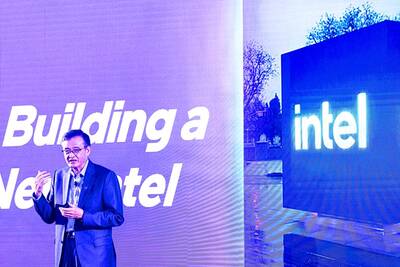
Intel Corp is joining Elon Musk’s long-shot effort to develop semiconductors for Tesla Inc, Space Exploration Technologies Corp and xAI, marking a surprising twist in the chipmaker’s comeback bid. Intel would help the Terafab project “refactor” the technology in a chip factory, the company said on Tuesday in a post on X, Musk’s social media platform. That is a stage in the development process that typically helps make chips more powerful or reliable. The chipmaker’s shares jumped 4.2 percent to US$52.91 in New York trading on Tuesday. The Terafab project is a grand plan by Musk to eventually manufacture his own chips for


 RSS
RSS