


Japan Display Inc, a struggling Japanese maker of smartphone screens, has agreed to a ¥75 billion (US$637 million) injection of cash from a government-backed fund.
The supplier to Apple Inc will issue ¥45 billion of convertible debt to Innovation Network Corp of Japan (INCJ), already its largest shareholder, Japan Display said in a statement in Tokyo yesterday.
Japan Display is also getting a ¥30 billion subordinated loan from INCJ.
Japan Display climbed 2.5 percent to ¥366 at the close in Tokyo before the announcement, after broadcaster NHK reported that it was about to secure the financing.
Japan Display is headed for a third straight annual loss, as global mobile demand sputters and competitors from South Korea and China undercut prices to grab market share.
Japan Display said it will use the capital for the development of organic light-emitting diode displays (OLED), which offer more vibrant and energy-efficient screens for mobile devices.
Apple, the company’s biggest customer, is considering shifting to next-generation smartphone screens as early as next year.
“They were running out of cash,” said Amir Anvarzadeh, Singapore-based head of Japanese equity sales at BGC Partners Inc.
“This will be used for a combination of things” including OLED research and development as well as restarting idled LCD plants, he said. “There’s also a political issue of not letting these companies go bust.”
Japan Display also announced yesterday that it is raising its stake in JOLED Inc, a Japanese OLED-display maker, from 15 percent to 51 percent, through a transfer of shares held by INCJ to Japan Display.
JOLED is working on a new method of manufacturing OLED screens that lack higher resolutions, but are cheaper to make.
Japan Display is seeking to reduce its reliance on mobile devices by shifting toward autos, virtual-reality gadgets, high-end laptops and other areas such as healthcare and education, the Tokyo-based company said in the statement.
“The competitive environment has intensified due to a [South] Korean manufacturer’s active marketing for OLED displays,” Japan Display said.
INCJ has a track record of rescuing ailing Japanese corporations.
Four years ago, the fund created Japan Display by merging the troubled screen-making units of Toshiba Corp, Sony Corp and Hitachi Ltd.
It also put money into Renesas Electronics Corp, formed in 2010 from the hard-pressed semiconductor operations of Mitsubishi Electric Corp, Hitachi and NEC Corp.
The convertible debt issued by Japan Display can be exercised from 2019, at a strike price that is about 17 percent higher than the current stock price.
Earlier this year, INCJ lost a bidding war with Taiwan’s Foxconn Technology Group (富士康) over control of Sharp Corp, JDI’s only domestic rival.
Japan Display and Sharp may need massive amounts of capital to invest in OLED, considered the future standard for iPhones and other mobile devices.
Apple is struggling to find enough OLED supply for its new iPhones, expected next year, Bloomberg News reported last month.
However, initial costs for screen suppliers could reach US$2 billion, stretching their finances even before they get any firm orders.
“It’s a long-term investment — Sharp and Japan Display both have said we’re not going to be anywhere near supplying these displays in volumes,” Anvarzadeh said. “Forget 2017 or 2018, if they’re lucky they’ll get some volume growth in OLED perhaps in 2019.”
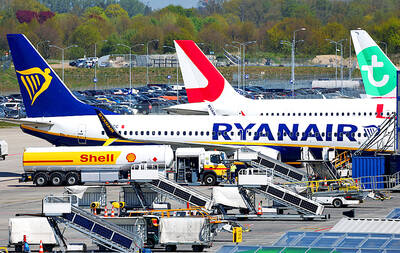
Ryanair, Transavia, Volotea and other low-cost airlines are feeling the financial pain from high jet fuel prices as a result of the Middle East war and are cutting flights. The closure of the Strait of Hormuz has taken a huge chunk of oil supplies off the market, sending the price of jet fuel soaring and triggering fears of shortages that could force airlines to cancel flights. Airlines are not waiting for a lack of supplies to react. “Travel alert: Airlines are cutting thousands of flights right now,” Travel Therapy host Karen Schaler said in an Instagram reel this past weekend.
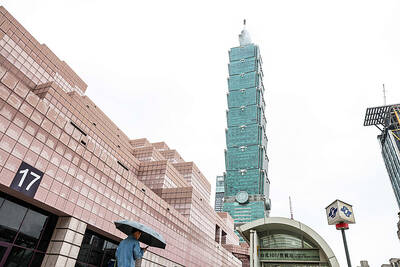
MANAGING RISKS: Taiwan has secured LNG sufficient to cover 95 percent of electricity demand for next month, UBS said, describing the government’s approach as proactive UBS Group AG has raised its forecast for Taiwan’s economic growth this year to 8 percent, up from 6.9 percent previously, and said expansion could reach as high as 8.6 percent if external energy shocks are avoided. The upgrade reflects a stronger-than-expected first-quarter performance and sustained momentum in artificial intelligence (AI)-driven exports, which UBS said are providing a firm foundation for growth despite geopolitical and energy risks. Taiwan’s GDP expanded 13.69 percent year-on-year in the first quarter, the fastest growth since the second quarter of 1987, the Directorate-General of Budget, Accounting and Statistics (DGBAS) reported on Thursday. On a seasonally

The list of Asian stocks that benefit from business partnership with Nvidia Corp is getting longer, as the region further integrates into the artificial intelligence (AI) chip giant’s business ecosystem. Just in the past week, South Korea’s LG Electronics Inc, Taiwan’s Nanya Technology Corp (南亞科技), as well as China’s Huizhou Desay SV Automotive Co (德賽西威) and Pateo Connect Technology Shanghai Corp (博泰車聯) have become the latest to rally on news of tie-ups, supply-chain participation or product collaboration with the US chip designer. Asian suppliers account for about 90 percent of Nvidia’s production costs, up from about 65 percent last year, data compiled
The Fair Trade Commission’s (FTC) ongoing review of Grab Holdings Ltd’s US$600 million acquisition of Foodpanda Taiwan’s operations, announced on March 23, has taken on fresh urgency as industry experts warn that the transaction could embed significant Chinese cybersecurity vulnerabilities into Taiwan’s digital infrastructure through Grab’s deep ties to autonomous-driving firm WeRide (文遠知行). Less than 16 months after the FTC blocked Uber Eats’ direct attempt to acquire Foodpanda Taiwan — citing potential combined market shares of 80 to 90 percent — the emergence of Grab as the buyer has prompted questions about whether the same competitive harm is simply being rerouted


 RSS
RSS