


Thousands of clients are being booted out of bank accounts in Asia’s wealth management industry, which is cleaning up after a money laundering scandal in Malaysia, the “Panama Papers” expose and a global push for tax transparency, bankers say.
“For some global wealth managers, up to 30 percent of private wealth clients in Asia are in the firing line,” said Benjamin Quinlan, CEO of Hong Kong consultancy Quinlan & Associates.
The clean-up is mainly focused on problematic clients in the Asian financial hubs of Singapore and Hong Kong, which manage more than US$1 trillion of managed assets combined.
The scrutiny in Asia began in 2014 as banks moved to comply with tougher anti-money laundering rules, top bankers and compliance officers at nearly a dozen banks in Asia told Reuters.
However, it has really gathered pace this year, they said.
The urgency increased with announcements that Switzerland and Singapore were conducting criminal investigations into billions of dollars allegedly misappropriated by Malaysian state investment fund 1Malaysia Development Berhad.
Then came the leaked documents in April from Panama law firm Mossack Fonseca on 214,000 offshore companies. They showed Hong Kong was the world’s most active center for the creation of shell firms, which can be used to avoid taxes.
Private banks in Asia have also felt the pressure of aggressive tax amnesty programs in Indonesia and India aimed at bringing offshore wealth back home and fear regulators may impose big fines on banks who breach the rules.
Next year a global tax transparency campaign starts to bite: Singapore, Switzerland and Hong Kong will be among 101 jurisdictions to begin collecting tax information that they will share to combat tax evasion.
All of this has “sparked a major review and filtering process,” Quinlan said, “with one global private bank we spoke to looking to offboard roughly 3,000 wealth management clients in Asia in 2017.”
Compliance and regulatory costs affecting the banking industry have soared since the 2008 global financial crisis.
Consultant LexisNexis Risk Solutions Inc said efforts to prevent money laundering are costing banks US$1.5 billion annually in the Asia-Pacific region and rising. Banks globally are expected to spend US$12 billion on anti-money laundering compliance this year, according to Quinlan & Associates.
Account and transaction surveillance is expensive, so it is often cheaper for banks to kick out tricky clients, bankers said.
For some, there is no warning: they know their accounts have been closed when they suddenly are unable to access them online or get an unexpected check in the post, six people working at law firms, funds and service providers said.
They said several funds incorporated in the Cayman and British Virgin Islands but operating in Hong Kong, were among those who found their bank accounts abruptly closed.
“We had one client whose account was just frozen, and they couldn’t get the money out,” one Hong Kong fund administrator said.
New standards adopted two years ago in Asia require banks to clearly identify a client, the client’s business and — crucially — the origin of the money deposited. The banks also need to check the clients have paid all due taxes back home.
Nearly 40 percent of wealth firms in the Asia-Pacific region have cited compliance as their main strategic budget focus next year, EY said in its Global Wealth Report. That compares with 11 percent and 9 percent for European and North American firms respectively.
Compliance staff also are gearing up for tax investigations.
Western governments led by the US have already aggressively targeted European wealth management centers such as Switzerland to recoup undeclared tax money. This led to whopping US fines against top wealth managers including UBS Group AG, Credit Suisse Group AG, HSBC Holdings PLC and a host of Swiss banks.
Asia could be next in the line of fire, with Singapore and Hong Kong as key targets, lawyers and banking sources say.
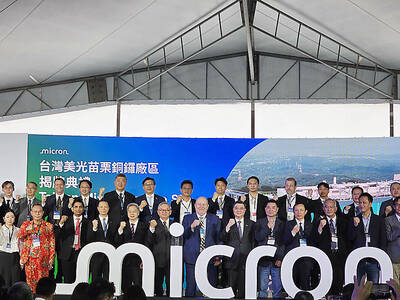
UNPRECEDENTED PACE: Micron Technology has announced plans to expand manufacturing capabilities with the acquisition of a new chip plant in Miaoli Micron Technology Inc unveiled a newly acquired chip plant in Miaoli County yesterday, as the company expands capacity to meet growing demand for advanced DRAM chips, including high-bandwidth memory chips amid the artificial intelligence boom. The plant in Miaoli County’s Tongluo Township (銅鑼), which Micron acquired from Powerchip Semiconductor Manufacturing Corp (力積電) for US$1.8 billion, is expected to make a sizeable capacity contribution to the company from fiscal 2028, the company said in a statement. It would be an extended production site of Micron’s large-scale manufacturing hub in Taichung, the company said. As the global semiconductor industry is racing to reach US$1 trillion

Singapore-based ride-hailing and delivery giant Grab Holdings Ltd has applied for regulatory approval to acquire the Taiwan operations of Germany-based Delivery Hero SE's Foodpanda in a deal valued at about US$600 million. Grab submitted the filing to the Fair Trade Commission on Friday last week, with the transaction subject to regulatory review and approval, the company said in a statement yesterday. Its independent governance structure would help foster a healthy and competitive market in Taiwan if the deal is approved, Grab said. Grab, which is listed on the NASDAQ, said in the filing that US-based Uber Technologies Inc holds about 13 percent of

Taiwan’s food delivery market could undergo a major shift if Singapore-based Grab Holdings Ltd completes its planned acquisition of Delivery Hero SE’s Foodpanda business in Taiwan, industry experts said. Grab on Monday last week announced it would acquire Foodpanda’s Taiwan operations for US$600 million. The deal is expected to be finalized in the second half of this year, with Grab aiming to complete user migration to its platform by the first half of next year. A duopoly between Uber Eats and Foodpanda dominates Taiwan’s delivery market, a structure that has remained intact since the Fair Trade Commission (FTC) blocked Uber Technologies Inc’s

Memory chip stocks extended their losses yesterday after Alphabet Inc’s Google publicized research that could allow more efficient use of the storage needed for artificial intelligence (AI) development. SK Hynix Inc and Samsung Electronics Co, South Korean leaders in the market, fell more than 6 percent and about 5 percent respectively in Seoul. In the US, Micron Technology Inc, Western Digital Corp and Sandisk Corp slid more than 2 percent in pre-market trading, after they all closed lower on Wednesday. Memory companies have been on a tear in recent months as the rapid development of AI infrastructure triggered a spike in chip


 RSS
RSS