


Hon Hai Precision Industry Co’s (鴻海精密) logistics subsidiary ChengDu Jusda Supply Chain Management Co LTD (準時達) yesterday joined forces with a South Korean peer in a bid to improve their performance on the global stage.
Jusda and SK Holding C&C Co inked a pact to set up a joint venture to deepen their presence in the logistics industry.
The agreement marked yet another collaboration between Hon Hai and SK Group after the Taiwanese company bought a 4.9 percent stake in SK Group’s IT services arm SK C&C for 381 billion won (US$346.83 million) in June 2014.
Jusda is Hon Hai’s wholly-owned logistics subsidiary based in China’s Chengdu that offers services via land, sea and air. It has 155 offices and storage facilities around the world.
Under the agreement, SK C&C is to own the management rights and a controlling stake of the joint venture by utilizing 30 billion won to 40 billion won in equity capital, Jusda and SK C&C said.
“The joint venture is expected to be established in South Korea later this month and will begin operations on several projects by the end of this year,” Jusda brand management official Lily Xiang (向立黎) said by telephone.
The joint venture will leverage the resources of Jusda’s global logistics capacity and SK C&C’s information and communication technologies (ICT) business, including artificial intelligence and a chatbot, Xiang said.
The joint venture is to explore new business opportunities in China, Japan, the Czech Republic and India, Jusda said.
Services are to include outsourcing businesses from transportation and customs clearing to storage. They plan to sell and license SK C&C’s ICT platforms starting with Jusda’s more than 200 clients, the two firms said.
The joint venture is also to cooperate with SK Group’s e-commerce platform 11Street to offer cross-border supply chain management services to enterprises in China’s tax-protected zones, Jusda said.
The announcement of the deal came after Jusda and Sharp Corp signed an agreement to form a logistics joint venture in Japan with capital of ¥50 million (US$481,619) on Sept. 30.
“Jusda plans to strengthen and expand its position in the global market through setting up joint ventures with international companies in various regions,” Xiang said.
She said the agreements with Sharp and SK C&C were Jusda’s latest expansion efforts in the Asia-Pacific market, adding that the firm is also exploring logistics business opportunities with Hon Hai in India.

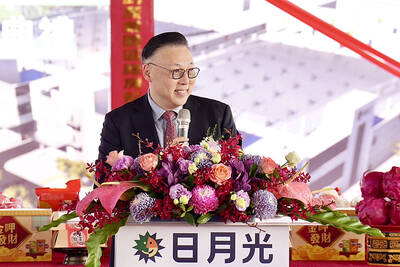
ENERGY ISSUES: The TSIA urged the government to increase natural gas and helium reserves to reduce the impact of the Middle East war on semiconductor supply stability Chip testing and packaging service provider ASE Technology Holding Co (日月光投控) yesterday said it planned to invest more than NT$100 billion (US$3.15 billion) in building a new advanced chip testing facility in Kaohsiung to keep up with customer demand driven by the artificial intelligence (AI) boom. That would be included in the company’s capital expenditure budget next year, ASE said. There is also room to raise this year’s capital spending budget from a record-high US$7 billion estimated three months ago, it added. ASE would have six factories under construction this year, another record-breaking number, ASE chief operating officer Tien Wu

The EU and US are nearing an agreement to coordinate on producing and securing critical minerals, part of a push to break reliance on Chinese supplies. The potential deal would create incentives, such as minimum prices, that could advantage non-Chinese suppliers, according to a draft of an “action plan” seen by Bloomberg. The EU and US would also cooperate on standards, investments and joint projects, as well as coordinate on any supply disruptions by countries like China. The two sides are additionally seeking other “like-minded partners” to join a multicountry accord to help create these new critical mineral supply chains, which feed into

For weeks now, the global tech industry has been waiting for a major artificial intelligence (AI) launch from DeepSeek (深度求索), seen as a benchmark for China’s progress in the fast-moving field. More than a year has passed since the start-up put Chinese AI on the map in early last year with a low-cost chatbot that performed at a similar level to US rivals. However, despite reports and rumors about its imminent release, DeepSeek’s next-generation “V4” model is nowhere in sight. Speculation is also swirling over the geopolitical implications of which computer chips were chosen to train and power the new

Intel Corp is joining Elon Musk’s long-shot effort to develop semiconductors for Tesla Inc, Space Exploration Technologies Corp and xAI, marking a surprising twist in the chipmaker’s comeback bid. Intel would help the Terafab project “refactor” the technology in a chip factory, the company said on Tuesday in a post on X, Musk’s social media platform. That is a stage in the development process that typically helps make chips more powerful or reliable. The chipmaker’s shares jumped 4.2 percent to US$52.91 in New York trading on Tuesday. The Terafab project is a grand plan by Musk to eventually manufacture his own chips for


 RSS
RSS