


Lite-On Technology Corp (光寶科技) yesterday announced it is to spend more than NT$10 billion (US$318.78 million) on expanding its operational base at the Nantze Export Processing Zone (楠梓出口加工區) in Kaohsiung, in a bid to cater to the expanding scope of its new businesses.
The expansion program includes building a new manufacturing plant for automotive electronics and an operational center for its cloud-computing, industrial automation and networking divisions, the company said.
“We plan to start building the manufacturing plant in January next year and expect it to be operational by the middle of 2019,” Lite-On chief executive officer Warren Chen (陳廣中) told a news conference.
The firm plans to begin building the operational center after the completion of the manufacturing plant and it is expected to start operations by 2021, with Lite-On’s cloud-computing, industrial automation and surveillance system divisions to move into the new operational center, Chen said.
“We forecast that the expanded operational base will bring at least 1,000 new jobs to Kaohsiung,” Chen said.
However, Chen declined to disclose the range of production capacity growth for its automotive electronics segment, saying it was still too early to estimate.
Lite-On chairman Raymond Soong (宋恭源) said the development of the firm’s new businesses is an important part of Lite-On’s corporate transformation amid slowing PC and smartphone industries.
The operational base in Kaohsiung would help Lite-On expand its automotive electronics segment and accelerate the development of other new businesses, Soong said.
The firm’s automotive electronics business includes LED automotive lighting products, camera modules, body control systems for windows and head-up displays, Lite-On said.
Given that the entry barrier for the automotive electronics industry is higher than for the PC industry, the contract electronics maker has been investing in automotive electronics products for two decades.
The years of effort have started to pay off, the company said, as it has entered the supply chains for 80 percent of the world’s tier-one automakers over the past few years.
Sales contributions from automotive electronics now accounts for 5 percent of Lite-On’s total revenues, and the company foresees the contribution being as high as 10 percent to 15 percent by 2018 on the back of steadily rising demand from clients, Chen said.
Lite-On shares rose 1.03 percent to close at NT$49.25 in Taipei trading yesterday, outperforming the TAIEX, which lost 0.02 percent.
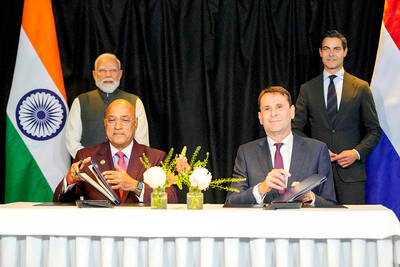
NEW MARKET: The partnership opens up India to the Dutch company, which already has a strong hold in the semiconductor market of South Korea, Taiwan and China ASML Holding NV entered into a partnership agreement with Tata Electronics Pvt Ltd aimed at ramping up India’s goal to develop domestic chip-manufacturing capabilities. The Dutch company’s technology would help power Tata Electronics’ planned 300 millimeter (mm) semiconductor foundry in Gujarat, according to a joint statement from the two companies on Saturday. The signing of a memorandum of understanding coincides with a visit by Indian Prime Minister Narendra Modi to the Netherlands, which is looking to deepen bilateral relations with New Delhi. ASML, whose top customers include Taiwan Semiconductor Manufacturing Co (台積電) and Samsung Electronics Co, makes lithography machines that can print

Tokyo Electron's Taiwan unit today said in a written response that it respects the judicial process, takes the court ruling seriously and would not appeal in the Taiwan Semiconductor Manufacturing Co (TSMC, 台積電) trade secrets case. Last month, a court fined the Taiwan unit of Japan's Tokyo Electron NT$150 million (US$4.74 million) in a case involving trade secrets related to TSMC's sensitive chip technology.
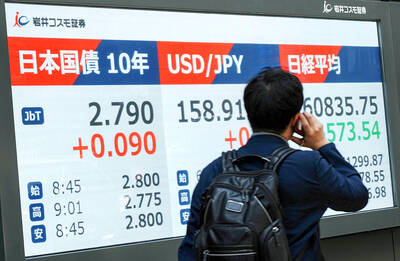
ROUGH RECORDS: Bonds in Japan, as well is in New Zealand, Australia and the US, are seeing the effects of a nervy market as stock exchanges across Asia edge down A deepening slump in Japanese government bonds added fuel to the selloff in global debt markets as rising oil prices stoked inflation fears and pushed yields to multi-decade highs. Japan’s 30-year yield yesterday surged as much as 20 basis points to the highest level since the tenor’s debut in 1999, before paring some of the move. Shorter-maturity Japanese debt was also under pressure, underscored by weak demand at a sale of five-year notes that offered a record-high coupon of 2 percent. Concerns over inflation and government spending rippling through markets including the US, Australia and New Zealand are being amplified in Japan,

Wall Street is licking its chops over an unprecedented slate of massive initial public offerings (IPOs) set to arrive in the coming months, beginning with Elon Musk’s Space Exploration Technologies Corp (SpaceX) next month. That is expected to be followed by artificial intelligence (AI) rivals OpenAI and Anthropic PBC. The trio of mega listings, each eyeing valuations around US$1 trillion or more, constitutes a heady period of elevated risk and reward. SpaceX is targeting an IPO that would raise up to US$80 billion — about double the funds generated from all IPOs last year. OpenAI and Anthropic are eyeing IPOs raising US$60 billion. “We’re


 RSS
RSS