


The Legislative Yuan’s Finance Committee yesterday tabled the review of a bill proposing to raise the taxable threshold for active stock traders until after a Cabinet reshuffle has been concluded, in a show of respect for policymakers.
The Ministry of Finance, which had earlier voiced reservations about the proposal, appeared to soften its stance and said it would now respect the decision of lawmakers on the matter.
At issue is a bill sponsored by Chinese Nationalist Party (KMT) Legislator Lo Ming-tsai (羅明才) and his legislative colleagues that suggests raising the taxable threshold on active stock traders from NT$1 billion (US$32.09 million) to NT$5 billion.
The clause is part of the capital gains tax on stock investments that is due to take effect next month and is widely blamed for the sluggish trading seen since September, as active traders flee the market.
“The clause, as it is, would generate a very limited amount of tax revenue per year, but it has already had a huge impact in terms of lost taxes on stock transactions,” Lo said.
Lo said he might seek to remove the clause altogether when the committee takes up the issue again on Monday.
Minister of Finance Chang Sheng-ford (張盛和) has refused to act on major policy or personnel issues after resigning along with the rest of the Cabinet on Monday.
Earlier, Chang said the light turnover of the local bourse has more to do with uncertainty over the ending of the US quantitative easing plan and other external factors.
It would be a better idea to re-evaluate the capital gains tax after it has been in practice for a period of time, Chang has said.
However, ministry officials have acknowledged that the market has been volatile in the past year, especially with another new policy on day trading, which has made it easier for major market players to be taxed.
The Financial Supervisory Commission introduced the new measures on day trading in two phases this year, aimed at invigorating the local bourse, but the most recent amendment to the capital gains tax was in June last year, Vice Minister of Finance Sheu Yu-jer (許虞哲) said yesterday.
Sheu admitted that the ministry failed to factor in the impact on day trading when it previously pushed for the new taxation on capital gains.
In current taxation legislation, individual investors who sell NT$1 billion in shares a year are subject to either a 15 percent tax on their capital gains, or a 0.1 percent tax rate on their stock trades that exceed NT$1 billion, effective next year.
The government already levies a transaction tax of 0.3 percent on all stock market trades, but does not impose capital gains tax on stock transactions.
Buoyed by hopes of the removal of the capital gains tax, the financial subindex on the Taiwan Stock Exchange climbed 1.81 percent yesterday, leading the TAIEX to rise 0.54 percent to 9,225.11 points on turnover of NT$103.46 billion.
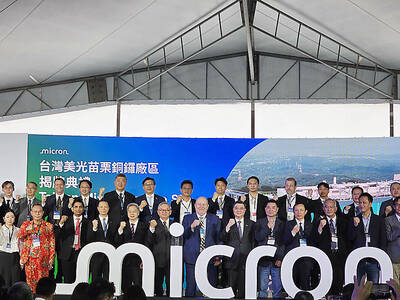
UNPRECEDENTED PACE: Micron Technology has announced plans to expand manufacturing capabilities with the acquisition of a new chip plant in Miaoli Micron Technology Inc unveiled a newly acquired chip plant in Miaoli County yesterday, as the company expands capacity to meet growing demand for advanced DRAM chips, including high-bandwidth memory chips amid the artificial intelligence boom. The plant in Miaoli County’s Tongluo Township (銅鑼), which Micron acquired from Powerchip Semiconductor Manufacturing Corp (力積電) for US$1.8 billion, is expected to make a sizeable capacity contribution to the company from fiscal 2028, the company said in a statement. It would be an extended production site of Micron’s large-scale manufacturing hub in Taichung, the company said. As the global semiconductor industry is racing to reach US$1 trillion

Singapore-based ride-hailing and delivery giant Grab Holdings Ltd has applied for regulatory approval to acquire the Taiwan operations of Germany-based Delivery Hero SE's Foodpanda in a deal valued at about US$600 million. Grab submitted the filing to the Fair Trade Commission on Friday last week, with the transaction subject to regulatory review and approval, the company said in a statement yesterday. Its independent governance structure would help foster a healthy and competitive market in Taiwan if the deal is approved, Grab said. Grab, which is listed on the NASDAQ, said in the filing that US-based Uber Technologies Inc holds about 13 percent of

Taiwan’s food delivery market could undergo a major shift if Singapore-based Grab Holdings Ltd completes its planned acquisition of Delivery Hero SE’s Foodpanda business in Taiwan, industry experts said. Grab on Monday last week announced it would acquire Foodpanda’s Taiwan operations for US$600 million. The deal is expected to be finalized in the second half of this year, with Grab aiming to complete user migration to its platform by the first half of next year. A duopoly between Uber Eats and Foodpanda dominates Taiwan’s delivery market, a structure that has remained intact since the Fair Trade Commission (FTC) blocked Uber Technologies Inc’s

Memory chip stocks extended their losses yesterday after Alphabet Inc’s Google publicized research that could allow more efficient use of the storage needed for artificial intelligence (AI) development. SK Hynix Inc and Samsung Electronics Co, South Korean leaders in the market, fell more than 6 percent and about 5 percent respectively in Seoul. In the US, Micron Technology Inc, Western Digital Corp and Sandisk Corp slid more than 2 percent in pre-market trading, after they all closed lower on Wednesday. Memory companies have been on a tear in recent months as the rapid development of AI infrastructure triggered a spike in chip


 RSS
RSS