


Local stock brokers yesterday pressed the government to abolish the capital gains tax on stock investments, saying the “active player clause” due to take effect next year is sidelining investors and depressing trade volume.
The Taiwan Securities Association (TSA, 證券公會) made the plea after the TAIEX yesterday closed down 0.2 percent at 8,731.07 with a stifling turnover of NT$61.7 billion (US$2.03 billion).
The sluggish trade drove the Financial Supervisory Commission to move its scheduled stimulus measures forward from Nov. 10 to Nov. 3, but analysts cast doubts over whether they would invigorate the market.
“We suggest the government scrap capital gains tax on stock investments, as the upcoming levy is scaring away active traders and weakening stock transactions,” TSA chairman Chien Hung-wen (簡鴻文) told a news conference.
Starting next year, individual investors who sell shares valued at NT$1 billion or more a year are set to have to pay a 15 percent tax on their capital gains, or an extra 0.1 percent tax on their stock transactions.
Stock turnover dropped to an average of NT$95.6 billion a day last month, from NT$109.5 billion in August and NT$126 billion in the first seven months, as heavier tax burdens loom, Chien said.
About 50 percent of investors with trading volume of NT$500 million a quarter have yet to rejoin the local bourse since talk of implementing a capital gains tax in 2012, Chien said.
The Ministry of Finance aims to collect a modest NT$2.4 billion in capital gains tax from last year, but it might suffer much greater losses in the stock transaction tax, Chien said.
Apart from small turnover, the capital gains tax is hurting other capital markets, the association found.
The 15 percent capital gains tax also applies to sales of 10,000 shares from initial public offerings, 100,000 shares in the emerging market and unlisted firms.
Investors who reside in Taiwan for less than 183 days a year are also subject to the levy.
The number of firms seeking a listing on the emerging stock market declined 50 percent last year because of the levy, the association said.
Taxation requirements are much more complicated and unfavorable for stock investments in Taiwan than in Hong Kong, Singapore and China as players have to pay both capital gains and stock transaction taxes to help shore up the health insurance program, Chien said.
The nation’s financial account saw net fund outflows for the past 16 consecutive quarters, suggesting declining interest on the part of Taiwanese to invest in local securities, the association said.
Sub-brokerage business grew by 37.2 percent during the same period as demand for investment overseas gained popularity, the association added.
“The figures warrant a reexamination of the policy,” Chien said.
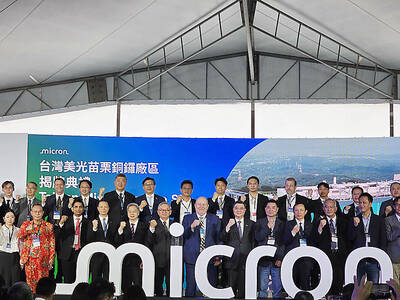
UNPRECEDENTED PACE: Micron Technology has announced plans to expand manufacturing capabilities with the acquisition of a new chip plant in Miaoli Micron Technology Inc unveiled a newly acquired chip plant in Miaoli County yesterday, as the company expands capacity to meet growing demand for advanced DRAM chips, including high-bandwidth memory chips amid the artificial intelligence boom. The plant in Miaoli County’s Tongluo Township (銅鑼), which Micron acquired from Powerchip Semiconductor Manufacturing Corp (力積電) for US$1.8 billion, is expected to make a sizeable capacity contribution to the company from fiscal 2028, the company said in a statement. It would be an extended production site of Micron’s large-scale manufacturing hub in Taichung, the company said. As the global semiconductor industry is racing to reach US$1 trillion

Singapore-based ride-hailing and delivery giant Grab Holdings Ltd has applied for regulatory approval to acquire the Taiwan operations of Germany-based Delivery Hero SE's Foodpanda in a deal valued at about US$600 million. Grab submitted the filing to the Fair Trade Commission on Friday last week, with the transaction subject to regulatory review and approval, the company said in a statement yesterday. Its independent governance structure would help foster a healthy and competitive market in Taiwan if the deal is approved, Grab said. Grab, which is listed on the NASDAQ, said in the filing that US-based Uber Technologies Inc holds about 13 percent of

Taiwan’s food delivery market could undergo a major shift if Singapore-based Grab Holdings Ltd completes its planned acquisition of Delivery Hero SE’s Foodpanda business in Taiwan, industry experts said. Grab on Monday last week announced it would acquire Foodpanda’s Taiwan operations for US$600 million. The deal is expected to be finalized in the second half of this year, with Grab aiming to complete user migration to its platform by the first half of next year. A duopoly between Uber Eats and Foodpanda dominates Taiwan’s delivery market, a structure that has remained intact since the Fair Trade Commission (FTC) blocked Uber Technologies Inc’s

Memory chip stocks extended their losses yesterday after Alphabet Inc’s Google publicized research that could allow more efficient use of the storage needed for artificial intelligence (AI) development. SK Hynix Inc and Samsung Electronics Co, South Korean leaders in the market, fell more than 6 percent and about 5 percent respectively in Seoul. In the US, Micron Technology Inc, Western Digital Corp and Sandisk Corp slid more than 2 percent in pre-market trading, after they all closed lower on Wednesday. Memory companies have been on a tear in recent months as the rapid development of AI infrastructure triggered a spike in chip


 RSS
RSS