


With its stock near a record high and its latest iPhone expected to be introduced on Tuesday next week, Apple Inc is facing new accusations of violations of labor rights and workplace safety at a supplier in China.
The allegations involve employees at a factory in Suqian owned by Taiwanese firm Catcher Technology Co (可成), that makes metal casings for Apple iPads and for other consumer electronics companies.
The employees are made to work excessive overtime and handle toxic chemicals without proper protective clothing, according to a report released on Thursday by environmental nonprofit group Green America and New York-based labor rights group China Labor Watch.
Apple, like Samsung Electronics Co and several other multinational companies, has previously faced scrutiny over the working conditions at the factories in China where its products are made.
However, the allegations in the latest report suggest that the company might need to increase its vigilance of the 200 major global suppliers that account for 97 percent of Apple’s component costs.
In a statement on Thursday, Apple said its most recent annual audit of the Suqian plant in May had “found some concrete areas for improvement in Catcher’s operations, and we worked with Catcher to develop a corrective action plan.”
Apple had scheduled a follow-up visit to the plant next month, but dispatched a team immediately to investigate the allegations in the new report, Apple spokesman Chris Gaither said in a statement.
An undercover investigation by China Labor Watch at the Suqian plant last month found that fire exits were locked and that flammable aluminum-magnesium alloy dust and shavings filled the air and littered the floors of some workshops.
Investigators also found that employees were forced to work as many as 100 hours of overtime a month and failed to receive the social insurance payments required under Chinese law, according to the report.
It said the plant made aluminum covers for an upcoming iPad and parts for the iPhone 5.
Workers at the plant, about 480km northwest of Shanghai in Jiangsu Province, were also required by Catcher to sign forms saying they had completed safety training, even though they had received none, according to the report.
China Labor Watch privately raised concerns about conditions at the Suqian plant with Apple in April last year, after an earlier undercover investigation.
According to the group, Apple responded at the time by conducting its own inspection, after which it said that Catcher would make changes, especially those related to occupational safety.
“The health and safety violations found in this factory two years in a row are startling,” Green America campaigns director Elizabeth O’Connell said.
Apple’s audits showed that the plant’s aluminum-polishing systems exceeded international safety standards, Apple’s Gaither wrote, while a fire safety inspection last week corrected some of the problems identified in the report, like unblocking corridors and fire exits. He said that the plant made cases for the iPad and MacBook but did not mention iPhone parts.
Regarding the allegation of excessive overtime, Gaither said Catcher had averaged 95 percent compliance, as of the end of last month, with the maximum 60-hour workweek that Apple enforces.
“We are deeply concerned about the claims made by China Labor Watch, and we take the report very seriously,” Greater Tainan-based Catcher Technology said in a statement on Thursday. “We are committed to following Apple’s supplier code of conduct and will investigate thoroughly.”
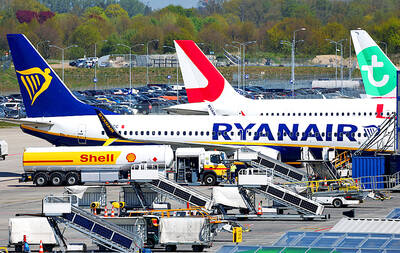
Ryanair, Transavia, Volotea and other low-cost airlines are feeling the financial pain from high jet fuel prices as a result of the Middle East war and are cutting flights. The closure of the Strait of Hormuz has taken a huge chunk of oil supplies off the market, sending the price of jet fuel soaring and triggering fears of shortages that could force airlines to cancel flights. Airlines are not waiting for a lack of supplies to react. “Travel alert: Airlines are cutting thousands of flights right now,” Travel Therapy host Karen Schaler said in an Instagram reel this past weekend.
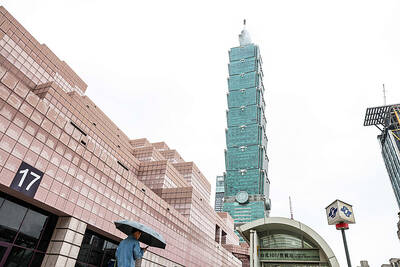
MANAGING RISKS: Taiwan has secured LNG sufficient to cover 95 percent of electricity demand for next month, UBS said, describing the government’s approach as proactive UBS Group AG has raised its forecast for Taiwan’s economic growth this year to 8 percent, up from 6.9 percent previously, and said expansion could reach as high as 8.6 percent if external energy shocks are avoided. The upgrade reflects a stronger-than-expected first-quarter performance and sustained momentum in artificial intelligence (AI)-driven exports, which UBS said are providing a firm foundation for growth despite geopolitical and energy risks. Taiwan’s GDP expanded 13.69 percent year-on-year in the first quarter, the fastest growth since the second quarter of 1987, the Directorate-General of Budget, Accounting and Statistics (DGBAS) reported on Thursday. On a seasonally

The list of Asian stocks that benefit from business partnership with Nvidia Corp is getting longer, as the region further integrates into the artificial intelligence (AI) chip giant’s business ecosystem. Just in the past week, South Korea’s LG Electronics Inc, Taiwan’s Nanya Technology Corp (南亞科技), as well as China’s Huizhou Desay SV Automotive Co (德賽西威) and Pateo Connect Technology Shanghai Corp (博泰車聯) have become the latest to rally on news of tie-ups, supply-chain participation or product collaboration with the US chip designer. Asian suppliers account for about 90 percent of Nvidia’s production costs, up from about 65 percent last year, data compiled
The Fair Trade Commission’s (FTC) ongoing review of Grab Holdings Ltd’s US$600 million acquisition of Foodpanda Taiwan’s operations, announced on March 23, has taken on fresh urgency as industry experts warn that the transaction could embed significant Chinese cybersecurity vulnerabilities into Taiwan’s digital infrastructure through Grab’s deep ties to autonomous-driving firm WeRide (文遠知行). Less than 16 months after the FTC blocked Uber Eats’ direct attempt to acquire Foodpanda Taiwan — citing potential combined market shares of 80 to 90 percent — the emergence of Grab as the buyer has prompted questions about whether the same competitive harm is simply being rerouted


 RSS
RSS