


US technology giant Apple Inc has lost a lawsuit against a Chinese state regulator over patent rights to voice recognition software such as the iPhone’s Siri, a Beijing court said.
The legal battle began in 2012 when Shanghai-based Zhizhen Network Technology Co (智臻網路) pursued Apple for allegedly infringing its Chinese patent with Siri, its “intelligent personal assistant.”
Apple asked China’s patent review board, which operates under the control of the Chinese State Intellectual Property Office, to declare Zhizhen’s original patent ineffective, but the request was rejected.
Late last year, Apple appealed to Beijing’s Number One Intermediate People’s Court to overturn that decision.
“The court did not support the cause of action stated by Apple,” the court said in a statement on Tuesday, referring to the case in which Apple “brought a lawsuit” against the government agency.
“The patent for the invention of the ‘type of chatbot system’ involved remains effective,” the court said, referring to Zhizhen’s patent.
Apple had decided to appeal to the Beijing Higher People’s Court, it added.
Apple’s Siri, which responds to user commands through voice recognition software, made its formal debut with the release of the iPhone 4S in 2011, while Zhizhen claims its earlier Xiao i Robot product works in a similar way.
It is not the first time that Apple has been embroiled in intellectual property rights controversy in China, where its products are popular.
Apple in 2012 paid US$60 million to settle a separate legal dispute with a Chinese firm over the iPad trademark.
TESLA
Meanwhile, US electric automaker Tesla Motors Inc on Wednesday denounced a Chinese businessman’s lawsuit seeking millions of US dollars for alleged trademark infringement as an attempt to “steal” its property.
Zhan Baosheng (占寶生), said to be the founder of a cosmetics Web site in the southern city of Guangzhou, registered “Tesla” as a trademark in China in 2009, the China Business News said.
He also sought to trademark a T-shaped logo and the phrase “Tesla Motors,” it said, although those applications were still pending following objections.
Zhan filed a lawsuit against Tesla in a Beijing court last week, the paper reported, demanding that it close its showrooms, service centers and charging facilities in China, terminate all sales and marketing activities in the country and pay 23.9 million yuan (US$3.9 million) in compensation.
An official with Beijing’s Third Intermediate People’s Court, who declined to be named, confirmed to reporters that it had received an intellectual property infringement action against the automaker.
Tesla slammed the lawsuit.
“There can be no legitimate dispute that Tesla created and used these trademarks long before Mr Zhan attempted to steal them from us in China,” Tesla said in a statement. “Since Mr Zhan does not rightfully own the trademark at issue, it follows that his lawsuit is without any conceivable merit.”
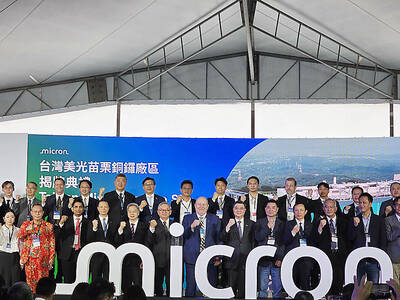
UNPRECEDENTED PACE: Micron Technology has announced plans to expand manufacturing capabilities with the acquisition of a new chip plant in Miaoli Micron Technology Inc unveiled a newly acquired chip plant in Miaoli County yesterday, as the company expands capacity to meet growing demand for advanced DRAM chips, including high-bandwidth memory chips amid the artificial intelligence boom. The plant in Miaoli County’s Tongluo Township (銅鑼), which Micron acquired from Powerchip Semiconductor Manufacturing Corp (力積電) for US$1.8 billion, is expected to make a sizeable capacity contribution to the company from fiscal 2028, the company said in a statement. It would be an extended production site of Micron’s large-scale manufacturing hub in Taichung, the company said. As the global semiconductor industry is racing to reach US$1 trillion

Singapore-based ride-hailing and delivery giant Grab Holdings Ltd has applied for regulatory approval to acquire the Taiwan operations of Germany-based Delivery Hero SE's Foodpanda in a deal valued at about US$600 million. Grab submitted the filing to the Fair Trade Commission on Friday last week, with the transaction subject to regulatory review and approval, the company said in a statement yesterday. Its independent governance structure would help foster a healthy and competitive market in Taiwan if the deal is approved, Grab said. Grab, which is listed on the NASDAQ, said in the filing that US-based Uber Technologies Inc holds about 13 percent of

Taiwan’s food delivery market could undergo a major shift if Singapore-based Grab Holdings Ltd completes its planned acquisition of Delivery Hero SE’s Foodpanda business in Taiwan, industry experts said. Grab on Monday last week announced it would acquire Foodpanda’s Taiwan operations for US$600 million. The deal is expected to be finalized in the second half of this year, with Grab aiming to complete user migration to its platform by the first half of next year. A duopoly between Uber Eats and Foodpanda dominates Taiwan’s delivery market, a structure that has remained intact since the Fair Trade Commission (FTC) blocked Uber Technologies Inc’s

Memory chip stocks extended their losses yesterday after Alphabet Inc’s Google publicized research that could allow more efficient use of the storage needed for artificial intelligence (AI) development. SK Hynix Inc and Samsung Electronics Co, South Korean leaders in the market, fell more than 6 percent and about 5 percent respectively in Seoul. In the US, Micron Technology Inc, Western Digital Corp and Sandisk Corp slid more than 2 percent in pre-market trading, after they all closed lower on Wednesday. Memory companies have been on a tear in recent months as the rapid development of AI infrastructure triggered a spike in chip


 RSS
RSS