


Hailing mainly from Aleppo, the massive influx of displaced families who have relocated to Syria’s coast has boosted Latakia, a city whose economy heavily relied on its port and summertime tourism before the war.
“People here on the coast are more relaxed,” said Haytham Ahmad, who heads the Latakia Governorate’s media office.
“We like to get up late, sip our coffee and smoke our nargileh [water pipes] before we go to work, but people from Aleppo can’t live if they aren’t working from morning until night,” he said.
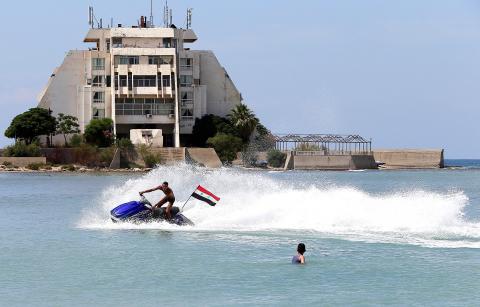
Photo: AFP
Latakia’s population has doubled with the arrival of 1 million people fleeing violence in the northern city of Aleppo, Homs in central Syria and Idlib in the northwest. The loyalist province has remained mostly untouched by Syria’s three-year war and as a result its economy is booming, unlike the rest of the country.
“There is a real economic boom. [The displaced] have got things moving and the jobless have found work,” said Sami Sufi, who heads the Latakia Chamber of Commerce and Industry. “People from Aleppo have a knack for business and they’ve headed out to the nearby countryside to set up detergent, cosmetics and even food packaging factories.”
Food, cheese and cable-making workshops have also sprung up on the outskirts of Syria’s fifth-largest city, where rent is cheaper.
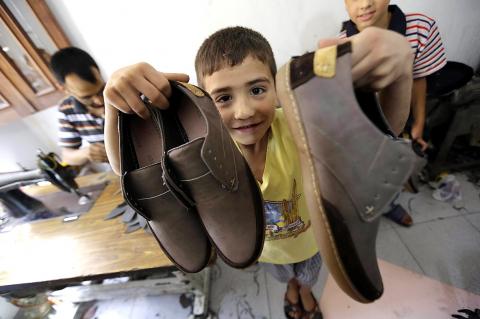
Photo: AFP
One of these new entrepreneurs is an Aleppo-born merchant who realized upon arriving in Latakia that there was only one man there selling kaak, a traditional Levantine sesame bread, and set up his own business. He now produces kaak in large quantities and distributes the delicacy throughout the province.
Even Aleppo’s famed olive oil-based soap-makers have found their way to Latakia and are now exporting their produce to the US from the Mediterranean port city.
Abandoned for years, the industrial zone is now buzzing with activity, as textile, metal and mechanical workshops fill it out entirely.
Hassan Shobak, who produces tanker trucks, was the first to set up shop in Latakia after he shut down his 4,000m2 factory in Aleppo last year.
“We gave life to this empty place. Today, I have four workshops, and there isn’t a single mete available, even as the owners raise the rent,” said the 46-year-old Shobak, who employs 40 workers and sells his goods both within Syria and elsewhere in the Arab world.
“If the municipality gives us more space, we could set up a huge factory like in Aleppo. I am sure many industry owners who closed down their businesses because of the crisis would come here,” Shobak said.
Aleppo was once Syria’s economic hub, until it became consumed by violence after a major rebel onslaught in July 2012 that split the city into opposition and regime-held territories.
Several districts of the historic city have been reduced to rubble by heavy bombing and fighting, forcing hundreds of thousands of people to flee.
People displaced from other parts of Syria have also sought refuge in the coastal area, with businessmen from Homs focus primarily on solar energy production, while those from Idlib concentrate on mechanics and electronics.
Latakia city’s commercial district has also become intensely vibrant thanks to the influx.
Omar Summak used to make hummus — the Levant’s favorite chickpea-based dip — in the east of Aleppo, but when his city became a war zone, he put his family in his pickup truck and they made their way to Latakia.
Once he reached the coast, the 30-year-old started out selling vegetables, but “after passing through Anana Street, I realized no one was selling accessories and trinkets,” Summak said as he stood in front of his truck, filled with brightly colored bracelets, plastic necklaces and earrings.
Prior to the war, Latakia’s economy thrived in the summer, thanks to the inflow of tourists. Now, its beach resorts have become homes to displaced families.
About 600 villas near Blue Beach, in the north of Latakia, have been full for two years, despite soaring rental prices.
Sitting on the beach with his two wives and eight children, 35-year-old Mohammad Sankar said he left Aleppo nearly two years ago.
“We love to work and do business. Look at me, I left my city because of the security situation and 10 days after I arrived, I reopened my sweet factory here,” Sankar said.
Sankar has also teamed up with a Latakia native to set up a sausage factory.
“Business is good, but of course, should the army retake Aleppo, I will return. I love Syria but my heart is still in my city,” he said.
Daad Juni, a 45-year-old shop attendant, said that the downside to the influx of refugees has been the massive increase in prices.
“Prices have doubled since they [the displaced] came — including apartment and shop rental costs and food — but we don’t complain, business is very good,” Juni said.

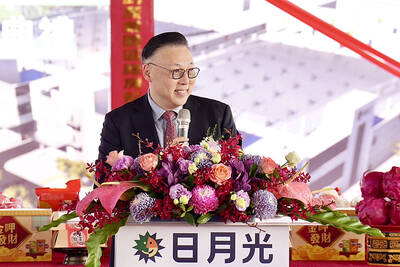
ENERGY ISSUES: The TSIA urged the government to increase natural gas and helium reserves to reduce the impact of the Middle East war on semiconductor supply stability Chip testing and packaging service provider ASE Technology Holding Co (日月光投控) yesterday said it planned to invest more than NT$100 billion (US$3.15 billion) in building a new advanced chip testing facility in Kaohsiung to keep up with customer demand driven by the artificial intelligence (AI) boom. That would be included in the company’s capital expenditure budget next year, ASE said. There is also room to raise this year’s capital spending budget from a record-high US$7 billion estimated three months ago, it added. ASE would have six factories under construction this year, another record-breaking number, ASE chief operating officer Tien Wu

The EU and US are nearing an agreement to coordinate on producing and securing critical minerals, part of a push to break reliance on Chinese supplies. The potential deal would create incentives, such as minimum prices, that could advantage non-Chinese suppliers, according to a draft of an “action plan” seen by Bloomberg. The EU and US would also cooperate on standards, investments and joint projects, as well as coordinate on any supply disruptions by countries like China. The two sides are additionally seeking other “like-minded partners” to join a multicountry accord to help create these new critical mineral supply chains, which feed into

For weeks now, the global tech industry has been waiting for a major artificial intelligence (AI) launch from DeepSeek (深度求索), seen as a benchmark for China’s progress in the fast-moving field. More than a year has passed since the start-up put Chinese AI on the map in early last year with a low-cost chatbot that performed at a similar level to US rivals. However, despite reports and rumors about its imminent release, DeepSeek’s next-generation “V4” model is nowhere in sight. Speculation is also swirling over the geopolitical implications of which computer chips were chosen to train and power the new
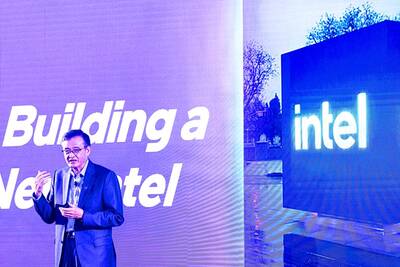
Intel Corp is joining Elon Musk’s long-shot effort to develop semiconductors for Tesla Inc, Space Exploration Technologies Corp and xAI, marking a surprising twist in the chipmaker’s comeback bid. Intel would help the Terafab project “refactor” the technology in a chip factory, the company said on Tuesday in a post on X, Musk’s social media platform. That is a stage in the development process that typically helps make chips more powerful or reliable. The chipmaker’s shares jumped 4.2 percent to US$52.91 in New York trading on Tuesday. The Terafab project is a grand plan by Musk to eventually manufacture his own chips for


 RSS
RSS