


Analysts believe the government’s recent intervention in the target redemption forward (TRF) business has added to headwinds in the near term for the financial industry.
TRF constitutes one type of Treasury marketing unit (TMU) product and may contribute 40 percent to 60 percent of total TMU profits throughout the domestic banking sector, Primasia Securities estimated.
Taiwanese banks account for 25 percent of the US$150 billion of TRFs outstanding, according to Morgan Stanley.
The new challenge comes as the industry is fighting with potentially weakening earnings growth in the coming quarters as a result of the delayed ratification of cross-strait service trade agreement, the upcoming business tax increases, the reduced ceiling on interest rates for revolving credit and the yuan’s depreciation.
Last week, the Financial Supervisory Commission announced it was banning Bank SinoPac (永豐銀行), the flagship unit of SinoPac Financial Holdings Co (永豐金控), from selling TRFs for a year due to its mis-selling practices and resulting disputes with customers.
Financial Supervisory Commission Chairman William Tseng (曾銘宗) said on Thursday last week that the commission did not rule out the possibility that more banks could be punished for TRF disputes if they do not fully disclose risk to their corporate clients.
Some analysts said SinoPac’s punishment exceeded their expectations and forecast bigger headwinds on financial firms that have higher revenue contribution from TMU businesses.
“The entire TMU-related business momentum will cool because of such regulatory scrutiny,” JPMorgan Securities Taiwan Ltd analyst Jemmy Huang (黃聖翔) said on Friday last week.
The one-way appreciation of yuan over the last two years has allowed Taiwanese banks to see strong growth in their TMU businesses as they sold a lot of foreign-exchange-related options to corporate clients.
However, with the yuan’s depreciation in recent months, these foreign-exchange options have backfired, Taipei-based Macquarie Capital Securities researcher Dexter Hsu (許世德) said.
“[The commission is] using this opportunity to tell banks to be cautious with yuan derivatives,” Credit Suisse Group AG analyst Chung Hsu (許忠維) told Bloomberg on Wednesday last week. “If the yuan continues to fall, there will be forced exits by design of the products, so as a result there will be unwinding.”
Taishin Financial Holding Co (台新金控) and Fubon Financial Holding Co (富邦金控) could also face a struggle, thanks to their higher revenue contribution from their TMU businesses, JPMorgan said.
However, Huang said potential headwinds for banks’ pre-provision operating profit growth this year should be manageable as TMU revenue only accounts for mid single-digits of total operating revenue at most Taiwanese banks.
Since the beginning of the year, financial shares have underperformed the broader market by 11.45 percent, according to Taiwan Stock Exchange data.
SinoPac Financial shares fell 3.31 percent yesterday to NT$13.15, Fubon Financial declined 1.14 percent to NT$39.15, while Taishin Financial rose 0.36 percent to NT$13.9.
“Investor expectations on sector outperformance are very low,” Barclays Capital Securities analyst Noel Chan (陳聖賢) said in a client note yesterday.
With investors mostly occupied by short-term risks, they tend to overlook the sector’s likely margin upside in the medium term, Chan said.
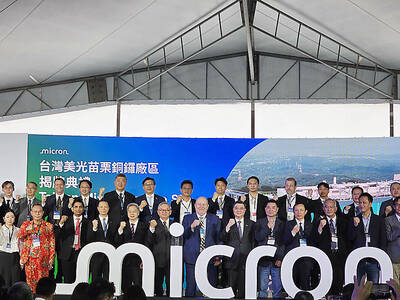
UNPRECEDENTED PACE: Micron Technology has announced plans to expand manufacturing capabilities with the acquisition of a new chip plant in Miaoli Micron Technology Inc unveiled a newly acquired chip plant in Miaoli County yesterday, as the company expands capacity to meet growing demand for advanced DRAM chips, including high-bandwidth memory chips amid the artificial intelligence boom. The plant in Miaoli County’s Tongluo Township (銅鑼), which Micron acquired from Powerchip Semiconductor Manufacturing Corp (力積電) for US$1.8 billion, is expected to make a sizeable capacity contribution to the company from fiscal 2028, the company said in a statement. It would be an extended production site of Micron’s large-scale manufacturing hub in Taichung, the company said. As the global semiconductor industry is racing to reach US$1 trillion

Singapore-based ride-hailing and delivery giant Grab Holdings Ltd has applied for regulatory approval to acquire the Taiwan operations of Germany-based Delivery Hero SE's Foodpanda in a deal valued at about US$600 million. Grab submitted the filing to the Fair Trade Commission on Friday last week, with the transaction subject to regulatory review and approval, the company said in a statement yesterday. Its independent governance structure would help foster a healthy and competitive market in Taiwan if the deal is approved, Grab said. Grab, which is listed on the NASDAQ, said in the filing that US-based Uber Technologies Inc holds about 13 percent of

Taiwan’s food delivery market could undergo a major shift if Singapore-based Grab Holdings Ltd completes its planned acquisition of Delivery Hero SE’s Foodpanda business in Taiwan, industry experts said. Grab on Monday last week announced it would acquire Foodpanda’s Taiwan operations for US$600 million. The deal is expected to be finalized in the second half of this year, with Grab aiming to complete user migration to its platform by the first half of next year. A duopoly between Uber Eats and Foodpanda dominates Taiwan’s delivery market, a structure that has remained intact since the Fair Trade Commission (FTC) blocked Uber Technologies Inc’s

Memory chip stocks extended their losses yesterday after Alphabet Inc’s Google publicized research that could allow more efficient use of the storage needed for artificial intelligence (AI) development. SK Hynix Inc and Samsung Electronics Co, South Korean leaders in the market, fell more than 6 percent and about 5 percent respectively in Seoul. In the US, Micron Technology Inc, Western Digital Corp and Sandisk Corp slid more than 2 percent in pre-market trading, after they all closed lower on Wednesday. Memory companies have been on a tear in recent months as the rapid development of AI infrastructure triggered a spike in chip


 RSS
RSS