


Japanese e-commerce giant Rakuten Inc is set to start issuing credit cards in Taiwan through a subsidiary, after the Financial Supervisory Commission (FSC) approved its plan to distribute own-brand cards locally.
The move is part of Rakuten’s overall strategy to achieve its ambitious annual growth target for its Taiwanese business.
The commission on Tuesday announced that it has granted Rakuten Card Co, a credit card subsidiary of the Japanese online retailer, permission to set up Rakuten Card Taiwan Inc (台灣樂天信用卡) with NT$300 million (US$9.93 million) in capital.
The new venture would be the nation’s fourth foreign-funded credit card-issuer, joining American Express International (Taiwan) Inc (台灣美國運通), Diners Club International (Taiwan) Co (台灣大來) and AEON Credit Card (Taiwan) Co (台灣永旺), the commission said in a statement.
Prior to the announcement, Grace Lo (羅雅薰), head of business at Taiwan Rakuten Ichiba Inc (台灣樂天市場), said at a press briefing on Tuesday that the credit card issuance is part of Rakuten’s plans to increase the portion of its revenue generated in Taiwan by more than 60 percent this year.
The company’s credit cards are to incorporate Rakuten Super Points, which can be earned with every NT$100 spent on Rakuten items and can be redeemed as payment for new purchases, Lo said.
Taiwan was the first overseas market Rakuten entered and since establishing its presence in the nation in 2008, the online retailer has expanded into 27 countries, including Singapore, Indonesia, Thailand and Malaysia.
Rakuten expects its Taiwan revenue to grow by more than 60 percent this year, a target it calls aggressive, but achievable through its a revamped business strategy, Lo said at the press conference.
The Japanese company also announced that it is to team up with Google Inc to give small and medium-sized Taiwanese enterprises easier access to the US firm’s advertising tools.
Under the partnership, Google will provide its AdWords keyword tools to boost Web site traffic and sales for the more than 2,800 Taiwanese retailers on Rakuten.com, while the Japanese firm will provide its e-commerce consulting services to those firms interested in using Google’s keyword tools.
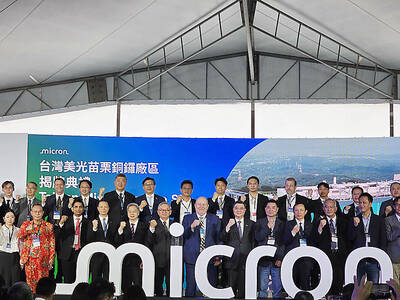
UNPRECEDENTED PACE: Micron Technology has announced plans to expand manufacturing capabilities with the acquisition of a new chip plant in Miaoli Micron Technology Inc unveiled a newly acquired chip plant in Miaoli County yesterday, as the company expands capacity to meet growing demand for advanced DRAM chips, including high-bandwidth memory chips amid the artificial intelligence boom. The plant in Miaoli County’s Tongluo Township (銅鑼), which Micron acquired from Powerchip Semiconductor Manufacturing Corp (力積電) for US$1.8 billion, is expected to make a sizeable capacity contribution to the company from fiscal 2028, the company said in a statement. It would be an extended production site of Micron’s large-scale manufacturing hub in Taichung, the company said. As the global semiconductor industry is racing to reach US$1 trillion

Singapore-based ride-hailing and delivery giant Grab Holdings Ltd has applied for regulatory approval to acquire the Taiwan operations of Germany-based Delivery Hero SE's Foodpanda in a deal valued at about US$600 million. Grab submitted the filing to the Fair Trade Commission on Friday last week, with the transaction subject to regulatory review and approval, the company said in a statement yesterday. Its independent governance structure would help foster a healthy and competitive market in Taiwan if the deal is approved, Grab said. Grab, which is listed on the NASDAQ, said in the filing that US-based Uber Technologies Inc holds about 13 percent of

Taiwan’s food delivery market could undergo a major shift if Singapore-based Grab Holdings Ltd completes its planned acquisition of Delivery Hero SE’s Foodpanda business in Taiwan, industry experts said. Grab on Monday last week announced it would acquire Foodpanda’s Taiwan operations for US$600 million. The deal is expected to be finalized in the second half of this year, with Grab aiming to complete user migration to its platform by the first half of next year. A duopoly between Uber Eats and Foodpanda dominates Taiwan’s delivery market, a structure that has remained intact since the Fair Trade Commission (FTC) blocked Uber Technologies Inc’s

Memory chip stocks extended their losses yesterday after Alphabet Inc’s Google publicized research that could allow more efficient use of the storage needed for artificial intelligence (AI) development. SK Hynix Inc and Samsung Electronics Co, South Korean leaders in the market, fell more than 6 percent and about 5 percent respectively in Seoul. In the US, Micron Technology Inc, Western Digital Corp and Sandisk Corp slid more than 2 percent in pre-market trading, after they all closed lower on Wednesday. Memory companies have been on a tear in recent months as the rapid development of AI infrastructure triggered a spike in chip


 RSS
RSS