


Taishin International Bank (台新銀行) yesterday teamed up with electronics retailer Tsann Kuen Enterprise Co (燦坤實業) in the hope of increasing its customer base by 1 million over the next decade, senior executives said.
The Taishin Financial Holding Co (台新金控)-owned lender signed a contract with Tsann Kuen to issue co-branded credit cards for the coming 10 years in a bid to reach the consumer electronics vendor’s 4 million members.
“We expect to issue 80,000 co-branded credit cards in the first year of cooperation, with per-card spending estimated at NT$7,000 a month,” Taishin retail banking executive Oliver Shang (尚瑞強) told a media briefing.

Photo: Lu Kuan-cheng, Taipei Times
That would add to Taishin Bank’s 3.48 million credit cards in circulation, consolidating its fourth place among local peers after CTBC Commercial Bank (中國信託商銀), Cathay United Bank (國泰世華銀行) and E.Sun Commercial Bank (玉山銀行).
According to the deal, Taishin Bank is to offer bonus credit and other benefits for cardholders shopping at Tsann Kuen’s 345 outlets nationwide.
However, the increase in the number of credit cards may not generate much profit, as regulators define credit cards as a payment tool instead of a credit vehicle through which banks can charge customers high borrowing costs, Shang said.
The Financial Supervisory Commission is inspecting all domestic credit card issuers to ensure fair pricing on concerns some banks charge unreasonable revolving interest rates of between 18 and 20 percent. The commission insists banks should set discriminated interest rates for customers depending on their different credit profiles.
Tsann Kuen also operates a travel agency, bakeries, restaurants and coffee shops, as well as Aurora Corp (震旦行), an office automation equipment and furniture supplier.
Tsann Kuen chairman Jerry Yen (閻俊傑) forecast mid-single-digit percentage growth in revenue this year on the back of wearable devices, while older-generation products and their accessories will generate limited profit contributions due to constant price discounts.
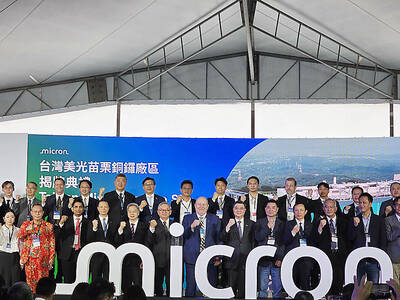
UNPRECEDENTED PACE: Micron Technology has announced plans to expand manufacturing capabilities with the acquisition of a new chip plant in Miaoli Micron Technology Inc unveiled a newly acquired chip plant in Miaoli County yesterday, as the company expands capacity to meet growing demand for advanced DRAM chips, including high-bandwidth memory chips amid the artificial intelligence boom. The plant in Miaoli County’s Tongluo Township (銅鑼), which Micron acquired from Powerchip Semiconductor Manufacturing Corp (力積電) for US$1.8 billion, is expected to make a sizeable capacity contribution to the company from fiscal 2028, the company said in a statement. It would be an extended production site of Micron’s large-scale manufacturing hub in Taichung, the company said. As the global semiconductor industry is racing to reach US$1 trillion

Singapore-based ride-hailing and delivery giant Grab Holdings Ltd has applied for regulatory approval to acquire the Taiwan operations of Germany-based Delivery Hero SE's Foodpanda in a deal valued at about US$600 million. Grab submitted the filing to the Fair Trade Commission on Friday last week, with the transaction subject to regulatory review and approval, the company said in a statement yesterday. Its independent governance structure would help foster a healthy and competitive market in Taiwan if the deal is approved, Grab said. Grab, which is listed on the NASDAQ, said in the filing that US-based Uber Technologies Inc holds about 13 percent of

Taiwan’s food delivery market could undergo a major shift if Singapore-based Grab Holdings Ltd completes its planned acquisition of Delivery Hero SE’s Foodpanda business in Taiwan, industry experts said. Grab on Monday last week announced it would acquire Foodpanda’s Taiwan operations for US$600 million. The deal is expected to be finalized in the second half of this year, with Grab aiming to complete user migration to its platform by the first half of next year. A duopoly between Uber Eats and Foodpanda dominates Taiwan’s delivery market, a structure that has remained intact since the Fair Trade Commission (FTC) blocked Uber Technologies Inc’s

Memory chip stocks extended their losses yesterday after Alphabet Inc’s Google publicized research that could allow more efficient use of the storage needed for artificial intelligence (AI) development. SK Hynix Inc and Samsung Electronics Co, South Korean leaders in the market, fell more than 6 percent and about 5 percent respectively in Seoul. In the US, Micron Technology Inc, Western Digital Corp and Sandisk Corp slid more than 2 percent in pre-market trading, after they all closed lower on Wednesday. Memory companies have been on a tear in recent months as the rapid development of AI infrastructure triggered a spike in chip


 RSS
RSS