


ScinoPharm Taiwan Ltd (台灣神隆), which makes made-to-order active pharmaceutical ingredients (API), yesterday completed the second stage of construction on its factory in Changshu in China’s Jiangsu Province.
The plant is set to boost the company’s total reactor volume by between 2.04 and 2.69 times to between 341,960 and 371,630 liters on both sides of the Taiwan Strait.
ScinoPharm’s pharmaceutical plant in Greater Tainan has a reactor volume of between 14,580 and 44,250 liters.
The second stage of construction included the building of a research and development center, as well as a multipurpose API plant, which can supply a larger variety of ingredients thanks to its two large production lines, the company said.
ScinoPharm has invested US$50 million to US$60 million in the two-stage project on a 40 hectare plot of land in the Chinese city, company president and chief executive Jo Shen (馬海怡) said yesterday.
The company plans to invest the same amount to build a formulation factory and expand its API production capacity on a nearby plot of land of a smiliar size, Shen said.
ScinoPharm has not made a timetable for its future investment because the schedule will depend on whether it can find Chinese partners to produce formulations, she said.
The Changshu factory has received drug production licenses from China’s Food and Drug Administration to manufacture four API products, but ScinoPharm still needs to apply for China’s good manufacturing practices certificates and drug permits for the four products before it can sell them on the market, she added.
ScinoPharm general manager Cheng Kuo-hsi (鄭國喜) said the factory is the first pharmaceutical plant in China that has complied with the country’s new good manufacturing standards.
The factory is expected to receive two drug permits in 2015 and 2016, after ScinoPharm and one of its clients submit the applications next year, Cheng said.
The Chinese facility began supplying intermediates to the company’s Greater Tainan factory in the second half of last year and is making drugs on a contract basis for two US companies and one Chinese firm, he added.
Meanwhile, the pharmaceutical ingredient maker is working with Chinese partners to sell its products across the Taiwan Strait and is in talks with another company in China to make drugs to treat glaucoma, according to Shen.
In Taiwan, ScinoPharm is building new production lines at its formulation factory in Greater Tainan, which may begin operating in the third quarter of next year, she said.
Alex Lo (羅智先), chairman of Uni-President Enterprise Co (統一企業), one of ScinoPharm’s largest shareholders, attended at the factory’s opening ceremony yesterday.
Companies affiliated with Uni-President own more than 60 percent of ScinoPharm shares.
Lo said Uni-President plans to follow in the footsteps of ScinoPharm and join its investment project.
“Uni-President will need the expertise of ScinoPharm to codevelop health products for the elderly,” he said.
From January through last month, ScinoPharm Taiwan registered revenue of NT$4.44 billion, up 9.87 percent from the NT$4.04 billion it made a year ago, while its net profit for the first three quarters was NT$1 billion, or NT$1.49 per share, up from NT$748.37 million, or NT$1.11 per share, the previous year.
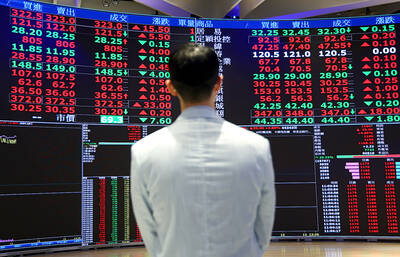
Shares in Taiwan closed at a new high yesterday, the first trading day of the new year, as contract chipmaker Taiwan Semiconductor Manufacturing Co (TSMC, 台積電) continued to break records amid an artificial intelligence (AI) boom, dealers said. The TAIEX closed up 386.21 points, or 1.33 percent, at 29,349.81, with turnover totaling NT$648.844 billion (US$20.65 billion). “Judging from a stronger Taiwan dollar against the US dollar, I think foreign institutional investors returned from the holidays and brought funds into the local market,” Concord Securities Co (康和證券) analyst Kerry Huang (黃志祺) said. “Foreign investors just rebuilt their positions with TSMC as their top target,
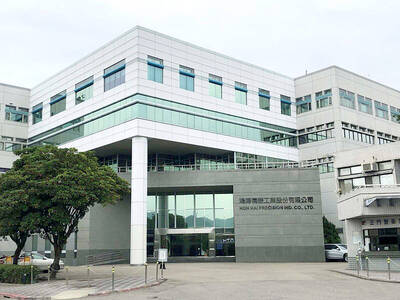
REVENUE PERFORMANCE: Cloud and network products, and electronic components saw strong increases, while smart consumer electronics and computing products fell Hon Hai Precision Industry Co (鴻海精密) yesterday posted 26.51 percent quarterly growth in revenue for last quarter to NT$2.6 trillion (US$82.44 billion), the strongest on record for the period and above expectations, but the company forecast a slight revenue dip this quarter due to seasonal factors. On an annual basis, revenue last quarter grew 22.07 percent, the company said. Analysts on average estimated about NT$2.4 trillion increase. Hon Hai, which assembles servers for Nvidia Corp and iPhones for Apple Inc, is expanding its capacity in the US, adding artificial intelligence (AI) server production in Wisconsin and Texas, where it operates established campuses. This
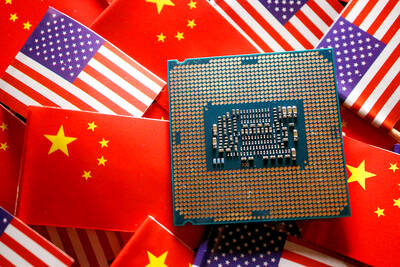
US President Donald Trump on Friday blocked US photonics firm HieFo Corp’s US$3 million acquisition of assets in New Jersey-based aerospace and defense specialist Emcore Corp, citing national security and China-related concerns. In an order released by the White House, Trump said HieFo was “controlled by a citizen of the People’s Republic of China” and that its 2024 acquisition of Emcore’s businesses led the US president to believe that it might “take action that threatens to impair the national security of the United States.” The order did not name the person or detail Trump’s concerns. “The Transaction is hereby prohibited,”
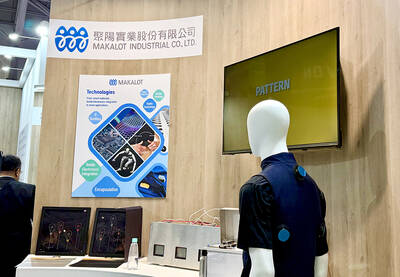
Garment maker Makalot Industrial Co (聚陽) yesterday reported lower-than-expected fourth-quarter revenue of NT$7.93 billion (US$251.44 million), down 9.48 percent from NT$8.76 billion a year earlier. On a quarterly basis, revenue fell 10.83 percent from NT$8.89 billion, company data showed. The figure was also lower than market expectations of NT$8.05 billion, according to data compiled by Yuanta Securities Investment and Consulting Co (元大投顧), which had projected NT$8.22 billion. Makalot’s revenue this quarter would likely increase by a mid-teens percentage as the industry is entering its high season, Yuanta said. Overall, Makalot’s revenue last year totaled NT$34.43 billion, down 3.08 percent from its record NT$35.52


 RSS
RSS