


Pixnet (痞客邦), a Taiwanese social network Web site, online photograph gallery and blog service provider, has become the fifth most-visited site in Taiwan, Web analytics company Alexa Internet Inc said yesterday.
Alexa’s latest rankings showed that the Web sites receiving the most traffic in Taiwan are Yahoo, Facebook, Google in traditional Chinese, Google in English, and Pixnet, with Pixnet moving up three spots from eighth on Thursday last week.
It vaulted past YouTube, Chinese-language 3C social network Web site Mobile01 and online media and chat room ck101.com into the top five in Taiwan, and also improved to 120th for total visitor traffic worldwide, from 531st early last month, according to Alexa’s data.
Pixnet Digital Media Corp chief executive officer Jenny Chou (周守珍) said the Web site has steadily gained in popularity because of the company’s dedication to improving the site’s user experience and Web content management since it was founded in 2003.
The latest boost in the rankings reflected how the site, with its coverage of all facets of life, 190 million articles, 230 million photos and ability to generate 300,000 articles a day, enables users to stay on top of social media trends, Chou said.
Providing innovative services for everyday life has always been Pixnet’s goal, the company’s founder, Chu Huang-wei (朱皇韋), added.
The company’s consolidation of its services in different app markets and devices has also helped Pixnet become the largest data center for everyday life in Taiwan, Chu said.
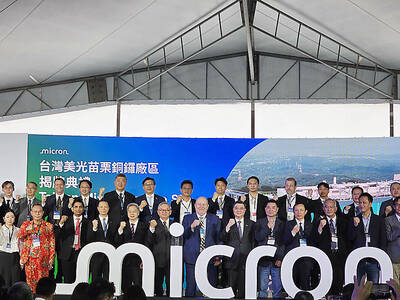
UNPRECEDENTED PACE: Micron Technology has announced plans to expand manufacturing capabilities with the acquisition of a new chip plant in Miaoli Micron Technology Inc unveiled a newly acquired chip plant in Miaoli County yesterday, as the company expands capacity to meet growing demand for advanced DRAM chips, including high-bandwidth memory chips amid the artificial intelligence boom. The plant in Miaoli County’s Tongluo Township (銅鑼), which Micron acquired from Powerchip Semiconductor Manufacturing Corp (力積電) for US$1.8 billion, is expected to make a sizeable capacity contribution to the company from fiscal 2028, the company said in a statement. It would be an extended production site of Micron’s large-scale manufacturing hub in Taichung, the company said. As the global semiconductor industry is racing to reach US$1 trillion

Singapore-based ride-hailing and delivery giant Grab Holdings Ltd has applied for regulatory approval to acquire the Taiwan operations of Germany-based Delivery Hero SE's Foodpanda in a deal valued at about US$600 million. Grab submitted the filing to the Fair Trade Commission on Friday last week, with the transaction subject to regulatory review and approval, the company said in a statement yesterday. Its independent governance structure would help foster a healthy and competitive market in Taiwan if the deal is approved, Grab said. Grab, which is listed on the NASDAQ, said in the filing that US-based Uber Technologies Inc holds about 13 percent of

Taiwan’s food delivery market could undergo a major shift if Singapore-based Grab Holdings Ltd completes its planned acquisition of Delivery Hero SE’s Foodpanda business in Taiwan, industry experts said. Grab on Monday last week announced it would acquire Foodpanda’s Taiwan operations for US$600 million. The deal is expected to be finalized in the second half of this year, with Grab aiming to complete user migration to its platform by the first half of next year. A duopoly between Uber Eats and Foodpanda dominates Taiwan’s delivery market, a structure that has remained intact since the Fair Trade Commission (FTC) blocked Uber Technologies Inc’s

Memory chip stocks extended their losses yesterday after Alphabet Inc’s Google publicized research that could allow more efficient use of the storage needed for artificial intelligence (AI) development. SK Hynix Inc and Samsung Electronics Co, South Korean leaders in the market, fell more than 6 percent and about 5 percent respectively in Seoul. In the US, Micron Technology Inc, Western Digital Corp and Sandisk Corp slid more than 2 percent in pre-market trading, after they all closed lower on Wednesday. Memory companies have been on a tear in recent months as the rapid development of AI infrastructure triggered a spike in chip


 RSS
RSS