


The two-month period between December and January has traditionally been a peak period for companies like New Palace International Co Ltd (新天地餐飲集團), which operates its own banqueting halls and offers catering services.
However, business has not been so brisk recently for New Palace, as the sluggish economy has crippled businesses’ willingness to hold annual banquets to thank their employees ahead of the Lunar New Year, weakening the revenues of the nation’s catering operators and hotels.
“Local companies’ demand for catering services for annual parties is definitely a very important driver for New Palace’s business,” a deputy manager of Grande Luxe Banquet (雅悅會館), a chain of banqueting halls run by New Palace, said by telephone last week.
The deputy manager, surnamed Dai (戴), said the company’s sales from orders of annual banquets this year have been slow compared with last year, as many clients have cut their budgets for annual dinners.
This year, New Palace said it has received catering orders from some major companies, including the Fubon Group (富邦集團), which plans to hold a 1,200-table banquet for its annual party.
STEADY BUSINESS
These orders are expected to keep the catering group’s business steady this month and next month, Dai said.
Formosa International Hotels Corp (FIHC, 晶華國際酒店集團), which has its own banqueting halls for hire and is capable of catering parties of more than 100 tables, is experiencing a similar situation.
FIHC public relations director Ellen Chang (張筠) said that the company has seen some customers adjust their spending on annual parties downward this season.
FIHC posted NT$339.3 million (US$11.69 million) in revenue last month, down 1.94 percent from a year earlier, with full-year sales totaling NT$3.71 billion, up 2.38 percent from 2011, the company’s data showed.
Chang said the company’s sales this month and next month would be supported by the restaurants at the Formosa Regent Taipei (晶華酒店) hotel, where many small businesses have made reservations for their annual parties this year.
However, the slowing economy has unexpectedly helped boost sales at restaurant chain groups like The Tai Tong Food & Beverage Group (瓦城泰統集團), which offer mid-priced menus.
SMALLER PARTIES
Tai Tong, the operator of three restaurant chains with 45 outlets, said it has seen some companies cut the scale of their annual parties and turn to its mid-priced restaurant brands such as Thai Town Cuisine (瓦城泰式料理).
That increased Tai Tong’s revenue last month by 22.51 percent from a year earlier, taking it to NT$173.73 million.
Tai Tong expected sales this month to increase from last month, as the company has seen reservations in its restaurants increase by 50 percent month-on-month this month.
Wowprime Corp (王品集團), which owns 11 restaurant chains with 293 outlets in Taiwan and China as of the end of last year, has also been receiving reservations for annual parties of less than 20 people.
Revenue for last month was NT$1.19 billion, up 25.79 percent from a month earlier, and up 28.14 percent from a year earlier, Wowprime’s monthly data show.
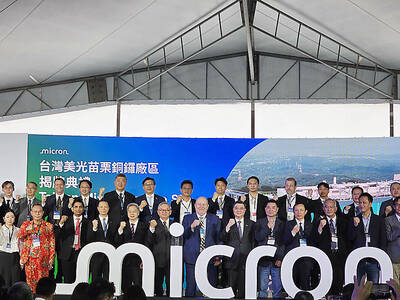
UNPRECEDENTED PACE: Micron Technology has announced plans to expand manufacturing capabilities with the acquisition of a new chip plant in Miaoli Micron Technology Inc unveiled a newly acquired chip plant in Miaoli County yesterday, as the company expands capacity to meet growing demand for advanced DRAM chips, including high-bandwidth memory chips amid the artificial intelligence boom. The plant in Miaoli County’s Tongluo Township (銅鑼), which Micron acquired from Powerchip Semiconductor Manufacturing Corp (力積電) for US$1.8 billion, is expected to make a sizeable capacity contribution to the company from fiscal 2028, the company said in a statement. It would be an extended production site of Micron’s large-scale manufacturing hub in Taichung, the company said. As the global semiconductor industry is racing to reach US$1 trillion

Singapore-based ride-hailing and delivery giant Grab Holdings Ltd has applied for regulatory approval to acquire the Taiwan operations of Germany-based Delivery Hero SE's Foodpanda in a deal valued at about US$600 million. Grab submitted the filing to the Fair Trade Commission on Friday last week, with the transaction subject to regulatory review and approval, the company said in a statement yesterday. Its independent governance structure would help foster a healthy and competitive market in Taiwan if the deal is approved, Grab said. Grab, which is listed on the NASDAQ, said in the filing that US-based Uber Technologies Inc holds about 13 percent of

Taiwan’s food delivery market could undergo a major shift if Singapore-based Grab Holdings Ltd completes its planned acquisition of Delivery Hero SE’s Foodpanda business in Taiwan, industry experts said. Grab on Monday last week announced it would acquire Foodpanda’s Taiwan operations for US$600 million. The deal is expected to be finalized in the second half of this year, with Grab aiming to complete user migration to its platform by the first half of next year. A duopoly between Uber Eats and Foodpanda dominates Taiwan’s delivery market, a structure that has remained intact since the Fair Trade Commission (FTC) blocked Uber Technologies Inc’s

Memory chip stocks extended their losses yesterday after Alphabet Inc’s Google publicized research that could allow more efficient use of the storage needed for artificial intelligence (AI) development. SK Hynix Inc and Samsung Electronics Co, South Korean leaders in the market, fell more than 6 percent and about 5 percent respectively in Seoul. In the US, Micron Technology Inc, Western Digital Corp and Sandisk Corp slid more than 2 percent in pre-market trading, after they all closed lower on Wednesday. Memory companies have been on a tear in recent months as the rapid development of AI infrastructure triggered a spike in chip


 RSS
RSS