


Detachable tablet computers will become popular next year and gradually replace smaller notebook computers, as they provide more mobility and run on application-centered operating systems, a local research house said.
“There is a likelihood that notebook computers will gradually be replaced by two or three-in-one tablets in the future, since most tablets are becoming multifunctional and detachable with optional docks or smartphones,” Digitimes Research senior analyst Joanne Chien (簡佩萍) said in an interview.
“As more PC manufacturers provide tablets supported by Apple Inc, Google Inc or Microsoft Corp’s operating systems, it offers users a wider choice of applications than notebook computers, benefiting both businesses and individuals,” Chien said.
In addition, detachable tablet computer’s portable features differentiate them from notebook computers, which are usually designed for larger screen sizes between 13 inches to 15 inches and are heavier, she added.
Digitimes Research estimated that global notebook shipments will decline by 1.4 percent from 192 million units this year to 189 million units next year, according to its report.
However, tablet computers and smartphones will have a 10 percent growth rate next year and more than 90 percent of mobile devices will run on Apple’s iOS and Google’s Android operating systems, while less than 10 percent will be powered by Microsoft’s Windows RT or Windows 8 operating systems, the report said.
Digitimes Research said notebook computers that are smaller in size will gradually be replaced by touch-screen tablets with seven-inch to 11-inch screens, while upcoming notebook computers will all be equipped with touch-screen panels and be moderately priced, similar to tablet computers.
“Though it costs more for manufacturers to provide notebooks with touch-screen panels, they will still add the feature to their new products to make them more appealing to customers, who still have a need for notebook computers,” Chien said by telephone.
Despite tablets being preferable in terms of portability and being easily detachable, desktop and notebook computers will still have their market shares, especially in emerging markets, where demand for high-end software and hardware are relatively lower than that in more advanced countries, she said.
This year, US-based Hewlett-Packard Co is expected to lead the global notebook market with a 16.5 percent share, while China’s Lenovo Group Ltd (聯想) will grab 15.4 percent, followed by Acer Inc’s (宏碁) 12.6 percent and Asustek Computer Inc’s (華碩) 10.2 percent, Digitimes Research forecast.
Next year, Lenovo will become the No.1 notebook manufacturer holding 16.7 percent of market share, followed by HP with 16.2 percent and Asustek with 11.2 percent, the report said.


ENERGY ISSUES: The TSIA urged the government to increase natural gas and helium reserves to reduce the impact of the Middle East war on semiconductor supply stability Chip testing and packaging service provider ASE Technology Holding Co (日月光投控) yesterday said it planned to invest more than NT$100 billion (US$3.15 billion) in building a new advanced chip testing facility in Kaohsiung to keep up with customer demand driven by the artificial intelligence (AI) boom. That would be included in the company’s capital expenditure budget next year, ASE said. There is also room to raise this year’s capital spending budget from a record-high US$7 billion estimated three months ago, it added. ASE would have six factories under construction this year, another record-breaking number, ASE chief operating officer Tien Wu

The EU and US are nearing an agreement to coordinate on producing and securing critical minerals, part of a push to break reliance on Chinese supplies. The potential deal would create incentives, such as minimum prices, that could advantage non-Chinese suppliers, according to a draft of an “action plan” seen by Bloomberg. The EU and US would also cooperate on standards, investments and joint projects, as well as coordinate on any supply disruptions by countries like China. The two sides are additionally seeking other “like-minded partners” to join a multicountry accord to help create these new critical mineral supply chains, which feed into

For weeks now, the global tech industry has been waiting for a major artificial intelligence (AI) launch from DeepSeek (深度求索), seen as a benchmark for China’s progress in the fast-moving field. More than a year has passed since the start-up put Chinese AI on the map in early last year with a low-cost chatbot that performed at a similar level to US rivals. However, despite reports and rumors about its imminent release, DeepSeek’s next-generation “V4” model is nowhere in sight. Speculation is also swirling over the geopolitical implications of which computer chips were chosen to train and power the new
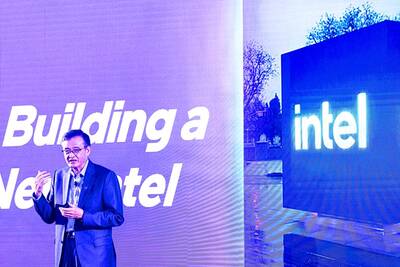
Intel Corp is joining Elon Musk’s long-shot effort to develop semiconductors for Tesla Inc, Space Exploration Technologies Corp and xAI, marking a surprising twist in the chipmaker’s comeback bid. Intel would help the Terafab project “refactor” the technology in a chip factory, the company said on Tuesday in a post on X, Musk’s social media platform. That is a stage in the development process that typically helps make chips more powerful or reliable. The chipmaker’s shares jumped 4.2 percent to US$52.91 in New York trading on Tuesday. The Terafab project is a grand plan by Musk to eventually manufacture his own chips for


 RSS
RSS