


The consortium that won the rights to develop the Taipei Twin Towers (雙子星大樓) project said yesterday it has adequate capital to construct the landmark complex next to Taipei Railway Station.
The clarifications came after Taipei City councilors recently raised questions over the multinational group’s funding ability and its alleged ties with local gangsters.
The consortium, composed of Taipei Gateway International Development Co (太極雙星) and Malaysia’s IGB Corp and Mid Valley City Sdn Bhd, on Oct. 28 won the contract to develop two high-rise buildings that may cost between NT$70 billion and NT$80 billion (US$2.39 billion to US$2.73 billion).
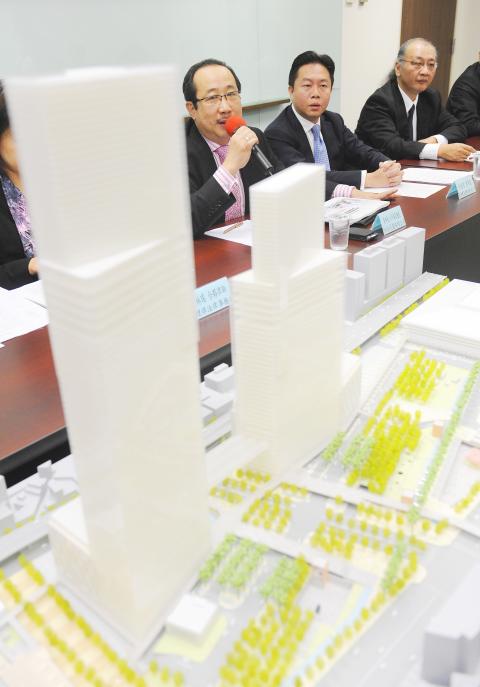
Photo: George Tsorng, Taipei Times
“Taipei Gateway no longer has any connection with Chen Hung-dao (程宏道)” after restructuring last month, company chairman Michael Ho (何岳儒) told a press conference.
Chen is a leader of the Four Seas Gang (四海幫).
He told the Chinese-language Next Magazine that he founded Taipei Gateway in December last year with capital of NT$30 million, but left the company because he realized the Twin Towers project was too big for him.
Taipei Gateway increased its capital to NT$77 million on Oct. 15 and won the contract two weeks later.
Taipei City councilors have since raised doubts about the firm’s financial strength, given the large amount of funding required for the development project.
“Consortium members will remit money here as things proceed,” Ho said, adding that the group is preparing the paperwork for inking the development contract to be signed in 30 to 45 days.
While Taipei Gateway is modestly capitalized, it is a unit of Kagawa International Investment Co, which draws the bulk of its funding from Japan’s Mori Group — owner of Mori Building Co and Mori Trust Co, Ho said.
However, Ho declined to supply details about the consortium’s capital structure, because he said doing so might affect the share price of IGB Corp, which is a listed firm in Malaysia.
At the press conference, Mickey Ng (黃坤義), head of Greater China at IGB, asked for more patience. He said the consortium would satisfy all media inquiries after it finalizes the deal with the Taipei City Government.
The consortium is expected to break ground for the construction of the two high-rise buildings — one with 56 stories above ground and four basement levels, and the other with 76 stories above ground and four basement levels — within one year.
The two buildings are to house shopping malls, office space, an international hotel and art galleries, the consortium said.
With a total floor space of 158,000 ping (522,332m2), or 1.5 times the size of Taipei 101, the project could create 23,000 jobs with an annual economic benefit of NT$30 billion, the consortium said.
When the project is completed in 2017, the twin towers will serve as the main hub for the Taiwan Taoyuan International Airport MRT line to Taipei and five other railway and MRT lines.

ENERGY ISSUES: The TSIA urged the government to increase natural gas and helium reserves to reduce the impact of the Middle East war on semiconductor supply stability Chip testing and packaging service provider ASE Technology Holding Co (日月光投控) yesterday said it planned to invest more than NT$100 billion (US$3.15 billion) in building a new advanced chip testing facility in Kaohsiung to keep up with customer demand driven by the artificial intelligence (AI) boom. That would be included in the company’s capital expenditure budget next year, ASE said. There is also room to raise this year’s capital spending budget from a record-high US$7 billion estimated three months ago, it added. ASE would have six factories under construction this year, another record-breaking number, ASE chief operating officer Tien Wu
The EU and US are nearing an agreement to coordinate on producing and securing critical minerals, part of a push to break reliance on Chinese supplies. The potential deal would create incentives, such as minimum prices, that could advantage non-Chinese suppliers, according to a draft of an “action plan” seen by Bloomberg. The EU and US would also cooperate on standards, investments and joint projects, as well as coordinate on any supply disruptions by countries like China. The two sides are additionally seeking other “like-minded partners” to join a multicountry accord to help create these new critical mineral supply chains, which feed into

For weeks now, the global tech industry has been waiting for a major artificial intelligence (AI) launch from DeepSeek (深度求索), seen as a benchmark for China’s progress in the fast-moving field. More than a year has passed since the start-up put Chinese AI on the map in early last year with a low-cost chatbot that performed at a similar level to US rivals. However, despite reports and rumors about its imminent release, DeepSeek’s next-generation “V4” model is nowhere in sight. Speculation is also swirling over the geopolitical implications of which computer chips were chosen to train and power the new
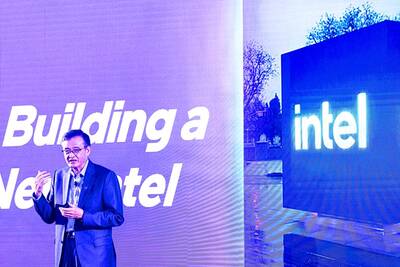
Intel Corp is joining Elon Musk’s long-shot effort to develop semiconductors for Tesla Inc, Space Exploration Technologies Corp and xAI, marking a surprising twist in the chipmaker’s comeback bid. Intel would help the Terafab project “refactor” the technology in a chip factory, the company said on Tuesday in a post on X, Musk’s social media platform. That is a stage in the development process that typically helps make chips more powerful or reliable. The chipmaker’s shares jumped 4.2 percent to US$52.91 in New York trading on Tuesday. The Terafab project is a grand plan by Musk to eventually manufacture his own chips for


 RSS
RSS