


Restaurant chain operator Wowprime Corp (王品) last week announced a venture plan to expand its operations in China, as the company moves cautiously amid the higher costs and tough business environment there.
The company, the nation’s largest restaurant chain with 11 brands such as Wang Steak (王品台塑牛排), Tasty (西堤) and Tokiya (陶板屋) across the Taiwan Strait, said on Wednesday it had decided to team up with Jollibee of the Philippines to establish a joint venture in China, that would operate the hotpot restaurant chain 12 Sabu (石二鍋) in China, Hong Kong and Macau.
In a statement sent to the Taiwan Stock Exchange, Wowprime said it and Jollibee would own a 48-percent stake each in the joint venture, with the remaining 4 percent share held by a third party with experience in developing channels in China.
This is the first time that Wowprime has decided to form a joint venture to expand its business reach.
Hot-Pot Market
The company said the joint venture would target the popular and low-priced hot pot market in China, aiming to open the first 12 Sabu store in Shanghai in the fourth quarter. In Taiwan, Wowprime runs 29 such stores.
Fubon Securities Investment Services Co (富邦投顧) analyst George Chu (朱家麟) praised Wowprime’s partnership with Jollibee, citing the latter’s established logistics system and mass-market pricing.
Jollibee is the largest restaurant chain operator in the Philippines, operating more than 2,500 stores around the world under a number of brands, including Jollibee, Chow King, Greenwich and Red Ribbon. In China, Jollibee operates 367 stores under three brands, namely Yonhe King (永和大王), Hong Zhuang Yuan (宏狀元) and San Pin Wan (三品王).
“Jollibee’s logistics will be a plus for the new 12 Sabu in China, as 12 Sabu’s high volume and low average selling price business model is incompatible with Wowprime’s existing logistics which serves 43 steak houses in China,” Chu said in a note on Thursday.
However, Wowprime has seemed to open stores at a slower-than-expected pace.
At the company’s Taiwan Stock Exchange share-listing ceremony on March 6, chairman Steve Day (戴勝益) said the firm aimed to add 65 new stores to the 244 in Taiwan and add 27 stores to the 71 in China by the end of this year. Currently, Wowprime has 210 stores in Taiwan, 46 in China and two stores in Thailand.
Slow Expansion
“The slow speed of expansion is much more conservative than Wowprime’s earlier outlook and is an indication of the higher costs and tough market in China,” Chu said.
“With the high costs of doing business in China, this slower expansion could avoid margin dilution and help the company’s bottom line in 2012, but will lead to less growth in 2013,” he said.
In the second quarter, Wowprime saw its net income narrow by 17.91 percent to NT$229.918 million (US$7.67 million), or earnings per share of NT$3.35, from NT$280.096 million, or NT$4.39 per share, in the first quarter, although the company still posted a 19 percent increase in first-half net income to NT$510.014 million, or NT$7.74 per share, from NT$428.194 million, or NT$7.13 per share, a year earlier, according to a stock exchange filing on Friday.
Revenue in the April-to-June period grew 1.47 percent quarter-on-quarter to NT$2.281 billion, rising 25 percent year-on-year, and revenue in the first six months increased 27.99 percent to NT$4.596 billion, the company’s filing showed.
Profit
This quarter, the company is expected to see profit increase by more than 20 percent sequentially and about 40 percent annually, thanks to higher profit contributions from its China operations, Chu forecast.
Fubon forecast the company’s net income to grow 43.9 percent to NT$1.11 billion this year, or NT$16.4 per share, and increase by a slower pace of 12.5 percent next year to NT$1.25 billion or NT$18.4 per share.
The company’s share price has risen 35.44 percent to NT$460.5 on Friday, since its March 6 debut with a listing price of NT$340.
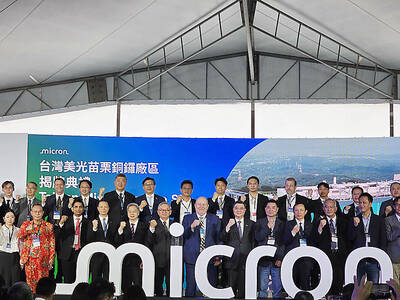
UNPRECEDENTED PACE: Micron Technology has announced plans to expand manufacturing capabilities with the acquisition of a new chip plant in Miaoli Micron Technology Inc unveiled a newly acquired chip plant in Miaoli County yesterday, as the company expands capacity to meet growing demand for advanced DRAM chips, including high-bandwidth memory chips amid the artificial intelligence boom. The plant in Miaoli County’s Tongluo Township (銅鑼), which Micron acquired from Powerchip Semiconductor Manufacturing Corp (力積電) for US$1.8 billion, is expected to make a sizeable capacity contribution to the company from fiscal 2028, the company said in a statement. It would be an extended production site of Micron’s large-scale manufacturing hub in Taichung, the company said. As the global semiconductor industry is racing to reach US$1 trillion

Singapore-based ride-hailing and delivery giant Grab Holdings Ltd has applied for regulatory approval to acquire the Taiwan operations of Germany-based Delivery Hero SE's Foodpanda in a deal valued at about US$600 million. Grab submitted the filing to the Fair Trade Commission on Friday last week, with the transaction subject to regulatory review and approval, the company said in a statement yesterday. Its independent governance structure would help foster a healthy and competitive market in Taiwan if the deal is approved, Grab said. Grab, which is listed on the NASDAQ, said in the filing that US-based Uber Technologies Inc holds about 13 percent of

Taiwan’s food delivery market could undergo a major shift if Singapore-based Grab Holdings Ltd completes its planned acquisition of Delivery Hero SE’s Foodpanda business in Taiwan, industry experts said. Grab on Monday last week announced it would acquire Foodpanda’s Taiwan operations for US$600 million. The deal is expected to be finalized in the second half of this year, with Grab aiming to complete user migration to its platform by the first half of next year. A duopoly between Uber Eats and Foodpanda dominates Taiwan’s delivery market, a structure that has remained intact since the Fair Trade Commission (FTC) blocked Uber Technologies Inc’s

Memory chip stocks extended their losses yesterday after Alphabet Inc’s Google publicized research that could allow more efficient use of the storage needed for artificial intelligence (AI) development. SK Hynix Inc and Samsung Electronics Co, South Korean leaders in the market, fell more than 6 percent and about 5 percent respectively in Seoul. In the US, Micron Technology Inc, Western Digital Corp and Sandisk Corp slid more than 2 percent in pre-market trading, after they all closed lower on Wednesday. Memory companies have been on a tear in recent months as the rapid development of AI infrastructure triggered a spike in chip


 RSS
RSS