


The newly passed luxury tax on property transactions has prompted Singaporean lender DBS Bank (星展銀行) to revise downward its growth estimate for mortgage lending this year and to place more emphasis on auto and personal loans instead, company executives said yesterday.
The largest lender in Southeast Asia by assets aims to double its earnings ability this year after posting a loss of NT$5 million (US$172,700) last year, said Jerry Chen (陳亮丞), general manager and head of DBS Bank Taiwan.
“We now expect a net increase of NT$1 billion to NT$1.2 billion in mortgage lending a month, from a previous forecast of NT$1.4 billion to NT$1.5 billion, after the luxury tax slashed home transactions by 30 percent in March,” Chen said.
The bank, which integrated Taiwan’s Bowa Bank (寶華銀行) into its operations in May 2008 after acquiring its positive bank assets, relaunched home loan operations in 2009, Chen said.
Home loans totaled NT$35 billion last year and are expected to expand to NT$50 billion this year, slowing from NT$53 billion last forecast, Chen said.
“The enactment [last week] of the luxury tax will weaken mortgage lending as evidenced by falling property transactions,” he said. “However, we support the government’s effort to cool the property market.”
The tax, which is slated to take effect on June 1, subjects properties resold within two years of purchase to a 10 percent tax. The rate will climb to 15 percent of trading prices if the properties are sold within one year of purchase.
The lender plans to strengthen car loans and roll out personal loans in June to make up for the expected slowdown in mortgage lending, Chen said.
Kevin Tang (唐正峰), managing director and head of consumer banking, expects auto loans to grow 1.5 times this year from the year-earlier level as the market -remains largely untapped.
The luxury tax, which will also impose a 10 percent levy on imported cars with a price tag of NT$3 million and more, will not have much impact on car sales in light of sales figures, Tang said.
Further, DBS Taiwan intends to move the launch of personal loans ahead and backburner credit card business because the latter entails higher risk, he said.
Regardless, the lender will press ahead with its plan to set up a subsidiary in Taiwan at the end of September and expects to gain regulatory approval next month.
To that end, the Singaporean parent has wired NT$2 billion to Taiwan and will inject an extra NT$8 billion next month, according to Chen.
A banking subsidiary must maintain at least NT$10 billion in working capital, as required of all domestic lenders, and is subject to regular stress tests by the Financial Supervisory Commission (FSC).
DBS, which aspires to become one of the top three foreign banks in Taiwan, will relocate its Taipei headquarters to the city’s prime Xinyi District (信義) from suburb Neihu (內湖) next month, Chen said.
The bank had a bad loan ratio of 0.76 percent as of the end of February, while pre-tax profits stood at NT$226 million, FSC data showed.
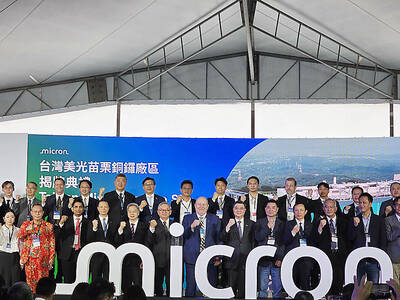
UNPRECEDENTED PACE: Micron Technology has announced plans to expand manufacturing capabilities with the acquisition of a new chip plant in Miaoli Micron Technology Inc unveiled a newly acquired chip plant in Miaoli County yesterday, as the company expands capacity to meet growing demand for advanced DRAM chips, including high-bandwidth memory chips amid the artificial intelligence boom. The plant in Miaoli County’s Tongluo Township (銅鑼), which Micron acquired from Powerchip Semiconductor Manufacturing Corp (力積電) for US$1.8 billion, is expected to make a sizeable capacity contribution to the company from fiscal 2028, the company said in a statement. It would be an extended production site of Micron’s large-scale manufacturing hub in Taichung, the company said. As the global semiconductor industry is racing to reach US$1 trillion

Singapore-based ride-hailing and delivery giant Grab Holdings Ltd has applied for regulatory approval to acquire the Taiwan operations of Germany-based Delivery Hero SE's Foodpanda in a deal valued at about US$600 million. Grab submitted the filing to the Fair Trade Commission on Friday last week, with the transaction subject to regulatory review and approval, the company said in a statement yesterday. Its independent governance structure would help foster a healthy and competitive market in Taiwan if the deal is approved, Grab said. Grab, which is listed on the NASDAQ, said in the filing that US-based Uber Technologies Inc holds about 13 percent of

Taiwan’s food delivery market could undergo a major shift if Singapore-based Grab Holdings Ltd completes its planned acquisition of Delivery Hero SE’s Foodpanda business in Taiwan, industry experts said. Grab on Monday last week announced it would acquire Foodpanda’s Taiwan operations for US$600 million. The deal is expected to be finalized in the second half of this year, with Grab aiming to complete user migration to its platform by the first half of next year. A duopoly between Uber Eats and Foodpanda dominates Taiwan’s delivery market, a structure that has remained intact since the Fair Trade Commission (FTC) blocked Uber Technologies Inc’s

Memory chip stocks extended their losses yesterday after Alphabet Inc’s Google publicized research that could allow more efficient use of the storage needed for artificial intelligence (AI) development. SK Hynix Inc and Samsung Electronics Co, South Korean leaders in the market, fell more than 6 percent and about 5 percent respectively in Seoul. In the US, Micron Technology Inc, Western Digital Corp and Sandisk Corp slid more than 2 percent in pre-market trading, after they all closed lower on Wednesday. Memory companies have been on a tear in recent months as the rapid development of AI infrastructure triggered a spike in chip


 RSS
RSS