


IMF chief Dominique Strauss-Kahn on Thursday said the currencies of China and other emerging economies should play a greater role in global finance, as part of a bid to promote monetary stability.
Strauss-Kahn, the managing director of the 187-nation IMF, backed the inclusion of the yuan in a basket of currencies that makes up the IMF’s Special Drawing Rights (SDR), a type of reserve currency.
Strauss-Kahn also advocated an expanded role for the SDR to help to bolster the monetary system in the face of damaging volatility.
Noting that the only way the world survived the 2008 financial crisis was through extraordinary -international policy cooperation, he said: “Global imbalances are back.”
If the problems were left unresolved, they “could even sow the seeds of the next crisis,” he said.
Such reform would help address the root of those global imbalances and bolster the system’s ability to prevent future crises.
“When we worry about the deficiencies of the international monetary system, we are mostly worrying about volatility: a sense that money sometimes flows around the globe in too volatile a fashion and that countries need a more stable, more predictable external environment in order to prosper,” Strauss-Kahn said.
He said the IMF has been -working to limit that volatility through several approaches: by strengthening coordination of economic and monetary policy, stepping up surveillance of capital flows and improving its financial safety net for member nations in need.
Under a mandate from the G20 developed and emerging economies, representing about 90 percent of global output, the IMF has launched a mutual assessment process that takes into account the global effect of country-level policies.
France, which holds the rotating G20 presidency this year, has put currency reform at the top of its agenda.
Strauss-Kahn’s remarks were his clearest yet showing an alignment with the remedies proposed by French President Nicolas Sarkozy.
As part of a reform toolkit, Strauss-Kahn suggested a central role for SDRs.
“Over time, there may also be a role for the SDR to contribute to a more stable international monetary system,” he said.
A key move would be expanding the SDR basket, which currently includes four major currencies: the US dollar, euro, yen and pound.
“Adding emerging market currencies — such as the renminbi [yuan] — could help the process of internationalization of these currencies, which would benefit the system as a whole,” he said.
The US cautiously welcomed the proposal, but a senior official said the yuan’s status would depend on whether Beijing allows the currency to trade freely.
“It is very important that the currencies in that basket be freely usable and be large in international transactions,” US Treasury Under Secretary Lael Brainard said.
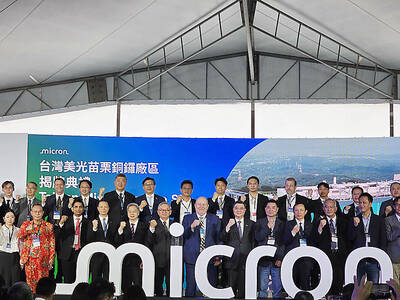
UNPRECEDENTED PACE: Micron Technology has announced plans to expand manufacturing capabilities with the acquisition of a new chip plant in Miaoli Micron Technology Inc unveiled a newly acquired chip plant in Miaoli County yesterday, as the company expands capacity to meet growing demand for advanced DRAM chips, including high-bandwidth memory chips amid the artificial intelligence boom. The plant in Miaoli County’s Tongluo Township (銅鑼), which Micron acquired from Powerchip Semiconductor Manufacturing Corp (力積電) for US$1.8 billion, is expected to make a sizeable capacity contribution to the company from fiscal 2028, the company said in a statement. It would be an extended production site of Micron’s large-scale manufacturing hub in Taichung, the company said. As the global semiconductor industry is racing to reach US$1 trillion

Singapore-based ride-hailing and delivery giant Grab Holdings Ltd has applied for regulatory approval to acquire the Taiwan operations of Germany-based Delivery Hero SE's Foodpanda in a deal valued at about US$600 million. Grab submitted the filing to the Fair Trade Commission on Friday last week, with the transaction subject to regulatory review and approval, the company said in a statement yesterday. Its independent governance structure would help foster a healthy and competitive market in Taiwan if the deal is approved, Grab said. Grab, which is listed on the NASDAQ, said in the filing that US-based Uber Technologies Inc holds about 13 percent of

Taiwan’s food delivery market could undergo a major shift if Singapore-based Grab Holdings Ltd completes its planned acquisition of Delivery Hero SE’s Foodpanda business in Taiwan, industry experts said. Grab on Monday last week announced it would acquire Foodpanda’s Taiwan operations for US$600 million. The deal is expected to be finalized in the second half of this year, with Grab aiming to complete user migration to its platform by the first half of next year. A duopoly between Uber Eats and Foodpanda dominates Taiwan’s delivery market, a structure that has remained intact since the Fair Trade Commission (FTC) blocked Uber Technologies Inc’s

Memory chip stocks extended their losses yesterday after Alphabet Inc’s Google publicized research that could allow more efficient use of the storage needed for artificial intelligence (AI) development. SK Hynix Inc and Samsung Electronics Co, South Korean leaders in the market, fell more than 6 percent and about 5 percent respectively in Seoul. In the US, Micron Technology Inc, Western Digital Corp and Sandisk Corp slid more than 2 percent in pre-market trading, after they all closed lower on Wednesday. Memory companies have been on a tear in recent months as the rapid development of AI infrastructure triggered a spike in chip


 RSS
RSS