


LGD falls on patent suit loss
Shares of LG Display Co (LGD), the world’s second-largest LCD maker, fell the most in two weeks in Seoul trading after a US federal judge ruled that AU Optronics Corp (AUO, 友達光電) didn’t infringe four of the company’s patents.
LGD lost 2.2 percent to 46,850 won (US$42) as of 12:05pm on the Korea Exchange, heading for the biggest drop since April 19. The benchmark Kospi stock index fell 1.2 percent. Hsinchu-based AUO gained 0.3 percent to NT$36.70.
LGD failed “to establish infringement by a preponderance of the evidence,” and AUO “has not established invalidity,” US District Judge Joseph Farnan Jr wrote in a 69-page opinion released in Wilmington, Delaware, on Friday.
The decision came as part of a series of claims and counterclaims in which Seoul-based LGD contended AUO and Taiwan’s Chi Mei Optoelectronics Corp (奇美) infringed its patents.
LGD plans to take action after receiving the final ruling, spokesman Park Sang-bae said by telephone yesterday.
TSMC buys equipment
Taiwan Semiconductor Manufacturing Co (TSMC, 台積電) bought NT$3.3 billion of gear from Applied Materials Inc and three other vendors, the Hsinchu-based company said in exchange filings.
The chipmaker purchased NT$1.1 billion of equipment from Applied Materials South East Asia Pacific Ltd, NT$1 billion of gear from Tokyo Electron Ltd, NT$569 million from Ebara Corp and NT$642 million from Lam Research International Corp, it said in separate filings.
Nan Shan review delayed
The regulatory review of the acquisition of Nan Shan Life Insurance Co (南山人壽) by a Hong Kong-based consortium led by Primus Financial Holding Ltd (博智) and China Strategic Holding (中策) will likely be delayed till July, the Investment Commission said yesterday.
The commission has asked the consortium to submit several supplementary documents before it can initiate the review process, along with the Financial Supervisory Commission and the Council of Labor Affairs.
Brushing aside questions of whether the delay could spell difficulty for the deal to be closed before its July 12 deadline, Nan Shan and Primus Financial said they would immediately submit documents required by the commission to allow the review process to proceed.
NT reverses gains, ends down
The New Taiwan dollar fell in the final two minutes of trading, reversing earlier gains, amid speculation the central bank intervened to combat appreciation that may hurt exporters.
The central bank sold the local currency for US dollars, said two traders who declined to be identified.
The currency has appreciated 1.9 percent this year amid the global economic recovery and optimism that improving ties with China would boost growth. Foreign funds have bought about US$4.3 billion more Taiwanese equities than they sold this year, according to stock exchange data.
“In the past days, the CBC [Central Bank of China] has come in quite frequently,” said Suan Teck Kin, an economist in Singapore at United Overseas Bank Ltd.
Monetary authorities “find the NT dollar has appreciated quite a bit. They are worried about [Taiwan’s] export competitiveness,” the economist said.
The currency weakened 0.3 percent to close at NT$31.519 against its US counterpart, according to Taipei Forex Inc. The currency earlier rose as much as 0.2 percent and last week reached NT$31.269, the strongest level since August 2008. It has weakened in the final two minutes of trading on most of the past 10 days.
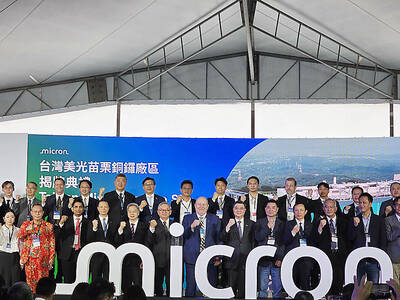
UNPRECEDENTED PACE: Micron Technology has announced plans to expand manufacturing capabilities with the acquisition of a new chip plant in Miaoli Micron Technology Inc unveiled a newly acquired chip plant in Miaoli County yesterday, as the company expands capacity to meet growing demand for advanced DRAM chips, including high-bandwidth memory chips amid the artificial intelligence boom. The plant in Miaoli County’s Tongluo Township (銅鑼), which Micron acquired from Powerchip Semiconductor Manufacturing Corp (力積電) for US$1.8 billion, is expected to make a sizeable capacity contribution to the company from fiscal 2028, the company said in a statement. It would be an extended production site of Micron’s large-scale manufacturing hub in Taichung, the company said. As the global semiconductor industry is racing to reach US$1 trillion

Singapore-based ride-hailing and delivery giant Grab Holdings Ltd has applied for regulatory approval to acquire the Taiwan operations of Germany-based Delivery Hero SE's Foodpanda in a deal valued at about US$600 million. Grab submitted the filing to the Fair Trade Commission on Friday last week, with the transaction subject to regulatory review and approval, the company said in a statement yesterday. Its independent governance structure would help foster a healthy and competitive market in Taiwan if the deal is approved, Grab said. Grab, which is listed on the NASDAQ, said in the filing that US-based Uber Technologies Inc holds about 13 percent of

Taiwan’s food delivery market could undergo a major shift if Singapore-based Grab Holdings Ltd completes its planned acquisition of Delivery Hero SE’s Foodpanda business in Taiwan, industry experts said. Grab on Monday last week announced it would acquire Foodpanda’s Taiwan operations for US$600 million. The deal is expected to be finalized in the second half of this year, with Grab aiming to complete user migration to its platform by the first half of next year. A duopoly between Uber Eats and Foodpanda dominates Taiwan’s delivery market, a structure that has remained intact since the Fair Trade Commission (FTC) blocked Uber Technologies Inc’s

Memory chip stocks extended their losses yesterday after Alphabet Inc’s Google publicized research that could allow more efficient use of the storage needed for artificial intelligence (AI) development. SK Hynix Inc and Samsung Electronics Co, South Korean leaders in the market, fell more than 6 percent and about 5 percent respectively in Seoul. In the US, Micron Technology Inc, Western Digital Corp and Sandisk Corp slid more than 2 percent in pre-market trading, after they all closed lower on Wednesday. Memory companies have been on a tear in recent months as the rapid development of AI infrastructure triggered a spike in chip


 RSS
RSS