


Lawmakers blasted the Financial Supervisory Commission (FSC) yesterday for failing to take solid action to protect investors, who are likely to suffer massive losses from investments linked to bankrupt Wall Street giant Lehman Brothers.
Chinese Nationalist Party (KMT) Legislator Alex Tsai (?⊥迤?? cited comments by a European bank's Taipei branch, which said that domestic banks shouldn't have sold highly complex structured notes to immature domestic investors.
He accused banks of neglecting their clients and urged them to take full responsibility.
He also told the commission to show some teeth and punish banks that capitalize on such investments but fail to clearly explain the risks to buyers.
In response, FSC Chairman Gordon Chen (?單邦) said if banks failed to fulfill their responsibility as distributors, or were found to have misinformed investors, "the FSC would not rule out revoking these banks' wealth management operating licenses."
Commission statistics showed that Taiwanese invested NT$882.8 billion (US$27.64 billion) in structured notes, NT$40 billion of which are linked to Lehman Brothers and might soon turn sour.
To protect investors, Chen said yesterday that the commission would complete its draft of an investor protection bill before the end of the year and submit it for legislative approval in order to set up a mechanism for bond investors to file class action suits against bank issuers.
Democratic Progressive Party (DPP) legislators David Huang (暺???? and Yu Jan-daw (雿???? accused the commission of siding with the banks.
Huang told Chen that Chinatrust Commercial Bank (銝剖?靽∟????) still distributed Lehman Brothers-issued structured notes to investors late last month, with the settlement date set at Sept. 8 but then immediately froze the redemption of such notes.
Chen Yu-shu (?喟?璅?, a 37-year-old investor, accused Chinatrust of fraud yesterday.
He told the Taipei Times he was persuaded by one of the bank's fund managers to convert his NT$6 million deposits into structured notes, which the manager said were fully guaranteed and offered better interest rates.
Chen said he only found out recently that he was unlikely to recover any cash from his NT$1 million investment in structured notes linked to Lehman Brothers, while his other NT$5 million investments had suffered about a 20 percent loss.
A Chinatrust vice president, who declined to be named, said he believed that the bank's fund managers had been fully advised to inform investors of potential losses prior to investment purchases.
However, the bank will take full responsibility if some managers were found to be overly anxious in closing deals and failed to fulfill their role as financial consultants, the Chinatrust official said by telephone yesterday.
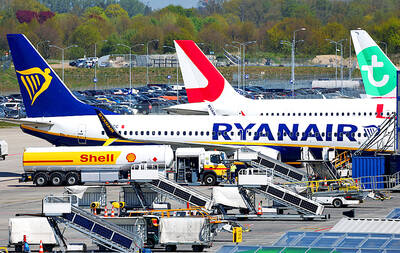
Ryanair, Transavia, Volotea and other low-cost airlines are feeling the financial pain from high jet fuel prices as a result of the Middle East war and are cutting flights. The closure of the Strait of Hormuz has taken a huge chunk of oil supplies off the market, sending the price of jet fuel soaring and triggering fears of shortages that could force airlines to cancel flights. Airlines are not waiting for a lack of supplies to react. “Travel alert: Airlines are cutting thousands of flights right now,” Travel Therapy host Karen Schaler said in an Instagram reel this past weekend.
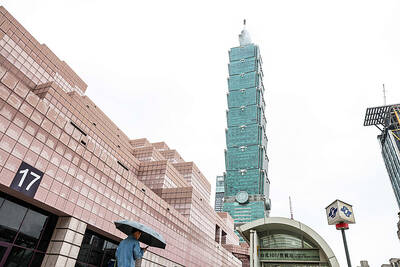
MANAGING RISKS: Taiwan has secured LNG sufficient to cover 95 percent of electricity demand for next month, UBS said, describing the government’s approach as proactive UBS Group AG has raised its forecast for Taiwan’s economic growth this year to 8 percent, up from 6.9 percent previously, and said expansion could reach as high as 8.6 percent if external energy shocks are avoided. The upgrade reflects a stronger-than-expected first-quarter performance and sustained momentum in artificial intelligence (AI)-driven exports, which UBS said are providing a firm foundation for growth despite geopolitical and energy risks. Taiwan’s GDP expanded 13.69 percent year-on-year in the first quarter, the fastest growth since the second quarter of 1987, the Directorate-General of Budget, Accounting and Statistics (DGBAS) reported on Thursday. On a seasonally
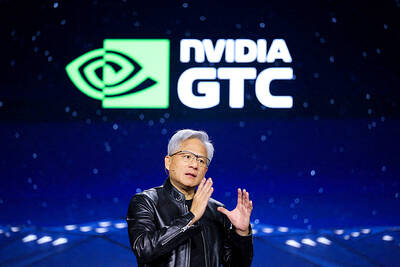
The list of Asian stocks that benefit from business partnership with Nvidia Corp is getting longer, as the region further integrates into the artificial intelligence (AI) chip giant’s business ecosystem. Just in the past week, South Korea’s LG Electronics Inc, Taiwan’s Nanya Technology Corp (南亞科技), as well as China’s Huizhou Desay SV Automotive Co (德賽西威) and Pateo Connect Technology Shanghai Corp (博泰車聯) have become the latest to rally on news of tie-ups, supply-chain participation or product collaboration with the US chip designer. Asian suppliers account for about 90 percent of Nvidia’s production costs, up from about 65 percent last year, data compiled
The Fair Trade Commission’s (FTC) ongoing review of Grab Holdings Ltd’s US$600 million acquisition of Foodpanda Taiwan’s operations, announced on March 23, has taken on fresh urgency as industry experts warn that the transaction could embed significant Chinese cybersecurity vulnerabilities into Taiwan’s digital infrastructure through Grab’s deep ties to autonomous-driving firm WeRide (文遠知行). Less than 16 months after the FTC blocked Uber Eats’ direct attempt to acquire Foodpanda Taiwan — citing potential combined market shares of 80 to 90 percent — the emergence of Grab as the buyer has prompted questions about whether the same competitive harm is simply being rerouted


 RSS
RSS