


3Com Corp, an unprofitable computer networking company, said on Friday that it had agreed to be acquired by Bain Capital Partners for US$2.2 billion in cash in an arrangement that also gives Chinese company Huawei Technologies Co (華為科技) a minority stake in the firm.
The deal means the end of an era for a storied Silicon Valley company that has stumbled in recent years in the face of more nimble competitors like Cisco Systems Inc and Nortel Networks Corp.
It also provides yet another test case for Washington lawmakers wary of high-technology deals with Chinese companies that they think could compromise US security.
3Com president and chief executive Edgar Masri said that the buyout would help make 3Com more competitive.
"Going private will give us more flexibility," he said. "We will be able to focus on our long-term strategic objectives."
Mark Sue, an analyst with RBC Capital, said 3Com had "struggled with execution and inconsistency" for so long that he doubted going private would solve its problems.
"Battling a strong Cisco in the enterprise may prove increasingly difficult," Sue said in a research note on Friday.
He said Huawei appeared to have the most to gain from the deal.
Under the terms of the deal, 3Com shareholders will receive US$5.30 in cash for each share of 3Com stock, a premium of about 44 percent over 3Com's US$3.68 closing price on Thursday. 3Com shares rallied US$1.26 a share, or 34 percent, to close at US$4.94. The deal, if approved, is expected to close in the first quarter of next year.
3Com executives said the size of Huawei's stake in the company would be disclosed in a few weeks.
Late last year, 3Com spent US$822 million to buy Huawei's share of a joint venture between the companies. 3Com and Huawei had formed the venture, known as H3C, in 2003 to broaden 3Com's reach in Asian markets while giving Huawei access to US customers.
Masri said the company had considered competing offers from several other companies, but selected Bain in part because of its experience in Asia. 3Com employs 6,000 people, most of them in Asia.
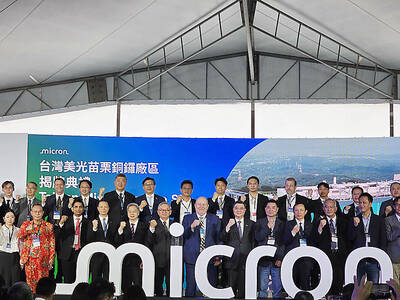
UNPRECEDENTED PACE: Micron Technology has announced plans to expand manufacturing capabilities with the acquisition of a new chip plant in Miaoli Micron Technology Inc unveiled a newly acquired chip plant in Miaoli County yesterday, as the company expands capacity to meet growing demand for advanced DRAM chips, including high-bandwidth memory chips amid the artificial intelligence boom. The plant in Miaoli County’s Tongluo Township (銅鑼), which Micron acquired from Powerchip Semiconductor Manufacturing Corp (力積電) for US$1.8 billion, is expected to make a sizeable capacity contribution to the company from fiscal 2028, the company said in a statement. It would be an extended production site of Micron’s large-scale manufacturing hub in Taichung, the company said. As the global semiconductor industry is racing to reach US$1 trillion

Singapore-based ride-hailing and delivery giant Grab Holdings Ltd has applied for regulatory approval to acquire the Taiwan operations of Germany-based Delivery Hero SE's Foodpanda in a deal valued at about US$600 million. Grab submitted the filing to the Fair Trade Commission on Friday last week, with the transaction subject to regulatory review and approval, the company said in a statement yesterday. Its independent governance structure would help foster a healthy and competitive market in Taiwan if the deal is approved, Grab said. Grab, which is listed on the NASDAQ, said in the filing that US-based Uber Technologies Inc holds about 13 percent of

Taiwan’s food delivery market could undergo a major shift if Singapore-based Grab Holdings Ltd completes its planned acquisition of Delivery Hero SE’s Foodpanda business in Taiwan, industry experts said. Grab on Monday last week announced it would acquire Foodpanda’s Taiwan operations for US$600 million. The deal is expected to be finalized in the second half of this year, with Grab aiming to complete user migration to its platform by the first half of next year. A duopoly between Uber Eats and Foodpanda dominates Taiwan’s delivery market, a structure that has remained intact since the Fair Trade Commission (FTC) blocked Uber Technologies Inc’s

Memory chip stocks extended their losses yesterday after Alphabet Inc’s Google publicized research that could allow more efficient use of the storage needed for artificial intelligence (AI) development. SK Hynix Inc and Samsung Electronics Co, South Korean leaders in the market, fell more than 6 percent and about 5 percent respectively in Seoul. In the US, Micron Technology Inc, Western Digital Corp and Sandisk Corp slid more than 2 percent in pre-market trading, after they all closed lower on Wednesday. Memory companies have been on a tear in recent months as the rapid development of AI infrastructure triggered a spike in chip


 RSS
RSS