


Fujitsu Taiwan Ltd launched its first ultra-mobile PC (UMPC) model in Taiwan yesterday, following launches in other Asia-Pacific markets, hoping the machine will make a splash in the region.
"Mobile users now need a portable computer that offers them full computing power, but in a smaller package," said Hanson Yap (葉瀚升), Fujitsu's product manager for the Asia-Pacific.
Sales, insurance and media executives who are always on the go are a good fit for UMPCs, which should meet their needs to connect to back-end office systems, he told reporters at a product launch yesterday.
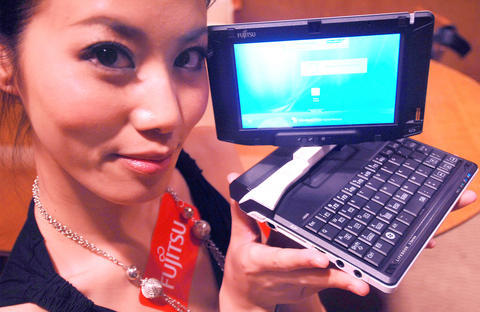
PHOTO: AFP
UMPCs are super-portable, fully featured computers similar to notebooks. But with a standard 7-inch touch screen, they are roughly the size of a paperback and weigh less than 1kg.
The uptake of UMPCs will be slow, said Aaron Kok (
"Performance of the smaller processors may not be on par with those used in normal notebooks and short battery life is another headache," said Kok, who reviewed Asustek Computer Inc's (華碩電腦) R2H, AMtek System Co's (奐億科技) T700 and Sony Corp's Vaio UX17.
"But it is still appealing to some as it is small, giving users an easy platform to surf the Internet anywhere," he said.
The Fujitsu LifeBook U1010, introduced yesterday, measures 5.6 inches and weighs just more than 0.5kg.
Despite its petite shape, the "mini powerhouse" can handle operations such as movie playback, Internet surfing, music listening, video-conferencing and Internet telephony.
With a retail price of NT$46,800 (US$1,400), the U1010 is expected to hit local shelves by the end of this month.
The company is confident it will sell approximately 500 units a month in the local market alone, Fujitsu product manager Frank Hsieh (
The UMPC received an overwhelming response, with the first-batch of 500 units selling out within two weeks after the launch in Hong Kong last month, Hsieh said.
"Judging from the positive feedback from Asian markets, sales of the U1010 could easily hit 4,000 units a month in Asia," he said.
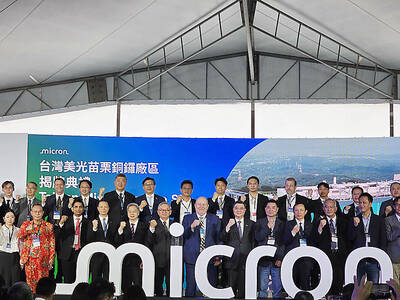
UNPRECEDENTED PACE: Micron Technology has announced plans to expand manufacturing capabilities with the acquisition of a new chip plant in Miaoli Micron Technology Inc unveiled a newly acquired chip plant in Miaoli County yesterday, as the company expands capacity to meet growing demand for advanced DRAM chips, including high-bandwidth memory chips amid the artificial intelligence boom. The plant in Miaoli County’s Tongluo Township (銅鑼), which Micron acquired from Powerchip Semiconductor Manufacturing Corp (力積電) for US$1.8 billion, is expected to make a sizeable capacity contribution to the company from fiscal 2028, the company said in a statement. It would be an extended production site of Micron’s large-scale manufacturing hub in Taichung, the company said. As the global semiconductor industry is racing to reach US$1 trillion

Singapore-based ride-hailing and delivery giant Grab Holdings Ltd has applied for regulatory approval to acquire the Taiwan operations of Germany-based Delivery Hero SE's Foodpanda in a deal valued at about US$600 million. Grab submitted the filing to the Fair Trade Commission on Friday last week, with the transaction subject to regulatory review and approval, the company said in a statement yesterday. Its independent governance structure would help foster a healthy and competitive market in Taiwan if the deal is approved, Grab said. Grab, which is listed on the NASDAQ, said in the filing that US-based Uber Technologies Inc holds about 13 percent of

Taiwan’s food delivery market could undergo a major shift if Singapore-based Grab Holdings Ltd completes its planned acquisition of Delivery Hero SE’s Foodpanda business in Taiwan, industry experts said. Grab on Monday last week announced it would acquire Foodpanda’s Taiwan operations for US$600 million. The deal is expected to be finalized in the second half of this year, with Grab aiming to complete user migration to its platform by the first half of next year. A duopoly between Uber Eats and Foodpanda dominates Taiwan’s delivery market, a structure that has remained intact since the Fair Trade Commission (FTC) blocked Uber Technologies Inc’s

Memory chip stocks extended their losses yesterday after Alphabet Inc’s Google publicized research that could allow more efficient use of the storage needed for artificial intelligence (AI) development. SK Hynix Inc and Samsung Electronics Co, South Korean leaders in the market, fell more than 6 percent and about 5 percent respectively in Seoul. In the US, Micron Technology Inc, Western Digital Corp and Sandisk Corp slid more than 2 percent in pre-market trading, after they all closed lower on Wednesday. Memory companies have been on a tear in recent months as the rapid development of AI infrastructure triggered a spike in chip


 RSS
RSS