


With prices of liquid-crystal-display (LCD) panels seeing a gradual drop, Fitch Ratings yesterday said more mergers and acquisitions (M&As) are likely to happen among second-tier panel makers as they seek to increase economies of scale.
"With the declining trend in panel prices, we expect more challenges for the lagging companies to keep pace with the frontrunners," Kevin Chang (張崇人), associate director for corporate affairs in the Asia-Pacific region, told reporters.
These mid-level makers have a more restrained product mix and lower capital spending to fund the establishment of newer factories, and therefore will feel the pressure as panel prices are declining, he added.
"They'll have to resort to M&As for survival, or they'll need to find a niche product line other than the common notebooks or monitors to ensure competitiveness," he said.
Those who can satisfactorily address product mix, cost management and client needs will be the best positioned to maintain their lead, he said.
LCD panel prices for notebooks, monitors and laptops have shown a gradual decrease in recent years, while experiencing a drastic drop in 2004, he said.
"Electronics products are not necessities and purchasing decisions vary from time to time, being mainly dependent on lower price tags," Chang said.
The nation's second-tier panel makers, such as Hannstar Display (瀚宇彩晶) and Chunghwa Picture Tubes Ltd (中華映管), have been feeling the heat since AU Optronics Corp (友達光電), the world's third-biggest LCD maker, announced plans to merge with the smaller player Quanta Display Inc (廣輝電子) on April 7.
The combined entity will create an LCD panel supplier whose market share could potentially exceed that of leaders Samsung Electronics Co and LG Philips LCD Co, according to iSuppli Corp.
In terms of Chi Mei Optoelectronics Corp (
Fitch Ratings also said that LCD TVs will be the new cash cow for panel makers to jump onto.
"As most countries are making a push to switch from analog TV broadcasting to digital between next year and 2012, LCD televisions will enjoy greater popularity among households," Chang said.
DisplaySearch forecasted that LCD penetration in television displays will rise to 46 percent in 2009, from 22 percent this year.
Meanwhile, iSuppli said in a report last Thursday that makers of plasma displays, which rival LCDs, are also being hindered.
"Profitability has been challenging for the majority of plasma-display makers, despite rising consumer uptake of plasma TV sets," the report said.
"Multiple factors are driving consolidation in the market, including swiftly declining panel prices, slower sales growth and increasing competition with alternative technologies in the large-screen TV market," it said.


ENERGY ISSUES: The TSIA urged the government to increase natural gas and helium reserves to reduce the impact of the Middle East war on semiconductor supply stability Chip testing and packaging service provider ASE Technology Holding Co (日月光投控) yesterday said it planned to invest more than NT$100 billion (US$3.15 billion) in building a new advanced chip testing facility in Kaohsiung to keep up with customer demand driven by the artificial intelligence (AI) boom. That would be included in the company’s capital expenditure budget next year, ASE said. There is also room to raise this year’s capital spending budget from a record-high US$7 billion estimated three months ago, it added. ASE would have six factories under construction this year, another record-breaking number, ASE chief operating officer Tien Wu

The EU and US are nearing an agreement to coordinate on producing and securing critical minerals, part of a push to break reliance on Chinese supplies. The potential deal would create incentives, such as minimum prices, that could advantage non-Chinese suppliers, according to a draft of an “action plan” seen by Bloomberg. The EU and US would also cooperate on standards, investments and joint projects, as well as coordinate on any supply disruptions by countries like China. The two sides are additionally seeking other “like-minded partners” to join a multicountry accord to help create these new critical mineral supply chains, which feed into

For weeks now, the global tech industry has been waiting for a major artificial intelligence (AI) launch from DeepSeek (深度求索), seen as a benchmark for China’s progress in the fast-moving field. More than a year has passed since the start-up put Chinese AI on the map in early last year with a low-cost chatbot that performed at a similar level to US rivals. However, despite reports and rumors about its imminent release, DeepSeek’s next-generation “V4” model is nowhere in sight. Speculation is also swirling over the geopolitical implications of which computer chips were chosen to train and power the new
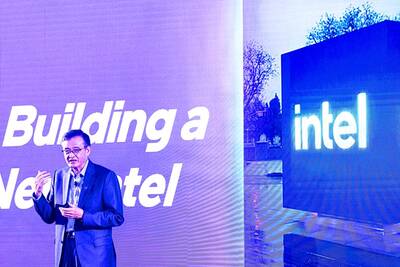
Intel Corp is joining Elon Musk’s long-shot effort to develop semiconductors for Tesla Inc, Space Exploration Technologies Corp and xAI, marking a surprising twist in the chipmaker’s comeback bid. Intel would help the Terafab project “refactor” the technology in a chip factory, the company said on Tuesday in a post on X, Musk’s social media platform. That is a stage in the development process that typically helps make chips more powerful or reliable. The chipmaker’s shares jumped 4.2 percent to US$52.91 in New York trading on Tuesday. The Terafab project is a grand plan by Musk to eventually manufacture his own chips for


 RSS
RSS