


Wall Street concluded a mixed week on Friday with the market debating the direction of stocks amid conflicting economic signals.
Over a holiday-shortened week, the Dow Jones Industrial Average of 30 blue chips fell 0.48 percent to 11,061.85.
The broad-market Standard & Poor's 500 index managed a weekly gain of 0.17 percent to 1,289.43 and the tech-heavy NASDAQ composite added 0.21 percent to 2,287.04.

PHOTO: AFP
Hugh Johnson, chief investment officer at Johnson Illington Advisors, said he sees the rally that started in January as on track -- but with some risks.
"The performance of the financial markets continues to be bullish. That is, the financial markets continue to signal that the current stock market/economic/interest rate cycle has further to go," he said in a note to clients.
But he said the market is confused by mixed economic signals and this leaves the outlook for interest rates uncertain.
One sign of this confusion is the inversion of the yield curve on the bond market, in which short-term rates are higher than long-term rates, which often signals an economic slowdown.
The inversion flies in the face of upbeat economic data and a bullish stock market outlook.
"We are concerned that the Federal Reserve will be seduced by concerns about inflation into raising short-term interest rates too high and causing a turndown in both the stock market and the economy," Johnson said.
"This risk, more than any other risk, is a reason we should not be in a hurry to dismiss as irrelevant the yield curve."
Johnson said that if the Fed lifts its key rate from the current level of 4.5 percent to 5 percent, it may be difficult to make a case for a stronger stock market.
Anderson and Strudwick analyst Kent Engelke said he believes the strong economic data have been skewed by unseasonably warm weather, overstating the risk of inflation and pushing the Fed to a more hawkish stand on rates.
"A concern that we harbor is that economic activity slows because of an overly aggressive Federal Reserve," he said.
The recent Wall Street rally has still not convinced many skeptics.
"The market has been in a rotational uptrend for the past three years, which is confusing, as not all stocks are moving in the same direction at the same time," said Bob Dickey at RBC Dain Rauscher.
Dickey said the market "continues to struggle" in its trading range, but he sees a positive if unexciting trend.
"Now, the market appears to be back to normal and on track for some relatively modest gains within an average yearly cycle," he said. "The current trend of sector rotation seems to be keeping a stronger general market trend from developing in either direction."
Bonds fell over the past week. The yield on the 10-year US Treasury bond rose to 4.567 percent from 4.541 percent and that on the 30-year bond increased to 4.515 percent from 4.512 percent. Bond yields and prices move in opposite directions.

NEW MARKET: The partnership opens up India to the Dutch company, which already has a strong hold in the semiconductor market of South Korea, Taiwan and China ASML Holding NV entered into a partnership agreement with Tata Electronics Pvt Ltd aimed at ramping up India’s goal to develop domestic chip-manufacturing capabilities. The Dutch company’s technology would help power Tata Electronics’ planned 300 millimeter (mm) semiconductor foundry in Gujarat, according to a joint statement from the two companies on Saturday. The signing of a memorandum of understanding coincides with a visit by Indian Prime Minister Narendra Modi to the Netherlands, which is looking to deepen bilateral relations with New Delhi. ASML, whose top customers include Taiwan Semiconductor Manufacturing Co (台積電) and Samsung Electronics Co, makes lithography machines that can print

Tokyo Electron's Taiwan unit today said in a written response that it respects the judicial process, takes the court ruling seriously and would not appeal in the Taiwan Semiconductor Manufacturing Co (TSMC, 台積電) trade secrets case. Last month, a court fined the Taiwan unit of Japan's Tokyo Electron NT$150 million (US$4.74 million) in a case involving trade secrets related to TSMC's sensitive chip technology.
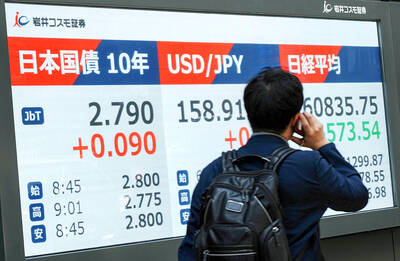
ROUGH RECORDS: Bonds in Japan, as well is in New Zealand, Australia and the US, are seeing the effects of a nervy market as stock exchanges across Asia edge down A deepening slump in Japanese government bonds added fuel to the selloff in global debt markets as rising oil prices stoked inflation fears and pushed yields to multi-decade highs. Japan’s 30-year yield yesterday surged as much as 20 basis points to the highest level since the tenor’s debut in 1999, before paring some of the move. Shorter-maturity Japanese debt was also under pressure, underscored by weak demand at a sale of five-year notes that offered a record-high coupon of 2 percent. Concerns over inflation and government spending rippling through markets including the US, Australia and New Zealand are being amplified in Japan,
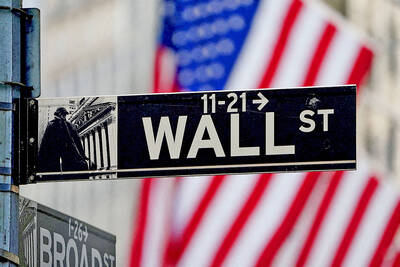
Wall Street is licking its chops over an unprecedented slate of massive initial public offerings (IPOs) set to arrive in the coming months, beginning with Elon Musk’s Space Exploration Technologies Corp (SpaceX) next month. That is expected to be followed by artificial intelligence (AI) rivals OpenAI and Anthropic PBC. The trio of mega listings, each eyeing valuations around US$1 trillion or more, constitutes a heady period of elevated risk and reward. SpaceX is targeting an IPO that would raise up to US$80 billion — about double the funds generated from all IPOs last year. OpenAI and Anthropic are eyeing IPOs raising US$60 billion. “We’re


 RSS
RSS