


Buying a house just before the Lunar New Year is considered a good way to enjoy the new year as the move indicates "settling down." However, homebuyers need not rush this year, as they can wait for better deals when the second quarter comes around with an expected onslaught of a wide range of new residential properties, market watchers suggested.
"This is a good year for both homebuyers and investors," said Lin Yung-meng (
The nation's housing market saw an oversupply last year -- about 130 percent more from that in 2004, Lin said, citing company statistics. With more newly completed properties slated to hit the market starting in the second quarter, supply will again far exceed demand, which means consumers will have better bargaining power, he said.
While the oversupply implies more room for negotiating prices, Lin warned that it does not mean that property prices will be very low. Rather, they will be comparatively low this year.
As the costs of land and construction materials have shown no signs of easing, property developers will likely pass on the cost to buyers in the form of higher selling prices, especially for new and presale properties, Lin said.
According to the latest report of Evertrust Rehouse (
The second highest selling prices can be found on the outskirts of Taipei City, such as Shihlin, Beitou and Neihu, where properties average NT$300,000 per ping, according to the report.
Supported by the expected completion of the extension of the mass rapid transport (MRT) system into Taipei County areas such as Banciao, Jhonghe and Sindian, housing prices in these locations have also climbed to more than NT$200,000 per ping, or even up to NT$300,000, a 16 percent jump from a year ago, the report said.
The slew of new properties is expected to trigger a wave of home replacement, which is expected to be a major driver of market demand this year, he said.
Diverse choice
A wide array of products to meet various demands is another feature of this year's housing market.
For high-income individuals who are looking for bigger and classier residences in Taipei City, they can choose from a variety of luxurious properties of over 50 pings that sell above NT$600,000 per ping. A prime example of this is The Palace on Renai Road, which brandishes the ultimate in sumptuous living and is priced at an astounding NT$1 million per ping.
For white-collar workers who are seeking single apartments in the city, 10 to 15 ping condominiums are available. Though the condominiums are tagged at about NT$400,000 per ping, this type of property is very popular as the units usually come with free interior decoration and furnishings.
For retirees that prefer a more peaceful and leisurely life, villas in the Taipei suburbs that offer beautiful mountain or river views -- some of which are even equipped with hot springs -- can be acquired at NT$200,000 per ping.
Mild growth
Overall, with the economy projected to see a mild expansion from last year, along with an expected halt in interest rate hikes, property sales are projected to mark a slight improvement this year.
According to the government's statistics bureau, Taiwan's GDP growth is expected to recover to 4.08 percent this year, from an estimated 3.8 percent last year.
The central bank raised its benchmark interest rate four times last year with the last hike in December bringing the rediscount rate charged to commercial lenders to 2.25 percent.
As the US Federal Reserve's rate increases seem to have come to a halt, Taiwan may follow suit, an incentive for home buyers to make their purchases this year.
The scheduled completion of several transportation lines -- including the high-speed railway, MRT system to Tucheng and Banciao in Taipei County, Sijhih Viaduct and Taipei-Ilan Freeway -- may also drive up buying along the lines, Lin said.
political influence
One potentially big impetus for the market is the easing of restrictions on major cross-strait policies, said Yeh Ling-chi (
The government was mulling allowing Chinese tourists to visit at the end of last year, as well as facilitating direct cross-strait transportation, and even opening up to Chinese investment in the nation.
Should these policies be implemented, the property market, both residential and commercial sectors, will boom due to the huge demand, Yeh said.
Grade A office space in Taipei City's Xinyi District, Dunhua circle and Minsheng area will benefit from the policies in terms of take-ups and rents, Yeh said, adding that the value of residential properties around the commercial sections, such as Songshan, Neihu and Nankang Districts, will also surge significantly.
However, the expected easing of the ban appears distant now, after President Chen Shui-bian's
"Cross-strait relations have become the key to determining the performance of Taiwan's stock and property markets this year," Yeh said.
Another factor that may weigh on the market are the year-end mayoral elections.
Similar to last year's campaign frenzy for local government posts which dampened the property market, the mayoral contests in Taipei and Kaohsiung cities are expected to have the same effect, Sinyi's Lin said.
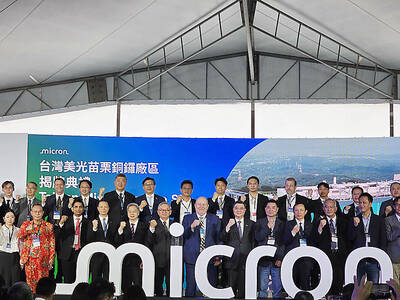
UNPRECEDENTED PACE: Micron Technology has announced plans to expand manufacturing capabilities with the acquisition of a new chip plant in Miaoli Micron Technology Inc unveiled a newly acquired chip plant in Miaoli County yesterday, as the company expands capacity to meet growing demand for advanced DRAM chips, including high-bandwidth memory chips amid the artificial intelligence boom. The plant in Miaoli County’s Tongluo Township (銅鑼), which Micron acquired from Powerchip Semiconductor Manufacturing Corp (力積電) for US$1.8 billion, is expected to make a sizeable capacity contribution to the company from fiscal 2028, the company said in a statement. It would be an extended production site of Micron’s large-scale manufacturing hub in Taichung, the company said. As the global semiconductor industry is racing to reach US$1 trillion

Singapore-based ride-hailing and delivery giant Grab Holdings Ltd has applied for regulatory approval to acquire the Taiwan operations of Germany-based Delivery Hero SE's Foodpanda in a deal valued at about US$600 million. Grab submitted the filing to the Fair Trade Commission on Friday last week, with the transaction subject to regulatory review and approval, the company said in a statement yesterday. Its independent governance structure would help foster a healthy and competitive market in Taiwan if the deal is approved, Grab said. Grab, which is listed on the NASDAQ, said in the filing that US-based Uber Technologies Inc holds about 13 percent of

Taiwan’s food delivery market could undergo a major shift if Singapore-based Grab Holdings Ltd completes its planned acquisition of Delivery Hero SE’s Foodpanda business in Taiwan, industry experts said. Grab on Monday last week announced it would acquire Foodpanda’s Taiwan operations for US$600 million. The deal is expected to be finalized in the second half of this year, with Grab aiming to complete user migration to its platform by the first half of next year. A duopoly between Uber Eats and Foodpanda dominates Taiwan’s delivery market, a structure that has remained intact since the Fair Trade Commission (FTC) blocked Uber Technologies Inc’s

Memory chip stocks extended their losses yesterday after Alphabet Inc’s Google publicized research that could allow more efficient use of the storage needed for artificial intelligence (AI) development. SK Hynix Inc and Samsung Electronics Co, South Korean leaders in the market, fell more than 6 percent and about 5 percent respectively in Seoul. In the US, Micron Technology Inc, Western Digital Corp and Sandisk Corp slid more than 2 percent in pre-market trading, after they all closed lower on Wednesday. Memory companies have been on a tear in recent months as the rapid development of AI infrastructure triggered a spike in chip


 RSS
RSS