


This much is true in the copper market: Prices are at record highs, and there is a Chinese trader named Liu Qibing (
Swirling around those two certainties are rumors and innuendo that have buffeted a market already prone to fluctuating on whispers, let alone fact.
Did Liu, a trader for China's State Reserve Bureau, make wrong-footed bets that copper prices would fall? Some traders and brokers believe it, and they estimate covering Liu's "short" positions -- in which a trader borrows a commodity and then sells it with the hope of buying it at a lower price and then returning it -- could cost the bureau hundreds of millions of dollars.
Or did China execute a commodities-trading head fake, driving up the price so it could sell stockpiles of copper at a greater profit, as some other traders believe?
And is Liu missing, as several reports have said, or is he about to be promoted?
disparities
The wide disparities in the reports about Liu, which surfaced at the beginning of the week, highlight how little factual information is available for the market. But that has not stopped people from buying copper.
In London, contracts for delivery in three months rose US$55, or 1.3 percent, to US$4,200 a metric ton after reaching a record US$4,243. In New York, copper for delivery next month rose 3.2 cents, or 1.6 percent, to US$1.978 a pound, the seventh consecutive record.
The normally tight-lipped officials responsible for overseeing China's commodity trading appeared to try to clear things up this week and started to make public statements about the country's copper stockpiles and Liu. But some traders and other market participants say this is further confusing the issue, because they suspect that the Chinese are supplying false information in a deliberate attempt to move prices.
The government-controlled China Daily identified Liu on Thursday as the import division chief of the National Control Center for the Reserve Bureau, which manages China's commodities reserves, and said he had built a "massive short position" in copper. Liu sold short 110,000 to 220,000 tonnes of copper, which need to be delivered to London Metal Exchange warehouses by Dec. 21, the paper said. By comparison, the current inventory of the exchange's warehouses is about 140,000 tonnes. Liu acted alone, the paper said, and the government is not responsible for his actions. Maqsood Ahmed, an analyst at Calyon Global Trading in London, is one of several market participants who do not accept the report as the full truth. Like many others in London, he has heard that Liu will return to his job next week at a higher level. Ahmed thinks that Liu may have executed the "greatest bluff of all time" by driving prices up.
"The whole thing about a short position is a smoke screen" to keep prices high so the Chinese can unload their considerable stockpiles of copper, amassed in recent years, at peak prices, Ahmed asserts. The State Reserve Bureau declined to comment about Liu's whereabouts, the short position or the amount of copper it may have stockpiled.
Ahmed, who has been an outspoken critic of copper's high prices in recent months, was quick to add that his theory could be wrong. In fact, the only thing most market participants in London say they are sure of is that they do not know precisely where China stands in the market.
"Most of us don't know the full details or the size of any Chinese positions or if the positions exist at all," said Jeremy Goldwyn, head of industrial commodities at Sucden, a London commodities broker that has no business relationship with the State Reserve Bureau. "The only people who know for sure are the brokers involved," he said.
The brokers who executed Liu's trades and who may be stuck with his losses if the Chinese government refuses to pay or deliver copper to cover them, if they exist, have been silent. Several participants in the market say the Standard Bank of South Africa and Sempra Energy, based in San Diego, hold at least some of the contracts. Spokeswomen from Standard and Sempra declined to comment on the issue.
Obtaining reliable information in the market, particularly about closely guarded end users like the Chinese, is impossible, participants say.
"You can only speculate on what's been published and whether it's true or not," added one London metals broker, who spoke on the condition of anonymity because he is not authorized to comment to the news media.
terrified
Other copper end-users, the manufacturers who actually need the physical product and are generally active in the futures market, are terrified to trade at all, the broker said, because they have no idea whether the market will plummet or continue its ascent.
In a sign of the market's hair-trigger jumpiness, prices dropped US$90 in five minutes on Wednesday, traders said, after Reuters, citing a bureau official, said the bureau was moving to export 200,000 tonnes of copper.
After the decline, some traders quickly decided the Chinese government was spreading that information to drive prices down, perhaps to cover Liu's short position, and drove it up instead by the close of the market.
"If you were going to export that much, why would you let the market know?" the broker said.
Whatever happens to Liu, analysts expect the market to be bumpy toward the end of the year.
Copper and other commodities, once niche investments, have become more mainstream in recent years, attracting money from pension and mutual funds. If China is vulnerable to losses, it may provide a painful reminder that commodities were niche investments for a reason -- they can be much more risky and volatile than stocks.
"There is a potential for larger declines in commodity markets than on a normal stock exchange," said Neil Buxton, an analyst with GFMS Metals Consulting in London.
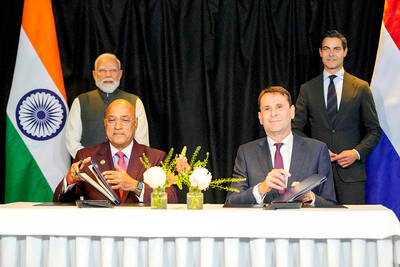
NEW MARKET: The partnership opens up India to the Dutch company, which already has a strong hold in the semiconductor market of South Korea, Taiwan and China ASML Holding NV entered into a partnership agreement with Tata Electronics Pvt Ltd aimed at ramping up India’s goal to develop domestic chip-manufacturing capabilities. The Dutch company’s technology would help power Tata Electronics’ planned 300 millimeter (mm) semiconductor foundry in Gujarat, according to a joint statement from the two companies on Saturday. The signing of a memorandum of understanding coincides with a visit by Indian Prime Minister Narendra Modi to the Netherlands, which is looking to deepen bilateral relations with New Delhi. ASML, whose top customers include Taiwan Semiconductor Manufacturing Co (台積電) and Samsung Electronics Co, makes lithography machines that can print

Tokyo Electron's Taiwan unit today said in a written response that it respects the judicial process, takes the court ruling seriously and would not appeal in the Taiwan Semiconductor Manufacturing Co (TSMC, 台積電) trade secrets case. Last month, a court fined the Taiwan unit of Japan's Tokyo Electron NT$150 million (US$4.74 million) in a case involving trade secrets related to TSMC's sensitive chip technology.
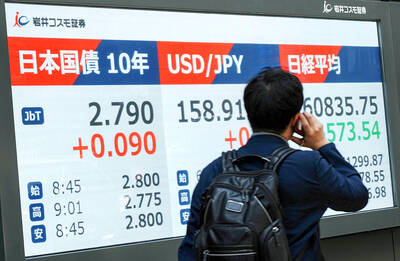
ROUGH RECORDS: Bonds in Japan, as well is in New Zealand, Australia and the US, are seeing the effects of a nervy market as stock exchanges across Asia edge down A deepening slump in Japanese government bonds added fuel to the selloff in global debt markets as rising oil prices stoked inflation fears and pushed yields to multi-decade highs. Japan’s 30-year yield yesterday surged as much as 20 basis points to the highest level since the tenor’s debut in 1999, before paring some of the move. Shorter-maturity Japanese debt was also under pressure, underscored by weak demand at a sale of five-year notes that offered a record-high coupon of 2 percent. Concerns over inflation and government spending rippling through markets including the US, Australia and New Zealand are being amplified in Japan,
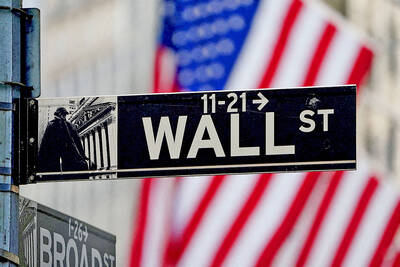
Wall Street is licking its chops over an unprecedented slate of massive initial public offerings (IPOs) set to arrive in the coming months, beginning with Elon Musk’s Space Exploration Technologies Corp (SpaceX) next month. That is expected to be followed by artificial intelligence (AI) rivals OpenAI and Anthropic PBC. The trio of mega listings, each eyeing valuations around US$1 trillion or more, constitutes a heady period of elevated risk and reward. SpaceX is targeting an IPO that would raise up to US$80 billion — about double the funds generated from all IPOs last year. OpenAI and Anthropic are eyeing IPOs raising US$60 billion. “We’re


 RSS
RSS