


MG Rover Group arrived at the end of the road as administrators for the stricken company -- Britain's last major car manufacturer -- said they intend to break it up, laying off 5,000 workers, after the Shanghai Automotive Industry Corp (SAIC) made clear it was not interested in a joint venture.
Rover's downfall was precipitated by the failure of talks with China's state-owned SAIC about a joint venture, and renewing the negotiations had been seen as the best chance of saving the company and the jobs of some 6,100 workers at its Longbridge factory in central England.
PricewaterhouseCoopers (PwC), which was appointed to oversee the company's future after it closed the plant and filed for a form of bankruptcy a week ago, said there was now no prospect of a sale of the company as a going concern to SAIC or anybody else.
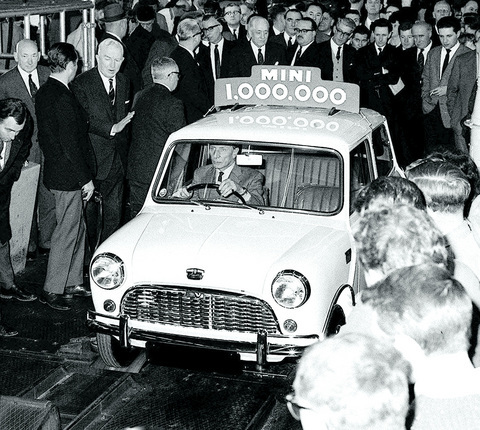
PHOTO: EPA
The resulting loss of jobs at Rover, and among 18,000 other workers at companies who supply parts to the automaker, is a development that could not come at a worse time for the British government, just weeks ahead of a general election.
"We'll explore what we would describe as the break-up of the business, we will carry on with the interested parties who want to talk about pieces of the business," PwC joint administrator Tony Lomas said Friday.
Rover had hoped the deal with SAIC would generate cash to allow it to introduce new models and stem the falling sales of its current makes. The company, which turned out 40 percent of the cars bought in Britain in the 1960s, has not produced a new model since 1998 and now holds only a 3 percent share of the market.
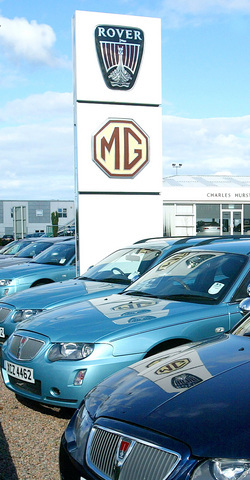
PHOTO: AP
But Lomas said that terms of a letter sent to the government, and copied to PwC, from SAIC officials early Friday were "clear and unambiguous."
"The SAIC board had concluded that in its view, MG Rover and [subsidiary] Powertrain Ltd. could not emerge from this process in a state which would justify then investing in it," Lomas said.
"As a result of that, they said they were not therefore willing to acquire, either in whole or in part, on a going concern basis, the business and assets of this business. Nor were they willing to enter a joint venture with a third party," he added.
Lomas said Rover had received expressions of interest from more than 70 other companies, but "the vast majority of that interest was either for specific, smaller parts of the business, for example the MG brand ... or was very, very early in the level of understanding the inquirer had about the business" and did not address the substantial funding needed.
"Our conclusion was that none of these other interested parties was likely to result in a transaction for the sale of the business as a going concern," he said.
Rover's collapse provides an embarrassing backdrop to the ruling Labour Party's election campaign, which is centered on the strength of the British economy, for the May 5 poll.
Prime Minister Tony Blair and Treasury Secretary Gordon Brown canceled election commitments Friday to travel to central England, where they announced a ?150 million (US$284 million) support package for Rover workers.
"We tried our level best to persuade the Chinese company to enter into a venture with MG Rover, it's not been possible to do that," Blair said. "Having done everything we possibly can to save Longbridge, what we've got to now do is look after the work force and the families of the work force."
PwC said the failure to pin down a deal with SAIC meant the administrator could not ask for an extension of a ?6.5 million (US$12.2 million) emergency loan from the government to pay workers.
Lomas said that PwC would "mothball" the Longbridge plant, keeping on just 600 workers to complete production on about 1,000 cars. About 400 staff will be retained at the company's Powertrain engine plant and 25 at MG Sport and Racing.
"The auctioneer is not coming in and selling it all off next week, we will be mothballing this facility so that we do have time to go back to SAIC and ask them to tell us if they do have any interest and precisely what that interest is, recognizing that they have of course acquired some of the intellectual property," Lomas said.
Some intellectual property rights for Rover models were sold to SAIC in a ?67 million deal last year, but the Chinese company does not hold the rights to produce the cars in Asia.
German car maker BMW AG has the rights to the Rover name, retaining them when it sold the company to Phoenix Venture Holdings for a token ?10 in 2000. BMW gave MG Rover permission to use the name indefinitely for free under a licensing agreement and said this week it would consider letting another company use the name in the event of Rover's collapse. BMW sold the rights to the MG name to Phoenix in the same deal.
The directors of Phoenix have been criticized for paying themselves significant salaries and pensions as the company was falling into the red. The so-called "Phoenix Four" earlier this week offered assets of up to ?30 million (US$56.8 million) to assist Rover as it tried to resuscitate talks with SAIC, but acknowledged that the assets on offer were subject to attack from creditors.
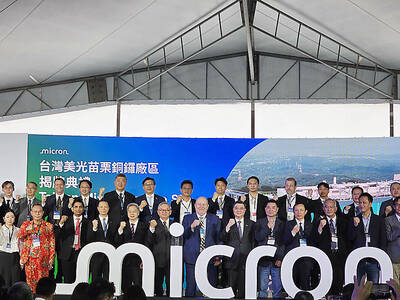
UNPRECEDENTED PACE: Micron Technology has announced plans to expand manufacturing capabilities with the acquisition of a new chip plant in Miaoli Micron Technology Inc unveiled a newly acquired chip plant in Miaoli County yesterday, as the company expands capacity to meet growing demand for advanced DRAM chips, including high-bandwidth memory chips amid the artificial intelligence boom. The plant in Miaoli County’s Tongluo Township (銅鑼), which Micron acquired from Powerchip Semiconductor Manufacturing Corp (力積電) for US$1.8 billion, is expected to make a sizeable capacity contribution to the company from fiscal 2028, the company said in a statement. It would be an extended production site of Micron’s large-scale manufacturing hub in Taichung, the company said. As the global semiconductor industry is racing to reach US$1 trillion

Singapore-based ride-hailing and delivery giant Grab Holdings Ltd has applied for regulatory approval to acquire the Taiwan operations of Germany-based Delivery Hero SE's Foodpanda in a deal valued at about US$600 million. Grab submitted the filing to the Fair Trade Commission on Friday last week, with the transaction subject to regulatory review and approval, the company said in a statement yesterday. Its independent governance structure would help foster a healthy and competitive market in Taiwan if the deal is approved, Grab said. Grab, which is listed on the NASDAQ, said in the filing that US-based Uber Technologies Inc holds about 13 percent of

Taiwan’s food delivery market could undergo a major shift if Singapore-based Grab Holdings Ltd completes its planned acquisition of Delivery Hero SE’s Foodpanda business in Taiwan, industry experts said. Grab on Monday last week announced it would acquire Foodpanda’s Taiwan operations for US$600 million. The deal is expected to be finalized in the second half of this year, with Grab aiming to complete user migration to its platform by the first half of next year. A duopoly between Uber Eats and Foodpanda dominates Taiwan’s delivery market, a structure that has remained intact since the Fair Trade Commission (FTC) blocked Uber Technologies Inc’s

Memory chip stocks extended their losses yesterday after Alphabet Inc’s Google publicized research that could allow more efficient use of the storage needed for artificial intelligence (AI) development. SK Hynix Inc and Samsung Electronics Co, South Korean leaders in the market, fell more than 6 percent and about 5 percent respectively in Seoul. In the US, Micron Technology Inc, Western Digital Corp and Sandisk Corp slid more than 2 percent in pre-market trading, after they all closed lower on Wednesday. Memory companies have been on a tear in recent months as the rapid development of AI infrastructure triggered a spike in chip


 RSS
RSS