


When Tsann Kuen Group (
Instead, its China business has so far seen heavy losses and its chairman, Wu Tsann-kuen (
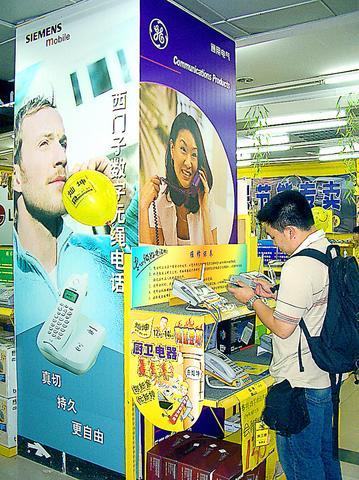
PHOTO: AMBER CHUNG, TAIPEI TIMES
"The [China] business has caused us a loss of US$31 million so far, which ate into our net profit," said the group's chief accounting officer Jack Huang (
Tsann Kuen opened more than 50 outlets across China, beginning last year. But the swelling losses have forced the company to trim back to just 31 outlets, mainly in the prosperous eastern and southern coastal areas of China.
In the first three quarters of this year, the company saw a combined net profit of US$3.02 million, which is significantly down from US$17 million a year ago, while revenue grew to US$560 million from US$310 million year-on-year, the company said last month.
Tsann Kuen, established in 1978, started out as a small home appliance maker. Its lucrative manufacturing business is expected to create US$600 million in total revenue this year and deliver 66 million units of home appliances, including coffee makers, grills and irons, to almost 90 percent of home appliance brands worldwide, such as Starbucks, Royal Philips Electronics, and General Electronic Co.
The company broke into Taiwan's home appliance and electronics retailing market in 1991 and has since expanded into the sector's dominant player with 153 outlets nationwide. In the first three quarters of this year its pre-tax income was NT$1.1 billion, with earnings per share of NT$5.06, on revenue of NT$22.89 billion.
"But it just didn't work out the way we thought," said Huang Fu-shan (
The fast expansion tactics also led to soaring costs for the retail in rental, personnel and inventory, he added.
The company, for instance, intended to set a new standard by using clean and purely yellow-colored outer walls and interior designs hoping it would help differentiate the chain from rivals in China in order to attract a growing number of China's wealthy customers, Huang Fu-shan said.
But they soon discovered that China's retail environment is very different, and they replaced their stores' design with colorful, large advertisements of various product brands to grab consumers' attention while securing extra advertising income from those vendors.
"Unlike Taiwan, the competition among product brands in China is far sharper than that among retailers," Huang Fu-shan said. He noted that Chinese electronics retailers are more like landlords that lease space to product vendors who not only bear all the costs including furnishing, personnel and inventory but pay rebates to retailers on monthly, quarterly, or even yearly basis.
In Taiwan, Tsann Kuen's salesclerks usually don't want to bother shoppers who are browsing in their stores. But customers in China have different shopping behavior, and actually feel insulted that no clerks come up to help them. Therefore they have introduced "shopping guides" in their China outlets, which have gotten a positive response from customers, Huang said.
Following the adoption of a new operating model since the middle of this year, the retailer has seen sales increase by around 60 percent, boosting the monthly revenue of a single store to between 12 million and 13 million Chinese yuan from 8 million yuan before, he added.
Tsann Kuen hopes its new business strategy will help its retail business in China break even by October next year, Huang said, noting that the company has received positive support from Taiwanese lenders such as Taishin International Bank (台新銀行) and Chinatrust Commercial Bank (中國信託). These banks, however, declined to comment.
To analysts, the clearance of inventory is the key issue to the retailer's future success.
"The company's retail business in China will see better performance only when they improve inventory management," said Chen Yen-liang (
"Tsann Kuen is still groping for ways to be successful in China like it was in its home market," the analyst said on condition of anonymity. Whether Tsann Kuen's new strategy will pay off is yet to be seen, he said.
But the company's advantages -- entering the China market early and a common cultural background with Chinese -- should help it withstand competition from foreign players once China lifts its restrictions over foreign capital's direct investment in the country's retailing this month, the analyst added.
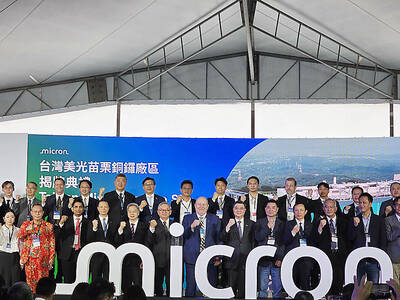
UNPRECEDENTED PACE: Micron Technology has announced plans to expand manufacturing capabilities with the acquisition of a new chip plant in Miaoli Micron Technology Inc unveiled a newly acquired chip plant in Miaoli County yesterday, as the company expands capacity to meet growing demand for advanced DRAM chips, including high-bandwidth memory chips amid the artificial intelligence boom. The plant in Miaoli County’s Tongluo Township (銅鑼), which Micron acquired from Powerchip Semiconductor Manufacturing Corp (力積電) for US$1.8 billion, is expected to make a sizeable capacity contribution to the company from fiscal 2028, the company said in a statement. It would be an extended production site of Micron’s large-scale manufacturing hub in Taichung, the company said. As the global semiconductor industry is racing to reach US$1 trillion

Singapore-based ride-hailing and delivery giant Grab Holdings Ltd has applied for regulatory approval to acquire the Taiwan operations of Germany-based Delivery Hero SE's Foodpanda in a deal valued at about US$600 million. Grab submitted the filing to the Fair Trade Commission on Friday last week, with the transaction subject to regulatory review and approval, the company said in a statement yesterday. Its independent governance structure would help foster a healthy and competitive market in Taiwan if the deal is approved, Grab said. Grab, which is listed on the NASDAQ, said in the filing that US-based Uber Technologies Inc holds about 13 percent of

Taiwan’s food delivery market could undergo a major shift if Singapore-based Grab Holdings Ltd completes its planned acquisition of Delivery Hero SE’s Foodpanda business in Taiwan, industry experts said. Grab on Monday last week announced it would acquire Foodpanda’s Taiwan operations for US$600 million. The deal is expected to be finalized in the second half of this year, with Grab aiming to complete user migration to its platform by the first half of next year. A duopoly between Uber Eats and Foodpanda dominates Taiwan’s delivery market, a structure that has remained intact since the Fair Trade Commission (FTC) blocked Uber Technologies Inc’s

Memory chip stocks extended their losses yesterday after Alphabet Inc’s Google publicized research that could allow more efficient use of the storage needed for artificial intelligence (AI) development. SK Hynix Inc and Samsung Electronics Co, South Korean leaders in the market, fell more than 6 percent and about 5 percent respectively in Seoul. In the US, Micron Technology Inc, Western Digital Corp and Sandisk Corp slid more than 2 percent in pre-market trading, after they all closed lower on Wednesday. Memory companies have been on a tear in recent months as the rapid development of AI infrastructure triggered a spike in chip


 RSS
RSS