


Almost two years after leaving the home-furnishing chain that he founded, Working House (生活工場), Simon Teng (鄧學中) decided to make a comeback with Piin (品東西家居), a new brand of home decor stores.
Teng, dressed in traditional Chinese-style attire, said at the launching ceremony yesterday that he's targeting higher-income customers as his main patrons and pins his hope on "a fusion of Eastern and Western fashion" to help Piin compete head-to-head with Working House, the nation's largest furnishings chain.

PHOTO: GEORGE TSORNG, TAIPEI TIMES
"Unlike the Swedish IKEA or other imported brands, Piin has a better understanding of how and what Taiwanese people want to decorate and furnish their homes," he said.
Teng said Working House mainly caters to customers between 15 and 25 years old, while IKEA attracts customers of ages 25 to 35. Instead, Piin targets those 30 and older, who are more economically independent and place quality before other considerations.
In December 2002, Teng resigned as chairman of Working House, which he established in 1994. He declined to comment on his departure yesterday except to say that "I felt at that time there should be another brand name to cater to a different market, because Working House has reached saturation with more than 100 outlets and development of a secondary label, Living Plus."
In February, Teng formed a 50-50 joint venture with Web Point Co (管家婆科技), a subsidiary of Acer Inc, with NT$100 million in capital to establish Piin.
Teng said yesterday that he thinks the new venture may break even in one year, and that he hopes to expand the brand to 12 stores by 2007.
He said he also plans to launch the brand to tap rising consumer spending in China next year.
Working House president Dennis Hsu (
"Actually, the cluster effect often brings in more business for Working House," Hsu said.
Citing the outlet in Taipei's New York New York shopping mall as an example, Hsu said one-outlet revenues this year have soared 70 percent since another player, MUJI (Taiwan) Corp (
"Through comparison, customers will know which is more suitable for them," he said.
The new 800-ping (2,600m2) Piin outlet is located on the sixth floor of Asiaworld Shopping Mall (
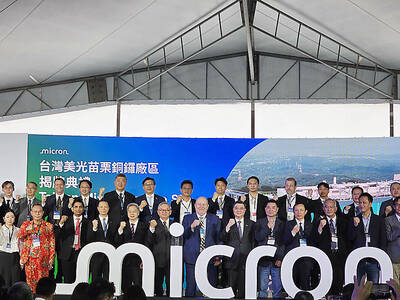
UNPRECEDENTED PACE: Micron Technology has announced plans to expand manufacturing capabilities with the acquisition of a new chip plant in Miaoli Micron Technology Inc unveiled a newly acquired chip plant in Miaoli County yesterday, as the company expands capacity to meet growing demand for advanced DRAM chips, including high-bandwidth memory chips amid the artificial intelligence boom. The plant in Miaoli County’s Tongluo Township (銅鑼), which Micron acquired from Powerchip Semiconductor Manufacturing Corp (力積電) for US$1.8 billion, is expected to make a sizeable capacity contribution to the company from fiscal 2028, the company said in a statement. It would be an extended production site of Micron’s large-scale manufacturing hub in Taichung, the company said. As the global semiconductor industry is racing to reach US$1 trillion

Singapore-based ride-hailing and delivery giant Grab Holdings Ltd has applied for regulatory approval to acquire the Taiwan operations of Germany-based Delivery Hero SE's Foodpanda in a deal valued at about US$600 million. Grab submitted the filing to the Fair Trade Commission on Friday last week, with the transaction subject to regulatory review and approval, the company said in a statement yesterday. Its independent governance structure would help foster a healthy and competitive market in Taiwan if the deal is approved, Grab said. Grab, which is listed on the NASDAQ, said in the filing that US-based Uber Technologies Inc holds about 13 percent of

Taiwan’s food delivery market could undergo a major shift if Singapore-based Grab Holdings Ltd completes its planned acquisition of Delivery Hero SE’s Foodpanda business in Taiwan, industry experts said. Grab on Monday last week announced it would acquire Foodpanda’s Taiwan operations for US$600 million. The deal is expected to be finalized in the second half of this year, with Grab aiming to complete user migration to its platform by the first half of next year. A duopoly between Uber Eats and Foodpanda dominates Taiwan’s delivery market, a structure that has remained intact since the Fair Trade Commission (FTC) blocked Uber Technologies Inc’s

Memory chip stocks extended their losses yesterday after Alphabet Inc’s Google publicized research that could allow more efficient use of the storage needed for artificial intelligence (AI) development. SK Hynix Inc and Samsung Electronics Co, South Korean leaders in the market, fell more than 6 percent and about 5 percent respectively in Seoul. In the US, Micron Technology Inc, Western Digital Corp and Sandisk Corp slid more than 2 percent in pre-market trading, after they all closed lower on Wednesday. Memory companies have been on a tear in recent months as the rapid development of AI infrastructure triggered a spike in chip


 RSS
RSS