


Computer security experts thwarted an attack by computer worm Sobig.F on Friday just as the FBI subpoenaed an Arizona Internet service provider in order to trace the fast-spreading virus experts believe was first posted on an adult-oriented Web site.
One expert said the Sobig.F e-mail virus was disguised so that anyone who clicked on a link purporting to show a sexually graphic picture became infected with the self-replicating worm, which then spread itself to other e-mail addresses.
"Sobig.F was first posted to a porn Usenet group," said Jimmy Kuo, research fellow at anti-virus software maker Network Associates Inc. Usenet is a popular forum on the Internet where computer users with similar interests post and read messages.
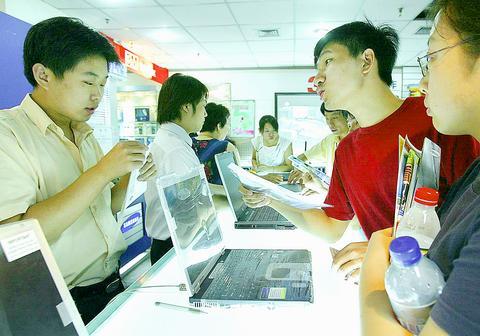
PHOTO: AFP
So far, as many as 100,000 computers have been infected with Sobig.F, which in turn has spewed "millions upon millions of infected e-mails" to other Internet users, Kuo added.
Sobig.F spreads when unsuspecting computer users open file attachments in e-mails that contain such familiar headings as "Thank You!," "Re: Details" or "Re: That Movie."
Once the file is opened, Sobig.F resends itself to e-mail addresses from the infected computer and signs the e-mail using a random name and address from the computer's address book.
Since Monday, computer users from South Korea to Norway have struggled to fend off attacks that have crippled corporate e-mail networks and have filled home users' inboxes with a glut of messages, before fanning out to find more victims.
Consulting firm Booz Allen Hamilton, Air Canada, transport company CSX Corp and possibly the New York Times are among hundreds of companies that have suffered network attacks from recent viruses.
Employees at the New York Times headquarters in midtown Manhattan were asked to shut down their computers, but a spokesman declined to comment on the cause of the shutdown.
"We will not speculate on the cause, effect or scope of the problem ... We plan to get the paper out tomorrow."
Sobig.F was written to expire on Sept. 10, but experts said they expect another version to follow. This is the sixth version of the portentously named virus since it first appeared in January.
The worm has been clogging e-mail inboxes with a hidden command directing infected PCs to make contact with one of 20 vulnerable computers at 12:00 California time every Friday and Sunday until it expires, said Steve Trilling, chief researcher at anti-virus vendor Symantec Corp.
Government and industry security experts raced against the clock on Friday to take offline 19 of the 20 home computers, thwarting an attack before the 12 noon deadline, said Mikko Hypponen, anti-virus research manager at F-Secure of Finland.
The computers were located in the US, Canada and South Korea, he said.
The remaining master computer, which was in the US, was taken down shortly after the deadline, experts said.
Experts had worried that the timed attack would slow down Internet traffic and possibly set in motion a new set of commands to launch new attacks.
However, they cautioned that it was too early to tell whether the threat of Sobig.F had ended. The next expected attack could spur new problems, they said.
Internet service provider Easy-news.com of Phoenix, Arizona said it had been contacted by investigators by telephone on Thursday and the company was issued a subpoena on Friday.
"It looks like the original variant was posted through us to Usenet on the 18th [of August]," Michael Minor, the Internet service provider's chief technology officer, told reporters.
An FBI spokesman said the organization was working with the US Department of Homeland Security to investigate who was behind the e-mail attacks. He declined to comment further.
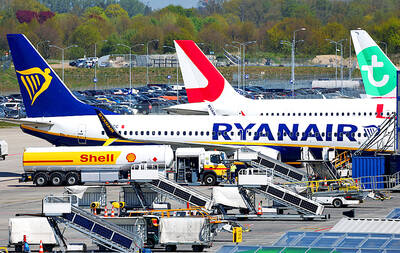
Ryanair, Transavia, Volotea and other low-cost airlines are feeling the financial pain from high jet fuel prices as a result of the Middle East war and are cutting flights. The closure of the Strait of Hormuz has taken a huge chunk of oil supplies off the market, sending the price of jet fuel soaring and triggering fears of shortages that could force airlines to cancel flights. Airlines are not waiting for a lack of supplies to react. “Travel alert: Airlines are cutting thousands of flights right now,” Travel Therapy host Karen Schaler said in an Instagram reel this past weekend.

MANAGING RISKS: Taiwan has secured LNG sufficient to cover 95 percent of electricity demand for next month, UBS said, describing the government’s approach as proactive UBS Group AG has raised its forecast for Taiwan’s economic growth this year to 8 percent, up from 6.9 percent previously, and said expansion could reach as high as 8.6 percent if external energy shocks are avoided. The upgrade reflects a stronger-than-expected first-quarter performance and sustained momentum in artificial intelligence (AI)-driven exports, which UBS said are providing a firm foundation for growth despite geopolitical and energy risks. Taiwan’s GDP expanded 13.69 percent year-on-year in the first quarter, the fastest growth since the second quarter of 1987, the Directorate-General of Budget, Accounting and Statistics (DGBAS) reported on Thursday. On a seasonally

The list of Asian stocks that benefit from business partnership with Nvidia Corp is getting longer, as the region further integrates into the artificial intelligence (AI) chip giant’s business ecosystem. Just in the past week, South Korea’s LG Electronics Inc, Taiwan’s Nanya Technology Corp (南亞科技), as well as China’s Huizhou Desay SV Automotive Co (德賽西威) and Pateo Connect Technology Shanghai Corp (博泰車聯) have become the latest to rally on news of tie-ups, supply-chain participation or product collaboration with the US chip designer. Asian suppliers account for about 90 percent of Nvidia’s production costs, up from about 65 percent last year, data compiled

The Fair Trade Commission’s (FTC) ongoing review of Grab Holdings Ltd’s US$600 million acquisition of Foodpanda Taiwan’s operations, announced on March 23, has taken on fresh urgency as industry experts warn that the transaction could embed significant Chinese cybersecurity vulnerabilities into Taiwan’s digital infrastructure through Grab’s deep ties to autonomous-driving firm WeRide (文遠知行). Less than 16 months after the FTC blocked Uber Eats’ direct attempt to acquire Foodpanda Taiwan — citing potential combined market shares of 80 to 90 percent — the emergence of Grab as the buyer has prompted questions about whether the same competitive harm is simply being rerouted


 RSS
RSS