


Up a rutted dirt road 6km as the eagle flies from the Pacific Ocean, nestled in a valley almost no one has heard of, Hans Backhoff is squeezing fine wine from the dry Mexican soil, carrying on a tradition that goes back nearly 500 years.
Despite his Teutonic name, Backhoff is, like his wine, a pure product of Mexico, with tangled roots abroad. He was born in 1946 in the coastal town of Ensenada, in Baja California, where his Nicaraguan-born father had gone.
Thirty years ago, while studying for a graduate degree in food science in Britain, he read a noted wine authority's dismissal of the possibility of growing good wine in Mexico. Too hot, said the expert. Thus began a lifelong obsession.
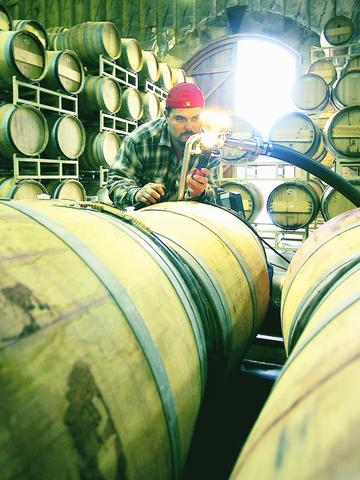
PHOTO: NY TIMES
"This land is a jewel, and very few people know it," he said, gazing into the distance from a ledge overlooking his fields.
The temperature falls to near freezing many a night here in the Guadelupe Valley. A cooling wind comes up from the Pacific and the hilly terrain is not so different from the curvaceous peaks of the other California, across the border in the US.
Wine had been made in Mexico since the 1520s, on orders from the Spanish conquerors, who commanded that 1,000 vines be planted for every 100 Indians enslaved.
"When the wine from the New World began to compete with Spanish wine, the Spanish crown ordered that the vines be ripped up," Backhoff said, shaking his head at the waste of it all.
For years, Backhoff nurtured a dream of someday cultivating his own wine -- one made in Mexico, but tasting as good as the French vintages he remembers sipping when a graduate student.
In 1988, after 15 years of seeking his fortune in the soft-drink business, he took the plunge, regarded by friends as somewhere beyond foolhardy, of starting up his vineyard, Monte Xanic. He grafted merlot and sauvignon blanc and chardonnay vines on to old rootstocks.
Since then, the wine has won awards in France and in California. Aeromexico, a state-owned airline, has started serving it to first-class passengers. Monte Xanic is making money, and now produces 47,000 cases a year, about 2,000 of which are sold in the US.
The wine tastes good; it intermingles all the cultures from which it rises -- French, Spanish, Californian -- but it tastes like none of them.
"They will hold their own with wine from anywhere in the world," said Todd Alexander, a wine distributor and importer in Atlanta who does not sell Monte Xanic.
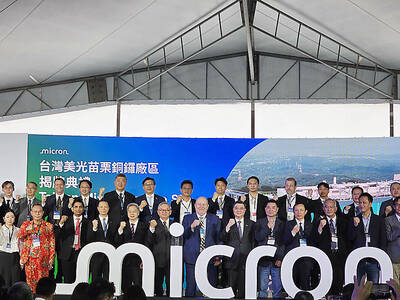
UNPRECEDENTED PACE: Micron Technology has announced plans to expand manufacturing capabilities with the acquisition of a new chip plant in Miaoli Micron Technology Inc unveiled a newly acquired chip plant in Miaoli County yesterday, as the company expands capacity to meet growing demand for advanced DRAM chips, including high-bandwidth memory chips amid the artificial intelligence boom. The plant in Miaoli County’s Tongluo Township (銅鑼), which Micron acquired from Powerchip Semiconductor Manufacturing Corp (力積電) for US$1.8 billion, is expected to make a sizeable capacity contribution to the company from fiscal 2028, the company said in a statement. It would be an extended production site of Micron’s large-scale manufacturing hub in Taichung, the company said. As the global semiconductor industry is racing to reach US$1 trillion

Singapore-based ride-hailing and delivery giant Grab Holdings Ltd has applied for regulatory approval to acquire the Taiwan operations of Germany-based Delivery Hero SE's Foodpanda in a deal valued at about US$600 million. Grab submitted the filing to the Fair Trade Commission on Friday last week, with the transaction subject to regulatory review and approval, the company said in a statement yesterday. Its independent governance structure would help foster a healthy and competitive market in Taiwan if the deal is approved, Grab said. Grab, which is listed on the NASDAQ, said in the filing that US-based Uber Technologies Inc holds about 13 percent of

Taiwan’s food delivery market could undergo a major shift if Singapore-based Grab Holdings Ltd completes its planned acquisition of Delivery Hero SE’s Foodpanda business in Taiwan, industry experts said. Grab on Monday last week announced it would acquire Foodpanda’s Taiwan operations for US$600 million. The deal is expected to be finalized in the second half of this year, with Grab aiming to complete user migration to its platform by the first half of next year. A duopoly between Uber Eats and Foodpanda dominates Taiwan’s delivery market, a structure that has remained intact since the Fair Trade Commission (FTC) blocked Uber Technologies Inc’s

Memory chip stocks extended their losses yesterday after Alphabet Inc’s Google publicized research that could allow more efficient use of the storage needed for artificial intelligence (AI) development. SK Hynix Inc and Samsung Electronics Co, South Korean leaders in the market, fell more than 6 percent and about 5 percent respectively in Seoul. In the US, Micron Technology Inc, Western Digital Corp and Sandisk Corp slid more than 2 percent in pre-market trading, after they all closed lower on Wednesday. Memory companies have been on a tear in recent months as the rapid development of AI infrastructure triggered a spike in chip


 RSS
RSS