


American Funds, the third-largest US mutual fund group, is hot on the heels of rivals Alliance Capital Management LP and Putnam Investments in the race to gather assets in college saving plans.
In the two months since introducing CollegeAmerica, American Funds has gathered US$436 million, according to the public information office of Virginia College Saving Plan, its partner in the plan. Alliance, whose college savings plan has been available since November 2000, has gathered US$2 billion. Putnam's, available since October 2000, has gathered US$1.5 billion.
American Funds, managed by Los Angeles-based Capital Research & Management Co, is benefiting in part from the fact that its stock funds have fared better than more aggressive offerings from Alliance and Putnam, analysts said.
"With American Funds, you may not get rich quick, but you will get rich, and in a bear market you can depend upon them not to lose a lot of money either," said Robert Powell, managing director at Acadient Inc, a Boston-based financial education company. "That's a story advisers love to tell."
College saving plans, also known as 529 plans after the section of the tax code that created them, are a fast-growing segment of the asset-management business. Assets invested in the plans totaled US$7.1 billion at the end of last year and are expected to grow to US$51 billion by 2006, according to Cerulli Associates, a Boston-based consulting firm.
To offer a 529 plan, a money-management firm must be selected by a state as its partner. Firms can sell their plans nationwide.
The plans allow money used to pay educational expenses to grow tax-free. Some states also offer an income tax deduction for contributions to the plans.
To be sure, the pace of flows into college saving plans has accelerated since June, when the tax code was amended to exempt qualified withdrawals from the plans starting this year. Alliance and Putnam declined to say how much has flowed into their plans in the last two months.
American Funds was the top-selling fund group through financial advisers each year from 1990 to 1995, according to Financial Research Corp, a Boston-based consulting firm.
From 1996 to 2000, Putnam or Alliance or both out-sold American Funds as their more aggressive stock funds outperformed American Funds' offerings in the bull market.
Over the last three years, American Funds' stock funds have outperformed 77 percent of their peers, on average, according to fund tracker Morningstar Inc. Putnam's stock funds were beaten by 58 percent of rivals while Alliance's underperformed 60 percent. Putnam is the fourth-largest US fund company.
American Funds was the top-selling broker-sold fund group last year for the first time since 1995. From 1992 though 2001, its stock funds outperformed 80 percent of their rivals on average. Putnam's were in the top 39 percent, Alliance's in the bottom 47 percent.
The long-term performance of its products was "a major factor" in Virginia's decision to select American Funds to run its 529 plan, said Diana Cantor, executive director of the Virginia College Savings Plan.
Virginia's college savings plan allows investors to select from any American Funds product, with the exception of its tax-free bond funds, which are not suited to a tax-deferred account.
Alliance's plan, offered in partnership with Rhode Island, allows investors to chose from two portfolios based on the beneficiary's age, four based on asset-allocation, and nine Alliance mutual funds.
Putnam's plan, a partnership with Ohio, offers an age-based option and three asset-allocation based options. All options include a combination of up to seven Putnam funds.
American Funds was the most popular mutual fund company among independent brokers recently surveyed by Tiburon Strategic Advisors.
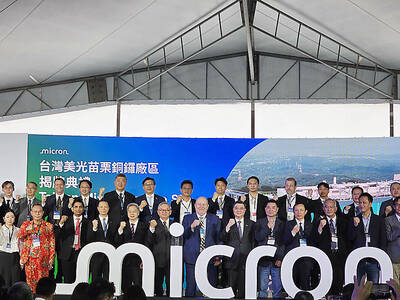
UNPRECEDENTED PACE: Micron Technology has announced plans to expand manufacturing capabilities with the acquisition of a new chip plant in Miaoli Micron Technology Inc unveiled a newly acquired chip plant in Miaoli County yesterday, as the company expands capacity to meet growing demand for advanced DRAM chips, including high-bandwidth memory chips amid the artificial intelligence boom. The plant in Miaoli County’s Tongluo Township (銅鑼), which Micron acquired from Powerchip Semiconductor Manufacturing Corp (力積電) for US$1.8 billion, is expected to make a sizeable capacity contribution to the company from fiscal 2028, the company said in a statement. It would be an extended production site of Micron’s large-scale manufacturing hub in Taichung, the company said. As the global semiconductor industry is racing to reach US$1 trillion

Singapore-based ride-hailing and delivery giant Grab Holdings Ltd has applied for regulatory approval to acquire the Taiwan operations of Germany-based Delivery Hero SE's Foodpanda in a deal valued at about US$600 million. Grab submitted the filing to the Fair Trade Commission on Friday last week, with the transaction subject to regulatory review and approval, the company said in a statement yesterday. Its independent governance structure would help foster a healthy and competitive market in Taiwan if the deal is approved, Grab said. Grab, which is listed on the NASDAQ, said in the filing that US-based Uber Technologies Inc holds about 13 percent of

Taiwan’s food delivery market could undergo a major shift if Singapore-based Grab Holdings Ltd completes its planned acquisition of Delivery Hero SE’s Foodpanda business in Taiwan, industry experts said. Grab on Monday last week announced it would acquire Foodpanda’s Taiwan operations for US$600 million. The deal is expected to be finalized in the second half of this year, with Grab aiming to complete user migration to its platform by the first half of next year. A duopoly between Uber Eats and Foodpanda dominates Taiwan’s delivery market, a structure that has remained intact since the Fair Trade Commission (FTC) blocked Uber Technologies Inc’s

Memory chip stocks extended their losses yesterday after Alphabet Inc’s Google publicized research that could allow more efficient use of the storage needed for artificial intelligence (AI) development. SK Hynix Inc and Samsung Electronics Co, South Korean leaders in the market, fell more than 6 percent and about 5 percent respectively in Seoul. In the US, Micron Technology Inc, Western Digital Corp and Sandisk Corp slid more than 2 percent in pre-market trading, after they all closed lower on Wednesday. Memory companies have been on a tear in recent months as the rapid development of AI infrastructure triggered a spike in chip


 RSS
RSS