


Easy access to credit cards is giving financially-illiterate students the ability to play with fire.
"Taiwanese students are unfamiliar with credit management ... yet they can apply for credit cards without proof of income or parental approval," said Tseng Yen-fen (
And with schools and curb-side marketers both promoting cards, access is readily available.
"There are lots of credit card sign-up booths on the streets," Tseng said. "And the booths use youth-orientated freebies to attract students."
Cartoon characters such as Hello Kitty and Betty Bop are on the front line of promoters' sign-up sellers.
Tseng said that sudents' lack of familiarity with credit management could lead them to charge beyond what they can afford.
"If students pay only the minimum every month, they can start digging a [financial] hole at a young age," Tseng said.
According to a Taiwan credit-card market study, credit-card issuers bank on young people's inability to pay.
"Because most card companies don't charge an annual fee, making money means getting students who can't pay the bill," said Annabel Lee (李思儀), a graduate student at NTU's sociology department, and researcher behind the study.
Lee said that another tactic is to encourage excessive card transactions by offering bonus money or gifts for multiple usage.
The spending habits of Taiwan students are definitely changing.
"Good saving habits are very popular among the middle-age generation, however, the younger generation is more likely to spend without thinking," said Cheng Tung-shen, (
According to statistics released in April by the Cabinet-level Directorate General of Budget, Accounting and Statistics, the national savings rate in 2000 was 25.2 percent, down from 26.7 percent in 1996 and 29.4 percent in 1991.
The use of plastic credit is on the rise, with total annual credit-card spending hitting NT$719.8 billion in 2000 -- an increase of 20.1 percent over 1999.
Peer pressure may also be a factor.
"Just like other teenagers, they want trendy things ... and they want a card to show off their economic independence," said Huang, Hen-chiang (
The distribution of student credit cards is only monitored by the Bankers Association.
"We have demanded that the government enforce stricter regulations on student credit-card issuances, and banks or schools should educate students on the importance of sound credit management," said attorney Joann Su (
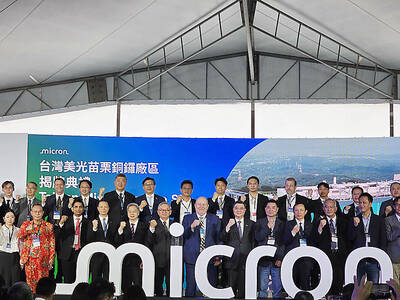
UNPRECEDENTED PACE: Micron Technology has announced plans to expand manufacturing capabilities with the acquisition of a new chip plant in Miaoli Micron Technology Inc unveiled a newly acquired chip plant in Miaoli County yesterday, as the company expands capacity to meet growing demand for advanced DRAM chips, including high-bandwidth memory chips amid the artificial intelligence boom. The plant in Miaoli County’s Tongluo Township (銅鑼), which Micron acquired from Powerchip Semiconductor Manufacturing Corp (力積電) for US$1.8 billion, is expected to make a sizeable capacity contribution to the company from fiscal 2028, the company said in a statement. It would be an extended production site of Micron’s large-scale manufacturing hub in Taichung, the company said. As the global semiconductor industry is racing to reach US$1 trillion

Singapore-based ride-hailing and delivery giant Grab Holdings Ltd has applied for regulatory approval to acquire the Taiwan operations of Germany-based Delivery Hero SE's Foodpanda in a deal valued at about US$600 million. Grab submitted the filing to the Fair Trade Commission on Friday last week, with the transaction subject to regulatory review and approval, the company said in a statement yesterday. Its independent governance structure would help foster a healthy and competitive market in Taiwan if the deal is approved, Grab said. Grab, which is listed on the NASDAQ, said in the filing that US-based Uber Technologies Inc holds about 13 percent of

Taiwan’s food delivery market could undergo a major shift if Singapore-based Grab Holdings Ltd completes its planned acquisition of Delivery Hero SE’s Foodpanda business in Taiwan, industry experts said. Grab on Monday last week announced it would acquire Foodpanda’s Taiwan operations for US$600 million. The deal is expected to be finalized in the second half of this year, with Grab aiming to complete user migration to its platform by the first half of next year. A duopoly between Uber Eats and Foodpanda dominates Taiwan’s delivery market, a structure that has remained intact since the Fair Trade Commission (FTC) blocked Uber Technologies Inc’s

Memory chip stocks extended their losses yesterday after Alphabet Inc’s Google publicized research that could allow more efficient use of the storage needed for artificial intelligence (AI) development. SK Hynix Inc and Samsung Electronics Co, South Korean leaders in the market, fell more than 6 percent and about 5 percent respectively in Seoul. In the US, Micron Technology Inc, Western Digital Corp and Sandisk Corp slid more than 2 percent in pre-market trading, after they all closed lower on Wednesday. Memory companies have been on a tear in recent months as the rapid development of AI infrastructure triggered a spike in chip


 RSS
RSS