


The admissions of China and Taiwan in to the WTO are seen as unlikely to be affected by a looming trade vote in the US Congress -- regardless of its outcome.
Although both China and Taiwan's bid are being considered separately by the WTO, China would only agree to Taiwan's entry only if its own application was considered first.
Any obstacle to China's bid being successful will subsequently delay Taiwan's entry. And with the signing of a trade deal between the EU and China last week, the only major obstacle remaining is the Permanent Normal Trade Relations (PNTR) vote in the US congress.
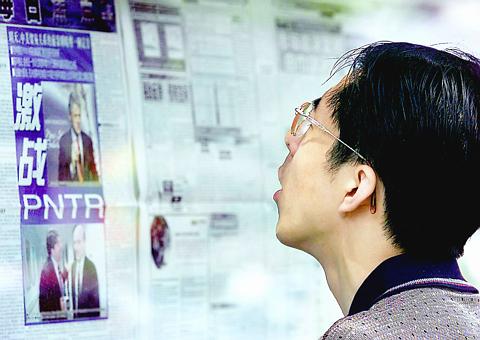
PHOTO: AFP
If the PNTR vote that President Clinton has fought so hard for fails in the US House of Representatives this week, it is possible that China may refuse to enter the WTO and subsequently hang Taiwan's own bid out to dry.
"If China doesn't get PNTR, it is quite possible Beijing will refuse to join the WTO, because it doesn't want to lose face," said Lin Tzu-chia (
If China stays out of the WTO, Taiwan will also be kept out, Lin said.
But according to one Europe-based trade official who requested anonymity, the more likely result of a negative outcome for PNTR would be the US invoking the non-application clause of the WTO general agreement -- Article 13 -- effectively rendering its bilateral agreement with China void.
As the article is reciprocal, China would also not have to honor the agreement and could enjoy WTO membership free of any obligation to extend the trading rights hammered out in the November agreement to US businesses on Chinese soil.
Another fear lingering in the minds of some Taiwanese officials and executives is the possibility of China throwing up an obstacle to Taiwan's bid to join the WTO after its own entry.
Such a move might be made to force Taiwan's hand on matters of political significance, such as the nation's long-standing ban on the direct "three links" with China, covering trade, transport and postal communications.
China raising the issue of the "three links" is a real possibility, according to Lin, who said that this could be used as a "bargaining chip" to force Taiwan to discuss the matter.
Similar fears also sent American Chamber of Commerce chairman Paul Cassingham to Washington recently to lobby for the trade bill's passage and to push for Taiwan's immediate entry into the WTO after China.
Concern was also raised over Beijing's intentions after it gains entry to the WTO by incoming economics chief Lin Hsin-yi (
A phrase well used by the former KMT leadership and now by President Chen Shui-bian's (陳水扁) administration as a precondition for improvement in cross-strait ties, "goodwill" was given some amplification by Lin.
Any "appropriate revision of trade restrictions" and the "no haste, be patient" policy would be in part dependent on whether China obstructed Taiwan's bid to join the WTO, Lin said.
But according to the Europe-based official, fears of China throwing a spanner in the works of Taiwan's WTO entry are totally unfounded, although quite understandable in light of the 50-year face off across the Taiwan Strait.
"The Chinese have at every level said they would not block Taiwan's admission ... they've said it publicly so many times that it would be an enormous loss of face if they did that," the official said.
In addition to this, China would risk losing the considerable support it enjoys among WTO members keen to see the free trade flow across the borders of the world's largest market.
These supporters, who agreed to China entering an application to join the WTO on condition they didn't block any bid by Taiwan, would all "disappear" if it changed its tune now, the official said.
These words were echoed by Nick Chen, chairman of AmCham's China Committee, who said "There is no indication at all that Beijing espouses anything other than simultaneous entry" into the WTO with Taiwan.
"Despite whatever fears and nightmares exist in Taiwan over this, there is currently no practical indication that is a reality," Chen said.
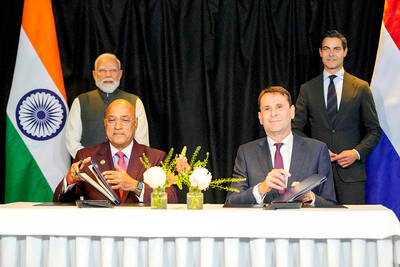
NEW MARKET: The partnership opens up India to the Dutch company, which already has a strong hold in the semiconductor market of South Korea, Taiwan and China ASML Holding NV entered into a partnership agreement with Tata Electronics Pvt Ltd aimed at ramping up India’s goal to develop domestic chip-manufacturing capabilities. The Dutch company’s technology would help power Tata Electronics’ planned 300 millimeter (mm) semiconductor foundry in Gujarat, according to a joint statement from the two companies on Saturday. The signing of a memorandum of understanding coincides with a visit by Indian Prime Minister Narendra Modi to the Netherlands, which is looking to deepen bilateral relations with New Delhi. ASML, whose top customers include Taiwan Semiconductor Manufacturing Co (台積電) and Samsung Electronics Co, makes lithography machines that can print
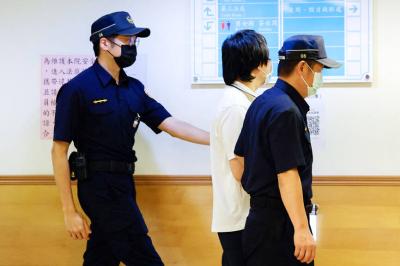
Tokyo Electron's Taiwan unit today said in a written response that it respects the judicial process, takes the court ruling seriously and would not appeal in the Taiwan Semiconductor Manufacturing Co (TSMC, 台積電) trade secrets case. Last month, a court fined the Taiwan unit of Japan's Tokyo Electron NT$150 million (US$4.74 million) in a case involving trade secrets related to TSMC's sensitive chip technology.
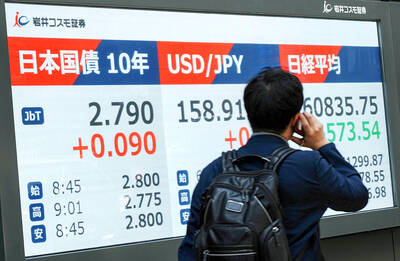
ROUGH RECORDS: Bonds in Japan, as well is in New Zealand, Australia and the US, are seeing the effects of a nervy market as stock exchanges across Asia edge down A deepening slump in Japanese government bonds added fuel to the selloff in global debt markets as rising oil prices stoked inflation fears and pushed yields to multi-decade highs. Japan’s 30-year yield yesterday surged as much as 20 basis points to the highest level since the tenor’s debut in 1999, before paring some of the move. Shorter-maturity Japanese debt was also under pressure, underscored by weak demand at a sale of five-year notes that offered a record-high coupon of 2 percent. Concerns over inflation and government spending rippling through markets including the US, Australia and New Zealand are being amplified in Japan,
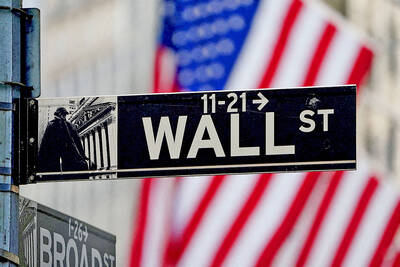
Wall Street is licking its chops over an unprecedented slate of massive initial public offerings (IPOs) set to arrive in the coming months, beginning with Elon Musk’s Space Exploration Technologies Corp (SpaceX) next month. That is expected to be followed by artificial intelligence (AI) rivals OpenAI and Anthropic PBC. The trio of mega listings, each eyeing valuations around US$1 trillion or more, constitutes a heady period of elevated risk and reward. SpaceX is targeting an IPO that would raise up to US$80 billion — about double the funds generated from all IPOs last year. OpenAI and Anthropic are eyeing IPOs raising US$60 billion. “We’re


 RSS
RSS