


A network of more than 150 US charter schools linked to followers of Fethullah Gulen, a Pennsylvania-based Muslim cleric the Turkish government blames for instigating July’s failed coup, has come under growing financial and legal strain, according to school officials, current and former members of Gulen’s movement and public records reviewed by reporters.
The publicly financed schools, a key source of jobs and business opportunities for US members of Gulen’s global movement, have sharply slowed their expansion in recent years, public records showed.
The slowdown comes amid a series of government probes in more than a dozen states into allegations ranging from misuse of taxpayer funds to visa fraud.
The investigations launched by state and federal officials have not resulted in criminal charges or directly implicated Gulen, whose name is not on any of the charter schools.
The increased pressure on the schools also comes as the Turkish government is cracking down on Gulen supporters at home and presses hard for Gulen’s extradition.
Just six new schools were opened between last year and this year to date, down from a peak of 23 new schools in 2010, according to a review of the public records of 153 charter schools and their management companies around the US.
The decline runs counter to the steady growth over the past six years of all US charter schools, which receive taxpayer funds, but are exempt from some rules that govern traditional state-run public schools.
At the same time, 15 schools have been closed or transferred to owners with no connection to Gulen’s movement since 2010. In at least 11 of those cases — including in Georgia, California, Pennsylvania and Ohio — the management firms or individual schools themselves had faced official investigations, reporters found.
“Since these investigations and pressures from media coverage have been going on, the schools are much more, maybe five times more careful, in terms of their finances, how they hire contractors,” said Hakan Berberoglu, acting executive director of the Illinois-based Niagara Foundation, which aims to promote the interfaith dialogue espoused by Gulen, its honorary president.
“They are much more careful in how they expand,” he told reporters.
Berberoglu said that the schools are not officially affiliated with Gulen and are not centrally controlled by anyone.
In another sign of a slowdown, the number of visa applications the schools submitted for guest workers from Turkey and other countries declined from more than 1,000 in 2010 to 360 last year, immigration records showed.
The trend reflects a desire by the schools linked to Gulen followers to avoid further government scrutiny, according to current and former members of the movement.
In the wake of the failed coup, Ankara’s attorneys in the US have stepped up an aggressive campaign to try to persuade local, state and federal authorities to open new inquiries and discredit the charter schools and other US operations linked to Gulen.
Asked about signs that the movement is under stress in the US, Alp Aslandogan, Gulen’s spokesman, said: “We are not worried about that.”
Many Gulen supporters in Turkey are now looking to their US-based brethren for material support and safe haven, according to current and former members of the movement.
“It’s been my job to save people, to help people who want to come over here,” said one US-based Turkish businessman, speaking on condition of anonymity because of the sensitivity of his efforts to assist would-be immigrants.
The reclusive Gulen, who has lived in self-imposed exile in Pennsylvania since 1999, denies involvement in the coup attempt.
Gulen’s global movement — known as Hizmet, which means “service” in Turkish — seeks to spread what his supporters say is the charismatic preacher’s moderate brand of Islam, which promotes Western-style education, free markets and interfaith communication.
The US has become the Gulen movement’s most important base of business operations outside Turkey, except for Germany, according to independent experts on the movement.
In addition to the schools, followers run a loosely affiliated collection of businesses, civic associations and charities.
Some Turkish-American-owned contractors who do business with the schools have been targeted in state and federal investigations over allegations they received preferential treatment, according to current and former members and legal documents.
Berberoglu said the schools have hired and done business with members of the movement because they can be relied on as trustworthy and capable.
“You want these schools to be successful, you need to depend on people that you know,” he said.
Groups linked to the Gulen movement, including several whose directors have also led charter schools, have sponsored hundreds of US congressional trips to Turkey and nearby countries in the past eight years, according to congressional records.
However, such trips have mostly halted since last year, when the US Department of Justice launched a criminal probe of possible irregularities in funding sources for some of the travels.
Aslandogan acknowledged that some of the schools were started by Gulen “sympathizers.”
He added that the movement led by the 77-year-old cleric exerts no central control, and some followers say his role is strictly inspirational.
The school network has put down deep roots in the US over the past nearly two decades, with administrators deftly navigating the public funding process.
A series of bond sales have totaled US$683 million since 2006, according to data collected by reporters. Bond sales by four of the school chains alone in 2014 — the latest annual data available for this niche — accounted for 6 percent of the entire tax-exempt US charter school bond market that year.
US lawyers for Turkish President Recep Tayyip Erdogan said they suspect the schools are a front that generates US$500 million annually that is funneled from Gulen’s movement for subversive activities against the Turkish state, such as bribing officials.
The attorneys did not provide specifics on how they believe this is done.
Aslandogan rejected the accusations as “false” and unsubstantiated, describing it as part of a vendetta against “movement participants” outside of Turkey.
In at least one instance — a Texas case — the Turkish government’s post-coup accusations against a large school chain have prompted renewed scrutiny.
The Texas Education Agency in late July said it was reviewing a complaint filed by the Turkish government’s legal team of alleged fiscal improprieties by Harmony Public Schools, a Houston, Texas-based firm that runs 48 charter schools.
In the complaint, lawyers for the Turkish government accused Harmony of misusing US$18 million in public funds, funneling money to Gulen’s organization and also of discriminatory employment practices.
No decision on whether to open a formal investigation has yet been announced.
Soner Tarim, one of Harmony’s founders, denied any wrongdoing and said there was no “underlying conspiracy” in running the nonprofit schools.
“The purpose was really to create math and science expertise,” Tarim told reporters.
However, Tarim acknowledged that his company has been squeezed by having to spend more on legal fees and public relations.
“So it has some effect on our resources, but not our reputation,” he said.

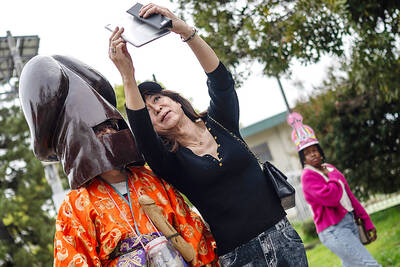
Showcasing phallus-shaped portable shrines and pink penis candies, Japan’s annual fertility festival yesterday teemed with tourists, couples and families elated by its open display of sex. The spring Kanamara Matsuri near Tokyo features colorfully dressed worshipers carrying a trio of giant phallic-shaped objects as they parade through the street with glee. The festival, as legend has it, honors a local blacksmith in the Edo Period (1603-1868) who forged an iron dildo to break the teeth of a sharp-toothed demon inhabiting a woman’s vagina that had been castrating young men on their wedding nights. A 1m black steel phallus sits in the courtyard of

HIGH HOPES: The power source is expected to have a future, as it is not dependent on the weather or light, and could be useful for places with large desalination facilities A Japanese water plant is harnessing the natural process of osmosis to generate renewable energy that could one day become a common power source. The possibility of generating power from osmosis — when water molecules pass from a less salty solution to a more salty one — has long been known. However, actually generating energy from that has proved more complicated, in part due the difficulty of designing the membrane through which the molecules pass. Engineers in Fukuoka, Japan, and their private partners think they might have cracked it, and have opened what is only the world’s second osmotic power plant. It generates

JAN. 1 CLAUSE: As military service is voluntary, applications for permission to stay abroad for over three months for men up to age 45 must, in principle, be granted A little-noticed clause in sweeping changes to Germany’s military service policy has triggered an uproar after it emerged that the law requires men aged up to 45 to get permission from the armed forces before any significant stay abroad, even in peacetime. The legislation, which went into effect on Jan. 1 aims to bolster the military and demands all 18-year-old men fill out a questionnaire to gauge their suitability to serve in the armed forces, but stops short of conscription. If the “modernized” model fails to pull in enough recruits, parliament will be compelled to discuss the reintroduction of compulsory service, German

When a hiker fell from a 55m waterfall in wild New Zealand bush, rescuers were forced to evacuate the badly hurt woman without her dog, which could not be found. After strangers raised thousands of dollars for a search, border collie Molly was flown to safety by a helicopter pilot who was determined to reunite the pet and the owner. A week earlier, an emergency rescue helicopter found the woman with bruises and lacerations after a fall at a rocky spot at the waterfall on the South Island’s West Coast. She was airlifted on March 24, but they were forced to


 RSS
RSS