


US President Barack Obama on Friday rejected a bill that would have allowed the families of victims of the Sept. 11, 2001, attacks to sue the government of Saudi Arabia, saying it undermined national security and setting up the possibility Congress might override his veto for the first time in his presidency.
Obama’s move escalates the fight over an emotional issue that has overlapped with the campaign debate over terrorism and the Middle East. The bill had sailed through both chambers of the US Congress with bipartisan support, clearing the final hurdle just days before the 15th anniversary of the 9/11 attacks, which killed nearly 3,000 people in New York, Washington and Pennsylvania.
The president said the bill, which does not refer specifically to Saudi Arabia, could backfire by opening up the US government and its officials to lawsuits by anyone accusing the US of supporting terrorism, rightly or wrongly.
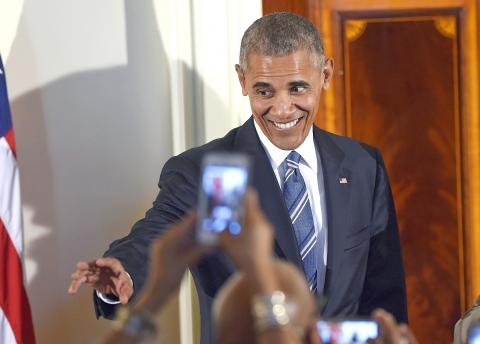
Photo: AP
“I have deep sympathy for the families of the victims of the terrorist attacks of Sept. 11, 2001,” Obama wrote to the Senate in a veto message about the bill, the Justice Against Sponsors of Terrorism Act (JASTA).
However, “the JASTA would be detrimental to US national interests more broadly,” he said.
Congress is determined to try to overturn the veto, which requires a two-thirds vote in the House and Senate. Previous attempts to overturn Obama’s vetoes have all been unsuccessful.
US House Minority Leader Nancy Pelosi, a Democrat, has said an override would pass in the Republican-controlled House. Yet the Senate would be the greater challenge. After furious lobbying to try to peel off supporters, the White House on Friday said it was unclear whether enough had defected to avert an override.
With lawmakers eager to return home to campaign, a vote could come early next week. US Senate Majority Leader Mitch McConnell’s office said the Senate would vote “as soon as practicable in this work period.”
US Senator Chuck Schumer, the Senate’s No. 3 Democrat and a traditional Obama ally, came out swinging against Obama, while predicting lawmakers would reverse it “swiftly and soundly.”
“The families of the victims of 9/11 deserve their day in court, and justice for those families shouldn’t be thrown overboard because of diplomatic concerns,” Schumer said.
A coalition of 9/11 victims’ families said they were “outraged and dismayed.”
In a response circulated by their lawyers, the families insisted the bill would deter terrorism, “no matter how much the Saudi lobbying and propaganda machine may argue otherwise.”
Though the concept of sovereign immunity generally shields governments from lawsuits, the bill creates an exception that allows foreign governments to be held responsible if they support a terrorist attack that kills US citizens on American soil.
Opponents say that is a slippery slope considering that the US is frequently accused wrongly by its foes of supporting terrorism.
“Americans are in countries all over the world,” US House Committee on Armed Services Chairman Mac Thornberry, a Republican, wrote on Friday in a letter urging colleagues to support a veto. “Many of those countries do not respect the rule of law, and we cannot expect their responses to be as measured and narrow as ours.”
Fifteen of the 19 men who carried out 9/11 were Saudi nationals. Families of the victims spent years lobbying lawmakers for the right to sue the kingdom in US court for any role elements of Saudi Arabia’s government may have played.
Saudi Arabia, a key US ally, strongly objected to the bill.
Obama long had objected, too, warning that foreign countries might reciprocate by dragging US government, diplomats and military members before courts.
The administration was also apprehensive about undermining a difficult yet strategic relationship with Saudi Arabia. Washington relies on Riyadh to counter Tehran’s influence in the Middle East and help combat the spread of terrorism.
Debate about the bill has spilled onto the presidential campaign trail, as candidates vie to appear tough on terrorism.
The issue is one of a few where Democratic presidential candidate Hillary Rodham Clinton, who supports the bill, has publicly disagreed with Obama.
Her Republican rival, Donald Trump, also backs it and said Obama’s veto was “shameful and will go down as one of the low points of his presidency.”

Kouri Richins, a Utah mother who published a children’s book about grief after the death of her husband is to serve a life sentence for his murder without the possibility of parole, a judge ruled on Wednesday. Richins was convicted in March of aggravated murder for lacing a cocktail given to her husband, Eric Richins, with five times the lethal dose of fentanyl at their home near Park City in 2022. A jury also found her guilty of four other felonies, including insurance fraud, forgery and attempted murder for trying to poison her husband weeks earlier on Feb. 14, 2022, with a
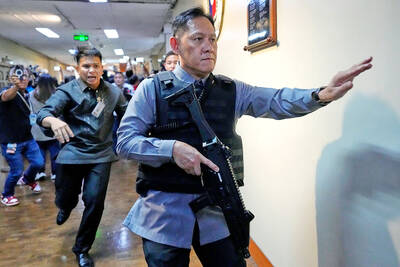
DELA ROSA CASE: The whereabouts of the senator, who is wanted by the ICC, was unclear, while President Marcos faces a political test over the senate situation Philippine authorities yesterday were seeking confirmation of reports that a top politician wanted by the International Criminal Court (ICC) had fled, a day after gunfire rang out at the Philippine Senate where he had taken refuge fearing his arrest. Senator Ronald “Bato” dela Rosa, the former national police chief and top enforcer of former Philippine president Rodrigo Duterte’s “war on drugs,” has been under Senate protection and is wanted for crimes against humanity, the same charges Duterte is accused of. “Several sources confirmed that the senator, Senator Bato, is no longer in the Senate premises, but we are still getting confirmation,” Presidential
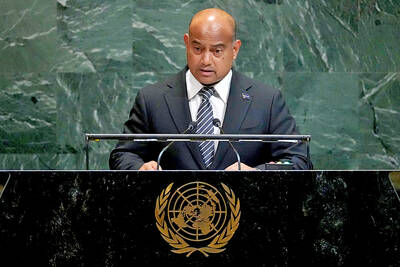
Nauru said it would hold a referendum to change its official name, described as a colonial relic from a time when “foreign tongues” mangled the native language. Nauru would change its name to Naoero to “more faithfully honor our nation’s heritage, our language and our identity,” Nauruan President David Adeang said in a statement on Tuesday. The Pacific island nation’s native language is Dorerin Naoero, which is spoken by the vast majority of its approximately 10,000 inhabitants. “Nauru emerged because Naoero could not be properly pronounced by foreign tongues, and was changed not by our choice, but for convenience,” the government said in
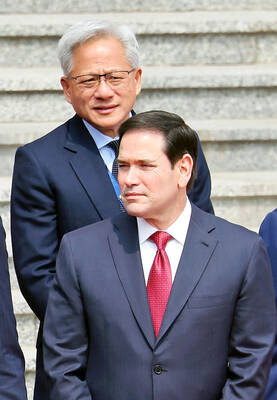
HELP DENIED? The US Department of State said that the Cuban leadership refuses to allow the US to provide aid to Cubans, ‘who are in desperate need of assistance’ US Secretary of State Marco Rubio on Wednesday said that Cuba’s leadership must change, as Washington renewed an offer of US$100 million in aid if the communist nation agrees to cooperate. Cuba has been suffering severe economic tumult led by an energy shortage that plunged 65 percent of the country into darkness on Tuesday. Cuba’s leaders have blamed US sanctions, but Rubio, a Cuban American and critic of the government established by Fidel Castro, said the system was to blame, including corruption by the military. “It’s a broken, nonfunctional economy, and it’s impossible to change it. I wish it were different,” he told


 RSS
RSS