


For years, legislation to raise the federal debt limit offered plenty of political theater on Capitol Hill, with the party out of power using it to rail against the party in power. As a senator, US President Barack Obama said in 2006 that a bill to raise the debt limit was “a sign of leadership failure.”
This time is different, and not only because the parties have switched roles. Now, conservative House of Representatives Republicans have a virtual veto over a measure to increase the debt ceiling and some freshmen in both chambers say they worry more about changing the ways of Washington than about getting re-elected.
“Re-election is the farthest thing from my mind,” Republican Representative Tom Reed said. “Like many of my colleagues in the freshman class, I came down here to get our fiscal house in order and take care of the threat to national security that we see in the federal debt. We came here not to have long careers. We came here to do something. We don’t care about re-election.”
It is not clear how genuine or widespread that sentiment is in Congress, but regardless, it has upended what Obama said on Friday had been a “difficult, but routine process” in past years.
The sheer size of the debt and its rapid growth in recent years have emboldened fiscal conservatives in the House, prompting some of them to pledge not to vote for a higher debt ceiling even if a compromise can be reached before Aug. 2, when the US Department of Treasury says it will hit the US$14.3 trillion debt cap and run out of borrowing authority.
Since Obama took office in January 2009, near the end of a long recession, the total federal debt — including debt held by the public and by government trust funds — has increased 35 percent. While debt exploded, the economy was stagnant, so debt as a share of GDP has also increased.
The current battle over deficits and debt could become the norm if Republicans hold onto their seats or make gains in Congress. The federal debt represents the accumulated total of past borrowing. So even if the government slashes the annual budget deficit, it generally cannot reduce the debt unless it runs a surplus.
Republican Senator Lindsey Graham said many freshman Republicans — “to their undying credit” — were not concerned with re-election.
“The people who got elected in 2010 are going to go down fighting,” said Graham, who served eight years in the House before winning a Senate seat in 2002. “They are not going to be persuaded by traditional politics. They could care less about [elections in] 2012. They want to do what they can on their watch.”
With the Aug. 2 deadline looming, Obama says a default would have calamitous consequences, jeopardizing the timely payment of Social Security benefits and driving up interest rates for the government and private borrowers alike.
Some Republicans say they do not worry much about being punished by their constituents for playing hardball with their votes on the debt limit and thus pushing the nation to the brink of default. And besides, they doubt that the consequences of a default would be as dire as Obama and many economists say.
Republican Representative Jeff Landry said: “I don’t believe, if we fail to raise the debt ceiling, that we will default.”
Even if the debt ceiling is reached, Landry said, the government has more than enough revenue coming in each month to pay principal and interest on the debt.
Republican Senator Patrick Toomey, a freshman, said a delay in raising the debt limit need not cause a default because the Treasury secretary could set priorities in paying government obligations. Many Republicans would give priority to Social Security, Medicare, veterans benefits and paychecks for the armed forces. The Obama administration rejects that approach as unworkable.
Former Republican senator Bob Packwood, a onetime chairman of the Finance Committee, worked on many bills to increase the debt limit, but said: “I don’t recall it ever getting this close to the brink.”
Donald Wolfensberger, the director of the Congress Project at the Woodrow Wilson International Center for Scholars, who was an aide to House Republicans for 28 years, said: “There is greater brinkmanship on the debt limit this year because there is a hard-core group that is more intransigent.”
See DEBT on page 10

The death of a former head of China’s one-child policy has been met not by tributes, but by castigation of the abandoned policy on social media this week. State media praised Peng Peiyun (彭珮雲), former head of China’s National Family Planning Commission from 1988 to 1998, as “an outstanding leader” in her work related to women and children. The reaction on Chinese social media to Peng’s death in Beijing on Sunday, just shy of her 96th birthday, was less positive. “Those children who were lost, naked, are waiting for you over there” in the afterlife, one person posted on China’s Sina Weibo platform. China’s

‘NO COUNTRY BUMPKIN’: The judge rejected arguments that former prime minister Najib Razak was an unwitting victim, saying Najib took steps to protect his position Imprisoned former Malaysian prime minister Najib Razak was yesterday convicted, following a corruption trial tied to multibillion-dollar looting of the 1Malaysia Development Berhad (1MDB) state investment fund. The nation’s high court found Najib, 72, guilty on four counts of abuse of power and 21 charges of money laundering related to more than US$700 million channeled into his personal bank accounts from the 1MDB fund. Najib denied any wrongdoing, and maintained the funds were a political donation from Saudi Arabia and that he had been misled by rogue financiers led by businessman Low Taek Jho. Low, thought to be the scandal’s mastermind, remains
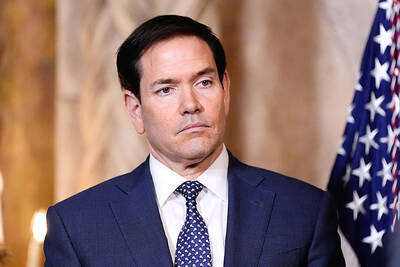
‘POLITICAL LOYALTY’: The move breaks with decades of precedent among US administrations, which have tended to leave career ambassadors in their posts US President Donald Trump’s administration has ordered dozens of US ambassadors to step down, people familiar with the matter said, a precedent-breaking recall that would leave embassies abroad without US Senate-confirmed leadership. The envoys, career diplomats who were almost all named to their jobs under former US president Joe Biden, were told over the phone in the past few days they needed to depart in the next few weeks, the people said. They would not be fired, but finding new roles would be a challenge given that many are far along in their careers and opportunities for senior diplomats can

Australian Prime Minister Anthony Albanese yesterday announced plans for a national bravery award to recognize civilians and first responders who confronted “the worst of evil” during an anti-Semitic terror attack that left 15 dead and has cast a heavy shadow over the nation’s holiday season. Albanese said he plans to establish a special honors system for those who placed themselves in harm’s way to help during the attack on a beachside Hanukkah celebration, like Ahmed al-Ahmed, a Syrian-Australian Muslim who disarmed one of the assailants before being wounded himself. Sajid Akram, who was killed by police during the Dec. 14 attack, and


 RSS
RSS