


Yoan used to earn US$25 a month working as a computer technician for a state company — and an extra US$500 selling Internet access on Cuba’s vast and varied black market.
The 31-year-old managed 10 accounts for government employees who had authorized e-mail access and would rent out their passwords to trusted clients under certain rules: they could only connect at night or in the early hours, and had to avoid political references.
“I did it because I couldn’t live off my salary,” Yoan said.

PHOTO: REUTERS
But the technician had taken a large risk amid a crackdown by the government of Cuban President Raul Castro as part of an offensive on illegal businesses.
“There was an audit a little while ago, they trawled through the telephone numbers and one customer gave the game away,” Yoan said. “They sacked me and I paid a 1,500 peso [US$60] fine.”
Yoan, who also received a ban from working for four years, was a tiny link in the chain connecting Cubans to the illegal network. An e-mail service costs US$10 to US$15 per month, it costs US$50 per month to navigate the Internet, and US$1 to send or receive an e-mail.
“I need to be in contact with my friends and the world, but I can’t afford ‘underground’ Internet so I only have e-mail. I connect at night because that’s what my illegal provider tells me to do,” said Aida, a 38-year-old former waitress.
Cuba connects to the Internet by satellite because the decades-long US embargo prevents access to underwater cables that pass near its coastlines.
The government blames the embargo for its limits on the service — it gives priority to state and foreign companies, academics, doctors and research centers.
Dissidents and critics of the government say Cuba, like China, limits Internet access to restrict freedom of information and control criticism of the regime.
They say that is why authorities block dissident sites or blogs, such as the award-winning blog of Yoani Sanchez, for being subversive.
Cubans can connect to e-mail at controlled state access points for US$1.5 per hour or access the Internet in hotels with cards costing US$7 per hour.
But with the average monthly salary at US$20, that is out of reach of most citizens.
“I can’t pay that — that’s why I have illegal e-mail to communicate with my father in Miami,” said Marilis, a 23-year-old law student.
“I’ve never written anything political,” she added indignantly.
Raul Castro allowed computer sales two years ago, but Internet access remains limited.
Barely 1.4 million of the 11.2 million inhabitants have Internet access, and only 630,000 have computers, according to official figures.
Shared access is blamed for slow and patchy connections.
Deputy Computing Minister Ramon Linares said recently that the island’s connection speeds had increased, and an underwater cable was due to start operating from Venezuela in 2011.
That still won’t be enough for Aida.
“Even if they solve the technical problems, we won’t have free access,” she said. “It’s clear that those who lead the country decide what we can consult.”

Kouri Richins, a Utah mother who published a children’s book about grief after the death of her husband is to serve a life sentence for his murder without the possibility of parole, a judge ruled on Wednesday. Richins was convicted in March of aggravated murder for lacing a cocktail given to her husband, Eric Richins, with five times the lethal dose of fentanyl at their home near Park City in 2022. A jury also found her guilty of four other felonies, including insurance fraud, forgery and attempted murder for trying to poison her husband weeks earlier on Feb. 14, 2022, with a

DELA ROSA CASE: The whereabouts of the senator, who is wanted by the ICC, was unclear, while President Marcos faces a political test over the senate situation Philippine authorities yesterday were seeking confirmation of reports that a top politician wanted by the International Criminal Court (ICC) had fled, a day after gunfire rang out at the Philippine Senate where he had taken refuge fearing his arrest. Senator Ronald “Bato” dela Rosa, the former national police chief and top enforcer of former Philippine president Rodrigo Duterte’s “war on drugs,” has been under Senate protection and is wanted for crimes against humanity, the same charges Duterte is accused of. “Several sources confirmed that the senator, Senator Bato, is no longer in the Senate premises, but we are still getting confirmation,” Presidential
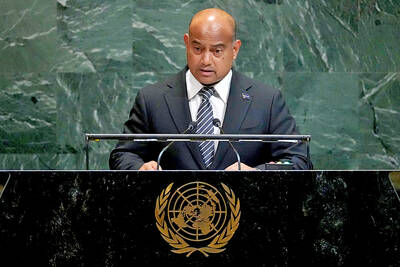
Nauru said it would hold a referendum to change its official name, described as a colonial relic from a time when “foreign tongues” mangled the native language. Nauru would change its name to Naoero to “more faithfully honor our nation’s heritage, our language and our identity,” Nauruan President David Adeang said in a statement on Tuesday. The Pacific island nation’s native language is Dorerin Naoero, which is spoken by the vast majority of its approximately 10,000 inhabitants. “Nauru emerged because Naoero could not be properly pronounced by foreign tongues, and was changed not by our choice, but for convenience,” the government said in

HELP DENIED? The US Department of State said that the Cuban leadership refuses to allow the US to provide aid to Cubans, ‘who are in desperate need of assistance’ US Secretary of State Marco Rubio on Wednesday said that Cuba’s leadership must change, as Washington renewed an offer of US$100 million in aid if the communist nation agrees to cooperate. Cuba has been suffering severe economic tumult led by an energy shortage that plunged 65 percent of the country into darkness on Tuesday. Cuba’s leaders have blamed US sanctions, but Rubio, a Cuban American and critic of the government established by Fidel Castro, said the system was to blame, including corruption by the military. “It’s a broken, nonfunctional economy, and it’s impossible to change it. I wish it were different,” he told


 RSS
RSS