


Guinea-Bissau, a West African country known for its political crises and coups, votes for a new leader today to replace late president Joao Bernardo “Nino” Vieira, who was assassinated more than three months ago.
The ballot in the tiny country flanked by Senegal and Guinea is expected to be peaceful, but analysts say the real test for the former Portuguese colony will come afterward.
The military has held sway over the country’s top politicians for decades, and since the introduction of multiparty politics 15 years ago no president has completed the constitutionally mandated five-year term in office. The poor African country also has seen drug money flow to corrupt officials as smugglers pay bribes to use its coastline and remote airstrips for cocaine transshipments.
“The real test for Guinea-Bissau is not whether the election is held peacefully, but whether state institutions have the capacity to prevent the country from sliding into chaos in the aftermath,” consulting group IHS Global Insight said. “The military has been far too dominant in Bissau-Guinean politics ... There is a real need for the international community to offer support.”
Vieira was murdered on March 2, just hours after his longtime rival, the head of the armed forces, was killed by a bomb. Little was done to investigate the killings and no arrests have been made.
Despite fears the army would take over, though, the transition has been smooth. The head of parliament, Raimundo Pereira, was swiftly named interim president and is leading the interim government organizing today’s vote.
The ballot is going ahead, despite the slaying earlier this month by security forces of presidential candidate Baciro Dabo, whose family denied allegations he had been involved in a coup plot.
Eleven candidates are vying for the presidency, but only three are considered serious contenders.
The first is Malam Bacai Sanha, who served as interim president for a year following the country’s 1998 to 1999 civil war and head of the national assembly from 1994 to 1999. Sanha is a candidate of the main political party, the African Party for the Independence of Guinea and Cape Verde, or PAIGC, which holds a majority in parliament.
The second candidate is Kumba Yala, a former president who was elected in 2000 but became deeply unpopular and was overthrown in a bloodless coup three years later. Yala, a former philosophy professor, is a candidate for the opposition Party for Social Renewal.
Henrique Rosa is the third key canddidate and served as interim head of state after Yala was ousted in the 2003 coup. A businessman and the race’s only independent, Rosa helped organize 2005 elections which brought Vieira to power.
Since independence from Portugal in 1974, Guinea-Bissau has been beset by a series of coups, military revolts and political assassinations. The lawlessness has in recent years attracted South American drugs traffickers, who have used the country as a transit point for shipping cocaine to Europe.
Given the history, many voters are skeptical the next president will be able to enforce the rule of law in a country where the military is deeply involved in politics and the judiciary is weak.
“It is not normal in a democratic state ... to have a group come and kill the president and nobody is accountable,” said Vladimir Monteiro, information officer at the UN peace-building mission.
The violence and instability that have wracked Guinea-Bissau since independence also have taken their toll on the country’s economic development. The nation sits at the bottom of most economic and health indices, ranking third from last on last year’s Human Development Index.
The majority of people live without electricity or clean running water, and there are few job opportunities for young people. The average life expectancy in Guinea-Bissau is just 46 years.
About 600,000 of Guinea-Bissau’s 1.5 million people are registered to vote in today’s ballot.
In the tiny capital, Bissau, colorful campaign posters cover worn-out buildings and wrap around lampposts promising peace and security.
While Yala’s supporters wear his trademark red woolen hat, Sanha fans imitate their candidate by pointing to an imaginary wristwatch and chanting his campaign slogan: “The time is now!”
Henrique Rosa’s poster promises peace and development.

Kouri Richins, a Utah mother who published a children’s book about grief after the death of her husband is to serve a life sentence for his murder without the possibility of parole, a judge ruled on Wednesday. Richins was convicted in March of aggravated murder for lacing a cocktail given to her husband, Eric Richins, with five times the lethal dose of fentanyl at their home near Park City in 2022. A jury also found her guilty of four other felonies, including insurance fraud, forgery and attempted murder for trying to poison her husband weeks earlier on Feb. 14, 2022, with a
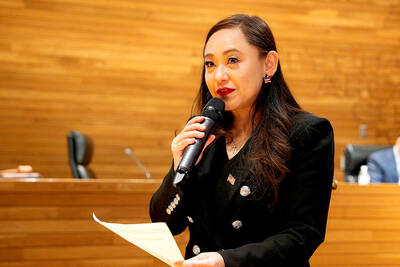
‘PERSONAL MISTAKES’: Eileen Wang has agreed to plead guilty to the felony, which comes with a maximum sentence of 10 years in federal prison A southern California mayor has agreed to plead guilty to acting as an illegal agent for the Chinese government and has resigned from her city position, officials said on Monday. Eileen Wang (王愛琳), mayor of Arcadia, was charged last month with one count of acting in the US as an illegal agent of a foreign government. She was accused of doing the bidding of Chinese officials, such as sharing articles favorable to Beijing, without prior notification to the US government as required by law. The 58-year-old was elected in November 2022 to a five-person city council, from which the mayor is selected
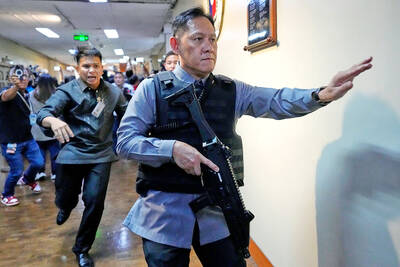
DELA ROSA CASE: The whereabouts of the senator, who is wanted by the ICC, was unclear, while President Marcos faces a political test over the senate situation Philippine authorities yesterday were seeking confirmation of reports that a top politician wanted by the International Criminal Court (ICC) had fled, a day after gunfire rang out at the Philippine Senate where he had taken refuge fearing his arrest. Senator Ronald “Bato” dela Rosa, the former national police chief and top enforcer of former Philippine president Rodrigo Duterte’s “war on drugs,” has been under Senate protection and is wanted for crimes against humanity, the same charges Duterte is accused of. “Several sources confirmed that the senator, Senator Bato, is no longer in the Senate premises, but we are still getting confirmation,” Presidential
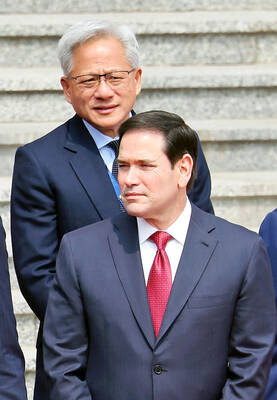
HELP DENIED? The US Department of State said that the Cuban leadership refuses to allow the US to provide aid to Cubans, ‘who are in desperate need of assistance’ US Secretary of State Marco Rubio on Wednesday said that Cuba’s leadership must change, as Washington renewed an offer of US$100 million in aid if the communist nation agrees to cooperate. Cuba has been suffering severe economic tumult led by an energy shortage that plunged 65 percent of the country into darkness on Tuesday. Cuba’s leaders have blamed US sanctions, but Rubio, a Cuban American and critic of the government established by Fidel Castro, said the system was to blame, including corruption by the military. “It’s a broken, nonfunctional economy, and it’s impossible to change it. I wish it were different,” he told


 RSS
RSS