

A fresh upsurge of dissident republican violence in Northern Ireland was orchestrated by a new nucleus of former IRA members who have defected from the Provisionals. Veterans of the Provisional IRA’s North Armagh brigade were behind the 24-hour wave of shootings, blast bomb attacks and riots that rocked the Craigavon area at the beginning of last week.
Senior security sources in Northern Ireland pointed this weekend to a small but dedicated number of former North Armagh brigade republicans who they say pose a major threat to the peace process.
“They include one ex-prisoner who served life for murder and another responsible for a series of assassinations around North Armagh,” one police officer said this weekend. “This core cannot be dismissed as amateurs or newcomers to the dissident scene. They have experience and a track record behind them which makes them good recruiting sergeants for kids around them.”
The violence in Craigavon means that in almost every corner of Northern Ireland there have been short outbursts of dissident terrorist activity over the last six months. Last month, dissidents linked to a Continuity IRA unit fired an improvised rocket at a mobile patrol.
Although no one was killed or injured, the attack was significant because it was the first time the dissidents had used semtex to set off a rocket-propelled grenade. Until then, it appeared that the dissident groups did not have access to the Czech-made plastic explosive, which the Provisional IRA was meant to have destroyed in the arms decommissioning process two years ago.
Its presence is an indication that some of that explosive was taken from Provisional IRA stashes and given to dissidents.
Attacks have taken place in Derry, Tyrone, Fermanagh and now Armagh. Significantly, none of the republican groups opposed to the power-sharing government between Sinn Fein and the Democratic Unionists — the Real IRA, Continuity IRA or a new group known as Oglaigh na hEireann — have mounted any major attacks in the Belfast area.
Police patrols came under fire from a sniper, two blast bombs were thrown and police vehicles were attacked with petrol bombs and stones during 24 hours of disturbances in the Tullygally and Drumbeg areas of Armagh.
By the end of last week, some calm had been restored to the nationalist districts, although residents said there had been heavy-handed police raids on homes.
Graffiti on walls and bus shelters warns of more violence. One even warned that anyone cooperating with police probes into the disturbances would be shot.

Former British prime minister Rishi Sunak on Wednesday urged so-called middle powers to become a “poisonous shrimp” to carve out strategic economic leverage in a more turbulent global environment. Sunak drew from a metaphor by former Singaporean prime minister Lee Kuan Yew (李光耀): A big fish will eat a smaller fish, and the smaller fish will eat the shrimp. Lee made the point a year after the Asian nation’s independence in 1966 that the city-state needed to build up its defense mechanisms — like a shrimp that stings — so it would be left alone by predators. “He was thinking about what Singapore’s

POLL POSITION: Democrats criticized the timing of the raid, saying that the US justice department historically avoids public investigations within 60 days of an election Federal agents on Monday searched the home of Democratic US Representative Ilhan Omar, a startling escalation in a criminal investigation that brings renewed focus to the frequent target of White House derision in the final weeks of her re-election bid. The search of the Minnesota congresswoman’s home so close to next month’s midterm contests that would determine control of the US House and the Senate was swiftly condemned by top Democrats in Congress, who raised questions about the timing given longstanding US Department of Justice (DOJ) protocol to avoid overt investigative steps involving political candidates in the direct run-up to an
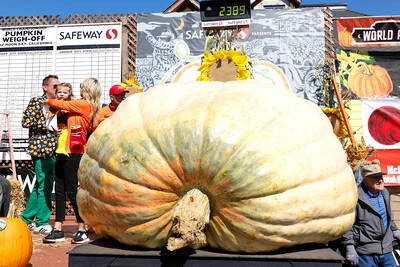
A Rhode Island pumpkin grower appears to have broken the world record for the heaviest pumpkin, with his giant squash topping the record by nearly 136kg. Ron Wallace of Greene, Rhode Island, weighed his pumpkin on Saturday at a contest in New England and is waiting for the Guinness World Records to confirm he smashed the record, set about a week earlier by a grower in England. Wallace said he has been in contact with Guinness officials who say his record is on track to be verified. “It’s truly massive, it was a pleasure to grow,” Wallace said on Monday. Guinness World Records lists

A 16-year-old on Thursday shot his way through locked doors to get into an elementary school in Bend, Oregon, killing three children and a teacher. He was then shot by a person at the scene who followed him inside, authorities said. The suspect was found dead inside the school minutes after the shooting was first reported, Bend Police Chief Mike Krantz said. The three children killed were aged 5, 8 and 11. Another child, 7, and a teacher, 54, were injured and taken to the hospital in critical condition, he said. The first 911 call came just before 1pm from a person in


 RSS
RSS