


A suicide car bomber rammed a convoy carrying foreign troops near the airport in Kabul yesterday, killing six civilians and wounding 18, police said.
The Taliban movement claimed responsibility for the blast, which happened during the morning rush-hour on one of the city's busiest roads and damaged around a dozen vehicles.
"Six civilians were martyred and 18 other civilians were wounded in the suicide car bomb attack against coalition forces," Kabul police chief General Salim Ahsas said.
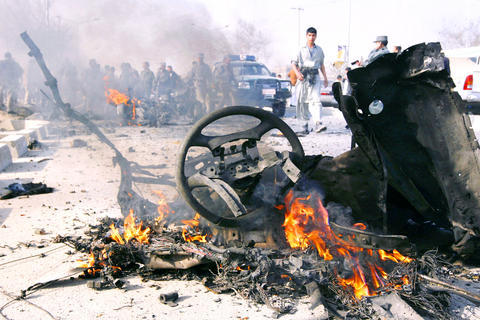
PHOTO: AP
Ahsas said the blast did not harm foreign troops who were travelling on the road to Kabul's international airport when the bomb exploded.
A spokesman for the coalition could not immediately comment on the incident.
Two armored vehicles, apparently the target of the attack, were damaged, a reporter at the scene said. Blood and scraps of human flesh littered the road along with the wreckage of cars, some of which were on fire.
The force of the blast damaged about 10 cars, said General Ali Shah Paktiawal, head of the police criminal investigation branch.
The wounded were rushed to different hospitals in the city, he said.
The Taliban said it was behind the blast -- similar to scores of others carried out by the insurgents.
"We claim responsibility for the suicide attack in Kabul today," Taliban spokesman Zabihullah Mujahid said in a telephone call from an unknown location.
"The attack was against two foreign military vehicles which killed all the soldiers in the two vehicles," he said.
The Taliban have often made claims about casualties from attacks which subsequently prove exaggerated.
Heavily guarded Kabul has suffered a rash of recent suicide bombings.
The last attack in Kabul was on Jan. 31 when a suicide attacker detonated his explosives-laden vehicle near an army bus, killing a civilian and wounding a handful of people, including an army officer.
On Jan. 14 Taliban militants staged a multiple suicide attack on the five-star Kabul Serena hotel that killed at least eight people, three of them foreign nationals.
That attack -- which involved suicide blasts, gunfire and grenade explosions -- was the first of its kind in the city and different in style to the Taliban's regular fare of suicide and roadside bombings.
Last year was the deadliest of an insurgency launched soon after the Taliban's five-year government was ended in an invasion led by the US with the backing of anti-Taliban Afghan movements.
About 6,000 people were killed, most of them insurgents but also about 1,500 civilians.
In other violence yesterday, a roadside bomb killed three policemen and wounded four in the southern province of Ghazni.

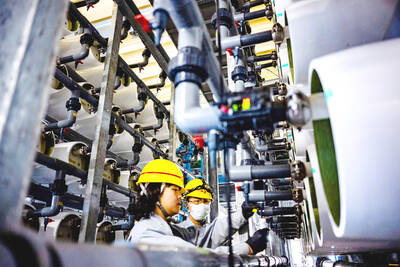
HIGH HOPES: The power source is expected to have a future, as it is not dependent on the weather or light, and could be useful for places with large desalination facilities A Japanese water plant is harnessing the natural process of osmosis to generate renewable energy that could one day become a common power source. The possibility of generating power from osmosis — when water molecules pass from a less salty solution to a more salty one — has long been known. However, actually generating energy from that has proved more complicated, in part due the difficulty of designing the membrane through which the molecules pass. Engineers in Fukuoka, Japan, and their private partners think they might have cracked it, and have opened what is only the world’s second osmotic power plant. It generates
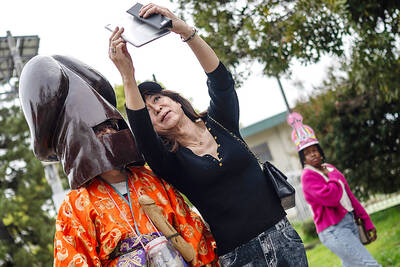
Showcasing phallus-shaped portable shrines and pink penis candies, Japan’s annual fertility festival yesterday teemed with tourists, couples and families elated by its open display of sex. The spring Kanamara Matsuri near Tokyo features colorfully dressed worshipers carrying a trio of giant phallic-shaped objects as they parade through the street with glee. The festival, as legend has it, honors a local blacksmith in the Edo Period (1603-1868) who forged an iron dildo to break the teeth of a sharp-toothed demon inhabiting a woman’s vagina that had been castrating young men on their wedding nights. A 1m black steel phallus sits in the courtyard of
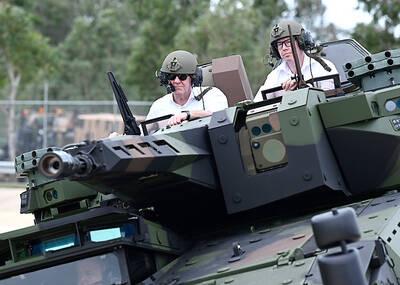
JAN. 1 CLAUSE: As military service is voluntary, applications for permission to stay abroad for over three months for men up to age 45 must, in principle, be granted A little-noticed clause in sweeping changes to Germany’s military service policy has triggered an uproar after it emerged that the law requires men aged up to 45 to get permission from the armed forces before any significant stay abroad, even in peacetime. The legislation, which went into effect on Jan. 1 aims to bolster the military and demands all 18-year-old men fill out a questionnaire to gauge their suitability to serve in the armed forces, but stops short of conscription. If the “modernized” model fails to pull in enough recruits, parliament will be compelled to discuss the reintroduction of compulsory service, German

When a hiker fell from a 55m waterfall in wild New Zealand bush, rescuers were forced to evacuate the badly hurt woman without her dog, which could not be found. After strangers raised thousands of dollars for a search, border collie Molly was flown to safety by a helicopter pilot who was determined to reunite the pet and the owner. A week earlier, an emergency rescue helicopter found the woman with bruises and lacerations after a fall at a rocky spot at the waterfall on the South Island’s West Coast. She was airlifted on March 24, but they were forced to


 RSS
RSS