


US Ambassador Tony Garza condemned threats against US reporters amid intelligence reports that drug traffickers were planning to kill foreign journalists along the US-Mexico border.
In a statement on Friday, Garza condemned threats against journalists as "an attempt to intimidate them from reporting the truth."
A US Embassy official said on condition of anonymity that US law enforcement officials have reliable information that drug traffickers are planning to target foreign journalists.
While past attacks have targeted local reporters, the threat against foreign journalists indicated that drug traffickers are becoming bolder in their attempts to silence news reports on their activities.
"We will work with authorities in the US and Mexico to do everything possible to ensure the safety of American reporters working along both sides of our common border," Garza said.
The embassy official said the threats appeared concentrated around the violent city of Nuevo Laredo, where a new police chief was gunned down two years ago hours after taking office, and hundreds of people have been killed in drug violence since.
Erik Vasys, spokesman for the FBI in San Antonio, Texas, said that "at this time, we are not aware of a specific threat to harm or injure any specific person or media entity."
"The FBI will use all of its resources to protect the free press from violence and intimidation," Vasys said.
The San Antonio Express-News pulled its correspondent, Mariano Castillo, out of Laredo, Texas, across the border from Nuevo Laredo, late on Thursday in light of the threats.
In a story posted on the newspaper's Web site on Friday, editor Robert Rivard said the paper was told by an official that a drug cartel was seeking to put out a hit on an American reporter in Laredo.
"We don't know that the report is credible and we hope it isn't," he said. "But until we feel comfortable knowing that, we're going to err on the side of caution."
Eloy Aguilar, president of the Foreign Correspondents Association in Mexico, sent out an e-mail advising foreign correspondents to "be extremely careful and security conscious."
Aguilar, who retired last year as Associated Press bureau chief in Mexico City, said the warning was "based on journalists who have been there and were told by sources on both sides of the border that there was a threat that was considered serious enough to be taken into account."
A television crew for the TV Azteca network disappeared in Monterrey in May, and an Acapulco correspondent was gunned down in April.
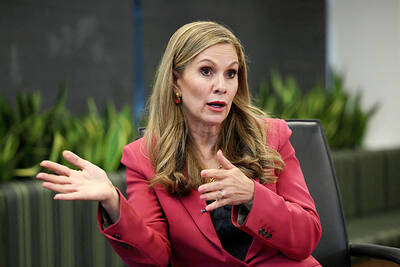
Australians were downloading virtual private networks (VPNs) in droves, while one of the world’s largest porn distributors said it was blocking users from its platforms as the country yesterday rolled out sweeping online age restriction. Australia in December became the first country to impose a nationwide ban on teenagers using social media. A separate law now requires artificial intelligence (AI)-powered chatbot services to keep certain content — including pornography, extreme violence and self-harm and eating disorder material — from minors or face fines of up to A$49.5 million (US$34.6 million). The country also joined Britain, France and dozens of US states requiring
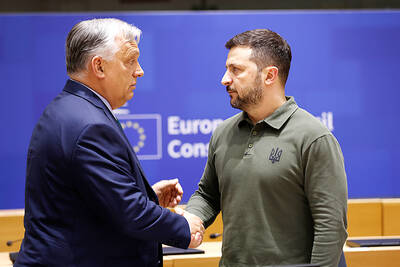
Hungarian authorities temporarily detained seven Ukrainian citizens and seized two armored cars carrying tens of millions of euros in cash across Hungary on suspicion of money laundering, officials said on Friday. The Ukrainians were released on Friday, following their detention on Thursday, but Hungarian officials held onto the cash, prompting Ukraine to accuse Hungary’s Russia-friendly government of illegally seizing the money. “We will not tolerate this state banditism,” Ukrainian Minister of Foreign Affairs Andrii Sybiha said. The seven detained Ukrainians were employees of the Ukrainian state-owned Oschadbank, who were traveling in the two armored cars that were carrying the money between Austria and
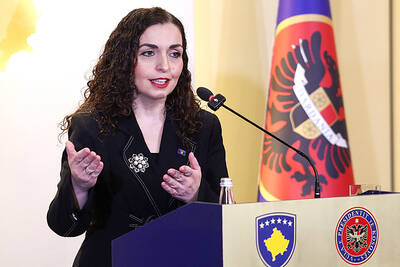
Kosovar President Vjosa Osmani on Friday after dissolving the Kosovar parliament said a snap election should be held as soon as possible to avoid another prolonged political crisis in the Balkan country at a time of global turmoil. Osmani said it is important for Kosovo to wrap up the upcoming election process and form functional institutions for political stability as the war rages in the Middle East. “Precisely because the geopolitical situation is that complex, it is important to finish this electoral process which is coming up,” she said. “It is very hard now to imagine what will happen next.” Kosovo, which declared

MORE BANS: Australia last year required sites to remove accounts held by under-16s, with a few countries pushing for similar action at an EU level and India considering its own ban Indonesia on Friday said it would ban social media access for children under 16, citing threats from online pornography, cyberbullying, online fraud and Internet addiction. “Accounts belonging to children under 16 on high-risk platforms will start to be deactivated, beginning with YouTube, TikTok, Facebook, Instagram, Threads, X, Bigo Live and Roblox,” Indonesian Minister of Communications and Digital Meutya Hafid said. “The government is stepping in so that parents no longer have to fight alone against the giants of the algorithm. Implementation will begin on March 28, 2026,” she said. The social media ban would be introduced in stages “until all platforms fulfill their


 RSS
RSS