


Thousands of protesters took to the streets in cities worldwide to demand urgent action on global warming as delegates continued their work at an international climate change conference to review and update the Kyoto protocol.
Police said about 7,000 people marched on Saturday in downtown Montreal -- some dressed up as polar bears. Five environmental groups, including Greenpeace and the Climate Crisis Coalition, delivered a petition signed by 600,000 Americans to the US consulate in Montreal urging US President George W. Bush and the US Congress to help slow global warming.
"We're worried about climate change, about ways of life in the Canadian Arctic disappearing," said Sarah Binder of Montreal's Urban Ecology Center.
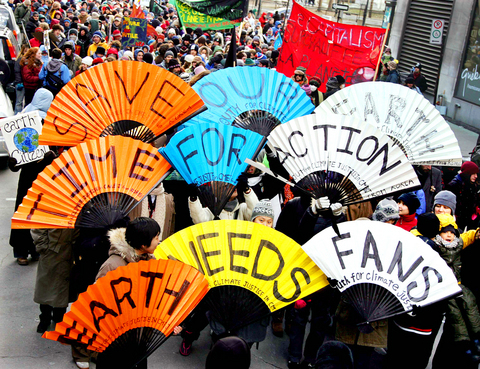
PHOTO: AP
Organizers said 10,000 people marched through London, passing Prime Minister Tony Blair's home on Downing Street, where they delivered a letter demanding the government reaffirm its commitment to Kyoto with legally binding targets on emissions reductions.
Chanting and blowing whistles, the marchers denounced Blair and Bush for their perceived environmental failings. Some held banners depicting Bush as "Wanted -- for crimes against the planet" and advising "Ditch Blair, not Kyoto."
Canadian Inuit traveled to Montreal from the Arctic north to join the protest there. Leader Jose Kusugak said that he brought along hunters, trappers and elders to reassure them that people from the south were not indifferent to their plight.
"It was important to show there are a lot of people in the world who care," he said.
Canada's Environment Minister Stephane Dion, who is presiding over the 10-day UN Climate Change Conference in Montreal, also took part in the march and said final negotiations next week involving some 120 environment ministers and other government leaders would be crucial to improving the Kyoto agreement.
Bush has been widely criticized for pulling out of the treaty, which binds industrialized nations to lower greenhouse gas emissions. The US -- which spews out nearly 25 percent of the world's carbon emissions -- was the target of many demonstrators on Saturday.
At a protest in Boston, speakers called on Massachusetts to join with seven other Northeast states putting limits on carbon dioxide emissions from power plants. Governor Mitt Romney has not signed on because he is concerned that the pact could mean increased utility rates.
The agreement's benefits are numerous, said Marc Breslow, director of Massachusetts Climate Action Network, who estimated that about 60 people rallied at Cathedral of St. Paul, an Episcopal church at the foot of Beacon Hill.
"We won't lose our beaches," he said. "We won't lose our oak trees. We won't have more-intense storms."
Protests were expected in 32 countries, including Canada, the United States, Japan, Germany, France, Bangladesh, Brazil, Australia and South Africa.
In Washington, drivers of hybrid cars planned to rally around the White House. In New Orleans, residents intended to hold a "Save New Orleans, Stop Global Warming" party in the French Quarter.

‘CROSSING THE LINE’: China’s embassy in Seoul criticized US Forces Korea Commander General Xavier Brunson, asking if his ‘hostile’ remarks were authorized by Washington South Korea and the US are in talks over recent public remarks by the commander of US Forces Korea, Seoul’s presidential office said yesterday, after the comments drew sharp criticism from China. In a recent podcast interview, US Forces Korea Commander General Xavier Brunson described South Korea as “the dagger in the heart of Asia” from China’s east coast, prompting the Chinese embassy in Seoul to say that he had “truly crossed the line.” The interview came amid growing speculation that Washington might seek to expand the role of US Forces Korea in countering the growing regional influence of China, a key

SEEKING ORDER: Rodrigo Paz said that ‘anyone who wants to destroy the nation will have to deal with this president and the full force of the constitution’ Bolivian President Rodrigo Paz on Wednesday said that the nation was at a “breaking point” after nearly a month of protests that have caused shortages of food, fuel and medicine. Paz, who took office six months ago amid the worst economic crisis there in four decades, is battling a groundswell of fury over his policies. The political capital, La Paz, has been besieged by low-income workers and members of the indigenous majority calling for his resignation. “The country needs order and is reaching breaking point,” the 58-year-old said at a public event in La Paz, renewing his appeal for dialogue. On Tuesday, the Bolivian

Through the noise of rushing papers and whirring belts at a print factory in Kyoto, two creators watch their photo essay come to life in broadsheet form — part of an effort to win new audiences in the age of artificial intelligence (AI). Despite the decline of the publishing industry, self-publication and handmade “zine” magazines are growing in popularity in Japan, reflecting the nation’s enduring love of paper in the digital era. While speaking to Agence France-Presse at the plant, his hands black with ink, one of the creators, Kazuma Obara, said: “I think [paper] is a medium that engages all five

Australian researchers have trained lab-grown brain cells on a silicon computer chip to play the 1990s shooter game Doom and said they are just scratching the surface of what the neurons could be capable of doing. It is the science-fiction work of biotech boffins at Cortical Labs, who researched and developed the technology that harnesses the workings of the brain’s networking system. Each so-called “biological computer” contains about 200,000 living human brain cells, grown from stem cells that were harvested from blood donations. Having mastered the simple computer game Pong, where a paddle is moved up and down to send a ball


 RSS
RSS