


Dozens of Palestinian gunmen stormed the home of deposed Gaza security chief Moussa Arafat before dawn yesterday and shot him dead, witnesses and police said.
Arafat, 65, a cousin of the late former Palestinian president Yasser Arafat, was fired earlier this year by Palestinian President Mahmoud Abbas. It was not immediately clear who the gunmen were.
At dawn yesterday, Abbas called an emergency meeting of his security commanders and Palestinian Prime Minister Ahmed Qureia at his office in Gaza City. No announcements had come out of the meeting an hour after it started.
On Tuesday, in the first fatal clash between Israeli forces and Palestinians since Israel removed its settlers from Gaza, soldiers shot and killed a Palestinian as dozens stormed an empty settlement and threw rocks at a tank.
Moussa Arafat was linked to corruption charges and had many powerful enemies, and it was thought that his killing was related to internal conflicts.
The gunmen fired at his house in Gaza City and fired rocket-propelled grenades, then stormed the house, killing him. His oldest son, Manhal, who is a senior security official, was either kidnapped or escaped, police at the scene said.
The brazen killing was certain to shake Palestinian politics, just as Abbas struggles to assert control of Gaza with the Israeli pullout.
Moussa Arafat was a founder of the ruling Fatah movement and a senior official in the Fatah Revolutionary Council, a top policy-making body. The council had been scheduled to meet later yesterday.
After he was fired from his security chief position, Moussa Arafat was given the considerably less influential job of military adviser to Abbas.
An AP news cameraman saw Moussa Arafat's body being taken from the house to Shifa Hospital in Gaza City, but angry bodyguards prevented him from taking pictures.
There was no immediate comment from the Palestinian Authority. A spokesman said a statement would be issued later yesterday.
Moussa Arafat was a target of previous assassination attempts and always traveled in a heavily guarded convoy, using an armored limousine that once transported Yasser Arafat.
Before sundown on Tuesday, dozens of young Palestinians marched on Neve Dekalim, once the largest Jewish settlement in Gaza. Palestinian police tried to stop them, but they failed.
An Israeli tank approached, and some youths threw rocks at it while others stormed into the settlement. Soldiers opened fire, killing one and wounding three others, doctors said.
The Israeli military said soldiers opened fire after 40 to 50 youths ran into the settlement and others climbed on the tank. TV footage showed youths pelting the tank with rocks, then tearing down the fence around the settlement and racing inside.
Though Israel has removed its settlers and torn down houses in the settlements, the Israeli military retains control of the settlement areas until the formal handover, expected on Thursday next week. Synagogues and some military bases are still intact there.
Late on Tuesday a rocket fired from Gaza exploded harmlessly in a field inside Israel. Such rocket fire has been rare since Israel's pullout began.
The Palestinian Cabinet also issued a statement saying that after inspections, it was found that 70 percent of the greenhouses in the settlements are in good condition. The Cabinet called on Israel to allow Palestinian workers to return there next week.
Israel emptied all 21 settlements in Gaza and four in the northern West Bank two weeks ago according to Israeli Prime Minister Ariel Sharon's "disengagement" plan. Sharon said the pullout would strengthen Israel's security, reduce international pressure and solidify its hold on main West Bank settlements.
On Tuesday, Israel said it approved construction of 117 new houses in the Ariel settlement in the heart of the West Bank.
Israeli officials said the 117 houses would be built in the center of Ariel and would not expand the settlement's territory.
However, Palestinian officials said that any new construction in Ariel is problematic because of its location deep inside the West Bank.
"If they insist on keeping the settlement, they will destroy the prospect of a contiguous, viable Palestinian state," Palestinian negotiator Saeb Erekat said.

SPEAKING OUT: After Siranudh Scott’s allegations surfaced, celebrities and public figures took to social media to share their own experiences of sexual misconduct and abuse A high-profile alleged sexual abuse case within a wealthy Thai beer brewing family has prompted a wave of painful accounts from survivors of unconnected abuse in the conservative nation. Siranudh Scott, a member of the billionaire Thai family that founded the ubiquitous Singha beer brand, posted an emotional video this month accusing his elder brother Sunit of repeatedly abusing him when he was a teenager. Sunit, who is in his 30s, later denied the allegations in a video posted online, but Singha parent Boonrawd dismissed him from his executive role with the company on Tuesday last week. “I felt I needed to speak

SEEKING ORDER: Rodrigo Paz said that ‘anyone who wants to destroy the nation will have to deal with this president and the full force of the constitution’ Bolivian President Rodrigo Paz on Wednesday said that the nation was at a “breaking point” after nearly a month of protests that have caused shortages of food, fuel and medicine. Paz, who took office six months ago amid the worst economic crisis there in four decades, is battling a groundswell of fury over his policies. The political capital, La Paz, has been besieged by low-income workers and members of the indigenous majority calling for his resignation. “The country needs order and is reaching breaking point,” the 58-year-old said at a public event in La Paz, renewing his appeal for dialogue. On Tuesday, the Bolivian
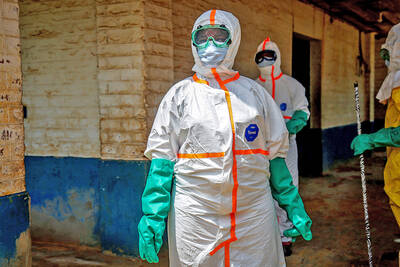
COMMUNITY CONFLICT: Concerns about disease spread from corpses has run up against friends and families’ desire to bury their dead as infection spreads in the area Angry residents of a town at the epicenter of the Ebola outbreak in the Democratic Republic of the Congo (DR Congo) attacked and burned a tent that was part of a health center where people are being treated for the virus, the staff there said Saturday. It was the second such attack in the region in a week. No one was hurt in the attack, according to reports but as patients ran out to escape the fire, 18 people with suspected Ebola infections fled the facility and are unaccounted for, a hospital director said. Angry residents arrived at the clinic in the

Forecasters in Europe yesterday warned of exceptional heat as record temperatures driven by a “heat dome” push temperatures well above seasonal norms across the continent. The surge follows a record-breaking Monday, with France logging its hottest day in the month of May on record, its weather agency said, and the UK also posting unprecedented highs. A so-called “heat dome” of warm air from northern Africa trapped under a high-pressure system over western Europe is behind the high temperatures not usually seen until high summer. Restrictions on outdoor work were imposed in parts of Italy, beaches in southwest France filled earlier than usual and


 RSS
RSS