


A court has acquitted an agent charged with the killing of an Iranian-Canadian photojournalist in a case that has damaged relations between Ottawa and Tehran, the lawyer and Nobel Peace laureate representing the victim's mother said.
The Tehran court on Saturday cleared Mohammad Reza Aghdam Ahmadi, the sole defendant in the case, of killing Zahra Kazemi, who died of a fractured skull and brain hemorrhage in detention in July last year, Shirin Ebadi said.
Ebadi said the legal proceedings were flawed and threatened to take the matter to international organizations.
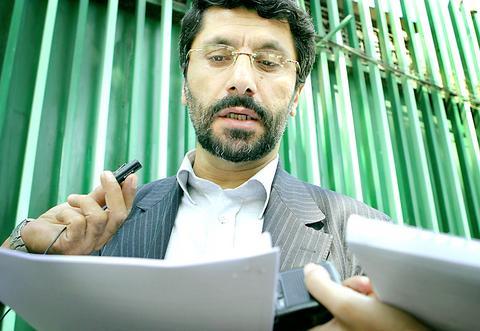
PHOTO: REUTERS
"I'm required to work until my last breath to make sure that justice is done to my client," Ebadi said. "I'll protest this verdict. If the appeals court and other legal stages fail to heed our objections, we will use all domestic and international facilities to meet the legal rights of my client."
Kazemi, a Canadian freelance journalist of Iranian origin, died in detention on July 10 last year after taking photographs outside a Tehran prison during student-led protests against the ruling theocracy.
Iranian authorities initially said Kazemi died of a stroke but a presidential committee later found she died of a fractured skull and brain hemorrhage.
Ahmadi pleaded innocent on July 17 and the trial was abruptly ended the next day.
Hardliners were angered when the defense team led by Ebadi accused prison official Mohammad Bakhshi of inflicting the fatal blow to Kazemi and the conservative judiciary of illegally detaining her.
Ebadi, who leads a four-member legal team, accused the court of deliberately failing to carry out justice.
"If the court had summoned the people we named during the trial for explanation, it could have accurately identified the people who committed the murder," she said.
Ebadi refused to sign the bill of indictment -- which implicated Ahmadi and cleared Bakhshi of any wrongdoing -- and demanded that the court summon several top officials, including hardline Tehran Prosecutor Saeed Mortazavi, to explain Kazemi's death.
Ebadi said filing a case against Bakhshi still remained an option before she would turn to international organizations.
Iran-Canada relations, soured by the slaying and subsequent burial in Iran against the wishes of Kazemi's son in Canada, further deteriorated after Iran rejected the idea of Canadian observers attending the trial. Relations were further strained when the Canadian ambassador was not allowed to attend the last session of the open trial last Sunday.
Canadian foreign affairs spokesman Andre Lemay declined comment on the verdict, saying he didn't have information on the reasons for acquittal, since Canadian observers were excluded from the court and received no official information.
"We don't understand the reasons for the acquittal. Lack of proof? Is this a mistrial? Are they going to set a new trial next week, in a month's time? We don't have any of those details. We're scrambling to find out as much as we can," he said.
Ebadi said the court also ruled that Kazemi's blood money will be paid from public, or government, funds. Blood money is the compensation that an Islamic court orders a convicted attacker to pay to the victim or the victim's relatives. In Kazemi's case, the money has to be paid from public funds since no murderer has been identified.
John Terry, a lawyer for Kazemi's son, Stephan Hachemi, said the family would reject any financial compensation.
"The family has reiterated that it will not be accepting any blood money," Terry said in Toronto. "[The family] views the whole provision of blood money here and the amount of it as a humiliating and insulting gesture."
Hachemi said the acquittal and the blood money offer were Iran's attempt to make the case go away.
"The Iranian judiciary, through this acquittal and through its offer of blood money, is telling the world that the Zahra Kazemi case is now closed. No way," Hachemi said.
Terry also said the verdict did not address the repatriation of Kazemi's body.
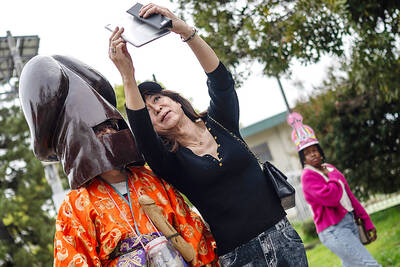
Showcasing phallus-shaped portable shrines and pink penis candies, Japan’s annual fertility festival yesterday teemed with tourists, couples and families elated by its open display of sex. The spring Kanamara Matsuri near Tokyo features colorfully dressed worshipers carrying a trio of giant phallic-shaped objects as they parade through the street with glee. The festival, as legend has it, honors a local blacksmith in the Edo Period (1603-1868) who forged an iron dildo to break the teeth of a sharp-toothed demon inhabiting a woman’s vagina that had been castrating young men on their wedding nights. A 1m black steel phallus sits in the courtyard of

JAN. 1 CLAUSE: As military service is voluntary, applications for permission to stay abroad for over three months for men up to age 45 must, in principle, be granted A little-noticed clause in sweeping changes to Germany’s military service policy has triggered an uproar after it emerged that the law requires men aged up to 45 to get permission from the armed forces before any significant stay abroad, even in peacetime. The legislation, which went into effect on Jan. 1 aims to bolster the military and demands all 18-year-old men fill out a questionnaire to gauge their suitability to serve in the armed forces, but stops short of conscription. If the “modernized” model fails to pull in enough recruits, parliament will be compelled to discuss the reintroduction of compulsory service, German

For two decades, researchers observed members of the Ngogo chimpanzee group of Kibale National Park in Uganda spend their days eating fruits and leaves, resting, traveling and grooming in their tropical rainforest abode, but this stable community then fractured and descended into years of deadly violence. The researchers are now describing the first clearly documented example of a group of wild chimpanzees splitting into two separate factions, with one launching a series of coordinated attacks against the other. Adult males and infants were targeted, with 28 deaths. “Biting, pounding the victim with their hands, dragging them, kicking them — mostly adult males,
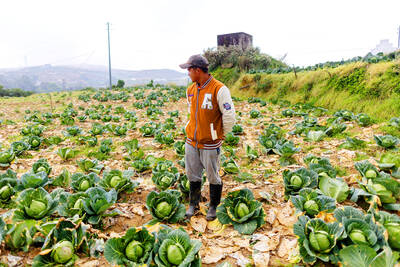
Filipino farmers like Romeo Wagayan have been left with little choice but to let their vegetables rot in the field rather than sell them at a loss, as rising oil prices linked to the Iran war drive up the cost of harvesting, labor and transport. “There’s nothing we can do,” said Wagayan, a 57-year old vegetable farmer in the northern Philippine province of Benguet. “If we harvest it, our losses only increase because of labor, transportation and packing costs. We don’t earn anything from it. That’s why we decided not to harvest at all,” he said. Soaring costs caused by the Middle East


 RSS
RSS